Key Highlights
- Employee self-service payroll gives staff secure access to payslips, tax details, and personal data without contacting HR.
- Businesses reduce payroll queries, manual admin, and processing errors through automation.
- ESS improves employee experience by offering transparency and on-demand access.
- Modern payroll ESS systems support compliance, audit trails, and secure data handling.
- Implementation success depends on communication, training, and provider support.
- The right payroll partner ensures scalability, integration, and long-term efficiency.
It is payday. Payroll has been processed, but instead of moving on to strategic work, HR is responding to emails. An employee cannot access their payslip. Another questions a tax code change. A manager needs confirmation of deductions for a mortgage reference. What should be a routine function quickly becomes reactive administration.
Payroll should be accurate, compliant, and predictable. Yet for many UK businesses, it continues to generate repetitive queries, manual document sharing, and avoidable back and forth between HR and staff. As headcount grows, these interruptions multiply, increasing the risk of errors and pulling teams away from higher-value priorities.
Employee expectations have also shifted. Staff expect secure, instant access to their pay information without relying on office hours or manual responses. Employers want systems that scale efficiently and support compliance. This guide explains how employee self-service payroll addresses these pressures and builds long-term operational control.
What Is Employee Self-Service Payroll?
An employee needs a payslip for a mortgage application. Instead of downloading it instantly, they email HR and wait. HR searches folders, attaches the file, and replies. Multiply that by dozens of requests each month, and payroll becomes reactive administration rather than a controlled process.
Employee self-service payroll is a secure online system that removes that dependency. Instead of contacting HR for routine documents, employees log into a protected portal where their pay information is available immediately.
Once payroll is processed, payslips and tax documents are uploaded automatically. Employees can view payslips, download P60s, check deductions, and update personal or bank details directly. The system integrates with payroll software, keeping records accurate and current.
The result is fewer interruptions for HR and structured, secure access for employees.
What Features Should A Payroll Employee Self-Service System Include?
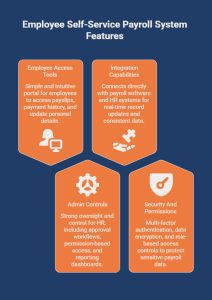
Choosing the wrong ESS system does not just slow adoption. It creates compliance gaps, duplicate data entry, and hidden administrative drag. If the platform adds friction instead of removing it, HR ends up managing the system rather than improving payroll control.
The right solution must reduce operational risk, cut repetitive workload, and maintain full visibility over sensitive payroll data.
1. Employee Access That Reduces Payroll Interruptions
If employees still email HR for basic documents, the system has failed.
An effective portal should:
- Allow instant access to payslips and P60S
- Display clear payment history and deduction breakdowns
- Enable secure updates to personal and bank details
- Provide reliable mobile access for distributed teams
The outcome is fewer inbound queries, faster document retrieval, and less reactive administration for HR.
2. Oversight Controls That Protect Compliance
Employee autonomy should never weaken governance. Without structured controls, payroll errors and unauthorised changes become real risks.
Look for systems that provide:
- Approval workflows before data changes are applied
- Role-based permissions to limit access appropriately
- Centralised dashboards for payroll visibility
- Full audit trails for accountability
The outcome is controlled flexibility. HR retains authority while routine processes move away from inbox management.
3. Integration That Eliminates Duplicate Work
Disconnected systems create rekeying, inconsistencies, and reporting errors. Integration is not convenient. It is risk prevention.
A strong ESS system should:
- Sync directly with payroll software
- Update records in real time
- Maintain consistent employee data
- Create a single source of truth
The outcome is reduced manual input, fewer reconciliation issues, and stronger reporting accuracy.
4. Security That Matches Payroll Sensitivity
Payroll data contains personal and financial information. Weak protection exposes businesses to regulatory and reputational risk.
A reliable system should include:
- Multi-factor authentication
- Encryption in transit and at rest
- Role-based access controls
- Ongoing system monitoring
The outcome is secure employee access without compromising compliance obligations.
When these elements work together, employee self-service payroll becomes an operational infrastructure. It reduces friction, strengthens control, and supports scalable payroll management rather than simply digitising existing problems
Discover why outsourcing payroll is a game-changer for growing businesses. Learn how it improves accuracy, reduces risk, and frees up internal resources.
What Are The Benefits Of Employee Self-Service For Payroll Clients?
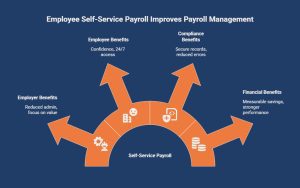
Employee self-service payroll improves how payroll information is accessed and managed. It reduces routine admin for employers while giving employees direct, secure control over their own pay data.
1. Employer Benefits
For employers, the main gain is efficiency. Routine queries and document requests drop significantly once employees can access information themselves.
Benefits include:
• Fewer payroll and HR interruptions
• Reduced printing and distribution costs
• Improved data accuracy
• Clear audit trails and centralised records
This allows payroll teams to focus on compliance and higher-value work.
2. Employee Benefits
For employees, access builds confidence.
Through a secure portal, staff can view payslips, download tax forms, and update details at any time. This creates:
• 24/7 payroll access
• Greater transparency
• Faster issue resolution
• Increased autonomy
The result is a smoother, more trusted payroll experience.
3. Compliance Benefits
Digital records reduce manual handling and strengthen oversight.
Key compliance advantages include:
• Secure, GDPR-aligned document storage
• Reduced data entry errors
• Traceable payroll updates
This supports stronger governance and lowers risk.
4. Financial Efficiency Benefits
Lower admin time, fewer errors, and reduced paper processes translate into measurable savings. Over time, employee self-service payroll strengthens both operational and financial performance.
In short, ESS benefits employers, employees, and compliance equally while improving long-term efficiency. Electronic payslips integrate directly into the portal, making secure, instant access a seamless part of payroll operations rather than a manual add-on.
What Are The Best Practice Payroll Employee Self-Service Implementation Strategies?
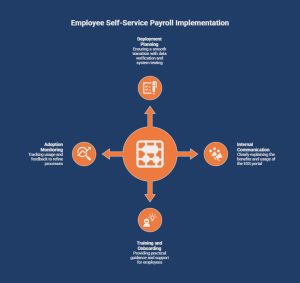
Implementing employee self-service payroll requires more than switching on a portal. To deliver real efficiency gains, businesses need a structured rollout plan that supports employees, protects payroll accuracy, and ensures long-term adoption across the organisation.
1. Deployment Planning And System Setup
Start with a clear implementation roadmap. Before launch, review existing payroll workflows and identify where automation will replace manual processes. Clean employee data, configure permissions, and test system integrations carefully.
Key deployment actions include:
• Verifying employee records before migration
• Setting role-based access controls
• Testing payslip publishing and document access
• Running a parallel payroll cycle if needed
A controlled rollout reduces risk and builds confidence internally.
2. Internal Communication Strategy
Clear communication drives adoption. Employees should understand why the ESS portal is being introduced and how it benefits them.
Communicate:
• The purpose of employee self-service payroll
• What information will be available
• How to access the portal
• Who to contact for support
Consistent messaging prevents confusion and lowers early resistance.
3. Training And User Onboarding
Even simple systems require guidance. Focus on practical, short-form training rather than lengthy manuals.
Effective onboarding may include:
• Step-by-step login guides
• Short walkthrough videos
• FAQs covering common payroll questions
• Temporary support during the first payroll cycle
When employees feel confident using the system, adoption becomes natural.
4. Adoption Monitoring And Continuous Improvement
After launch, monitor usage and performance to ensure the system delivers value.
Track:
• Portal login rates
• Reduction in payroll queries
• Employee feedback
• Time saved by HR and payroll teams
Regular review allows businesses to refine processes and ensure employee self-service payroll continues to support both workforce experience and operational efficiency.
A well-managed implementation transforms ESS from a simple tool into a long-term efficiency driver for the organisation.
Think payroll is just about paying staff on time? Discover the truth behind common assumptions in our guide to payroll myths and avoid costly misconceptions that could impact your business.
How Does Employee Self-Service Reduce HR And Payroll Workload?
For many organisations, payroll teams spend too much time answering repeated questions. Document reissues and data updates interrupt core processing cycles. Over time, this reduces productivity and increases pressure during payroll deadlines.
Employee self-service payroll reduces that burden by:
• Automating payslip distribution
• Digitally storing historic records
• Allowing employees to update their own details
• Minimising repetitive email traffic
The impact is practical and measurable. HR regains hours previously lost to low-value tasks. Payroll teams focus on compliance and accuracy instead of document management.
This shift turns payroll from an administrative bottleneck into a streamlined operation.
How Do You Choose The Right Payroll ESS Provider In The UK?
Selecting a payroll ESS provider is not just a software decision. It is a governance decision that affects compliance, data control, and operational resilience. The system you choose will sit at the centre of employee data access, HMRC reporting accuracy, and payroll transparency.
In the UK context, your provider must understand:
- HMRC Real Time Information submissions
- PAYE and National Insurance obligations
- GDPR data protection requirements
- UK payroll legislation and statutory entitlements
- UK-based support hours aligned to payroll cycles
Beyond features, evaluate the provider’s operational capability:
- Structured implementation methodology
- Clear data migration process
- Defined service level agreements
- Security certifications and encryption standards
- Ongoing support during payroll cycles
The right provider strengthens compliance, reduces operational risk, and supports scalable payroll governance. The wrong one introduces fragmentation and exposure. Choose a partner that understands UK payroll regulation as thoroughly as the technology itself.
ESS Payroll Vs Traditional Payroll Management: What Is The Difference?
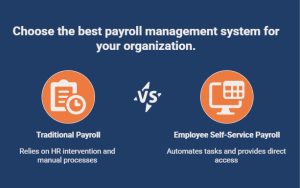
Traditional payroll management relies heavily on HR intervention. Employees request documents, HR distributes them, and updates are processed manually. This structure increases admin time and slows response cycles.
In contrast, employee self-service payroll introduces:
• Automated document publishing
• Direct employee access to records
• Fewer manual data entry points
• Reduced dependency on HR teams
The difference is structural. Traditional payroll centralises control, while ESS distributes access securely. The result is greater efficiency, improved accuracy, and a more modern payroll framework.
When Should A Business Implement Employee Self-Service Payroll?
Many businesses adopt ESS only after payroll strain becomes visible. By then, inefficiencies are already embedded in daily operations.
Growth is a common trigger. As headcount increases, payroll queries multiply, and manual processes slow HR down. But expansion is not the only signal.
You should consider implementing Employee Self-Service Payroll when facing:
- Scaling beyond a manageable employee threshold
- Regulatory pressure or tighter reporting requirements
- Remote or hybrid workforce expansion
- Rising payroll administration costs
- Merger or acquisition activity
- Broader digital transformation initiatives
- Limited HR capacity for strategic work
The cost of delay is cumulative. Manual payroll structures create repeated admin, higher error risk, slower response times, and reduced visibility for leadership. These inefficiencies compound as the organisation grows.
ESS is not just a convenience feature. It is a proactive payroll infrastructure. Implemented early, it strengthens compliance, supports scale, and builds operational readiness before strain turns into crisis.
Why Choose Direct Payroll Services for Employee Self-Service Payroll?
Introducing employee self-service payroll requires more than switching on a portal. It demands accurate payroll processing, secure data handling, and systems that integrate seamlessly with your existing operations. Direct Payroll Services supports UK employers in implementing ESS solutions that improve efficiency without compromising compliance.
Our team ensures your payroll software and employee self-service payroll portal work together smoothly. From automated payslip publishing to secure document storage and controlled employee updates, we help configure systems that reduce HR queries while maintaining full oversight and audit trails.
With Direct Payroll Services, you benefit from compliant payroll management, GDPR-aligned data protection, and dedicated UK-based expertise. We help you reduce administrative pressure, minimise errors, and create a clearer, more transparent payroll experience for your workforce.
Looking to modernise payroll and cut unnecessary admin? Speak to us today and take control of your payroll operations with confidence.
Final Thoughts
Employee Self Service (ESS) systems are revolutionising payroll management by giving employees direct access to their payroll information. This boosts efficiency and reduces HR’s administrative workload. Key benefits include higher employee satisfaction, streamlined processes, and improved compliance.
As workforce experience becomes a priority, adopting ESS solutions is essential. To learn how to implement ESS effectively in your organisation, contact us for a tailored consultation.
Frequently Asked Questions
Is employee self-service payroll software suitable for large UK businesses?
Yes. Employee self-service payroll scales effectively for large UK organisations. It reduces routine HR tasks, supports employee engagement, and integrates with HR software to manage employee information efficiently, delivering cost savings while easing pressure on HR professionals handling administrative tasks.
How can employees use ESS portals to access pay stubs and update details?
Employees log in securely to gain easy access to pay stubs, employee information, and personal details. Through the dashboard, they can update contact information, manage leave requests, request time off, and complete routine HR tasks without contacting HR professionals.
What common issues occur when logging into ESS payroll portals?
Common issues include forgotten passwords, locked accounts after multiple attempts, or outdated contact information. Occasionally, system updates or browser compatibility affect user experience. Most providers offer quick reset options to minimise disruption and restore access to important information.
Is employee self-service payroll suitable for managing performance and HR processes?
Yes. When integrated with HR software, ESS can support performance management, performance reviews, leave requests, and personal information management. This reduces manual tasks, improves data accuracy, and allows HR professionals to focus on strategic initiatives rather than administrative tasks.
Can I access the ESS portal on my phone?
Most modern ESS platforms are mobile-friendly. Employees can access pay stubs, submit leave requests, update personal details, and review important information directly from a smartphone, ensuring consistent user experience across remote and office environments.
Which payroll software should UK businesses choose?
The right payroll software depends on business size, integration needs, and compliance requirements. Look for solutions that automate routine HR tasks, support employee engagement, integrate with HR software, and reduce manual tasks while improving efficiency and cost savings.