Key Highlights
- A payroll bureau is an external service that supports businesses by managing payroll tasks such as payslip processing, HMRC reporting and payroll calculations.
- Payroll bureaus allow companies to retain internal control while outsourcing complex processing responsibilities to expert providers.
- More than half of UK businesses now outsource part or all of their payroll to reduce administrative workload, improve accuracy and maintain compliance.
- Payroll bureau services help organisations stay compliant with RTI submissions, pension auto-enrolment and evolving legislative requirements.
- Using a payroll bureau improves accuracy, saves time and money, and strengthens employee confidence through timely and error-free payments.
- Scalability is a significant advantage, enabling payroll bureaus to adapt support as organisations grow or payroll needs change.
- Partnering with experts like Direct Payroll Services offers industry-focused expertise, secure technology and reliable CIS and HMRC compliance support.
Running an organisation’s payroll can be a complex and time-consuming operation. This is especially true for businesses scaling rapidly or dealing with increasing payroll complexity.
More often, such organisations turn to a payroll bureau, which are third-party companies that offer expert support in managing their payroll processes. These services help organisations ensure accurate and timely payments and maintain compliance with evolving legislative requirements.
This blog provides extensive insight into understanding payroll bureau meaning, the difference between a payroll bureau and an outsourced payroll service, and the benefits, challenges, and considerations when investing in a payroll service. We will also explore alternatives to using a payroll bureau. So let’s get started!
What is a Payroll Bureau and How Does it Operate?
A Payroll Bureau is an external service provider that offers payroll services to other businesses. They effectively handle specific components of an organisation’s payroll processes, including processing payments and expenses, sending out payslips, and preparing payroll reports for HMRC.
How a Payroll Bureau Operates:
- The business submits payroll data, including hours worked, new starters, leavers and pay changes.
- The payroll bureau calculates wages, overtime, bonuses, deductions and pension contributions accurately.
- Payslips are generated and distributed to employees electronically or in print.
- HMRC submissions, including RTI (FPS/EPS), are completed on time to ensure compliance.
- Payroll summaries and reports are shared with the business for financial visibility.
- Year-end documents and statutory reporting requirements are managed and completed correctly.
- Ongoing support is provided for payroll queries, compliance issues and process adjustments.
By investing in expert knowledge and resources of a payroll bureau service like Direct Payroll Services, organisations without in-house payroll experts can ensure peace of mind.
Why Are More Organisations Investing In a Payroll Bureau Service?
Due to the increasing complexity of payroll-related legislation and the high costs associated with payroll errors, many companies are choosing to opt for payroll bureau services. According to outsourcing statistics published by CyberCrew, around 61% of UK businesses now outsource part or all of their payroll operations to external providers.
It allows them to lean on expert payroll support while retaining control over their payroll functions. This solution provides them with an assurance of accuracy and legislative compliance, allowing them to focus more on their core business operations rather than grappling with payroll intricacies.
What Are the Differences Between a Payroll Bureau and Outsourced Payroll?
Both payroll bureaus and fully outsourced payroll services help businesses manage their payroll, but the real difference comes down to how much control you want to keep. Some companies prefer hands-on involvement, while others want payroll taken care of completely.
| Aspect | Payroll Bureau | Outsourced Payroll |
|---|---|---|
| Level of Control | You keep control over certain parts of the process. | The provider handles everything from start to finish. |
| Client Involvement | You still manage data, exceptions and employee questions. | You simply provide basic information and approve results. |
| Process Ownership | The bureau follows your existing processes and systems. | The provider uses their own systems and schedule. |
| Flexibility | Very flexible, you choose what you want them to handle. | Less flexible, it’s an all-in, fully managed approach. |
| Best Suited For | Teams that want expert support but still prefer involvement. | Businesses with little time or no in-house payroll expertise. |
A payroll bureau gives you expert support while you stay in control of your processes and data. Outsourced payroll takes care of almost everything, making things easier and saving you time. The right choice depends on your payroll’s complexity and the support you need.
What Services Do Payroll Bureaus Typically Provide?
A payroll bureau takes care of the heavy lifting so your team doesn’t have to stress over the details. Here are some of the things they usually manage:
- Processing payments, expenses and statutory deductions.
- Sending digital or printed payslips to employees.
- Creating payroll reports for HMRC and internal review.
- Submitting RTI (FPS/EPS) and handling year-end tasks.
- Offering expert guidance when payroll gets complicated.
What Responsibilities Stay with the Client in a Payroll Bureau Model?
Even with support from a payroll bureau, you still stay in the driver’s seat. These are the things you’ll be responsible for:
- Supplying accurate payroll data (hours worked, new starters, leavers, etc.).
- Managing unusual payroll situations or one-off changes.
- Responding to payroll-related employee questions.
- Approving the final payroll before it’s processed.
What Payroll Deadlines Should UK Businesses Be Aware Of?
Staying on top of key deadlines is a must for any business using a payroll bureau. Missed submissions or late payments to HM Revenue & Customs (HMRC) can lead to penalties, interest and extra administrative work.
Key deadlines every employer must meet:
- Submit a Full Payment Submission (FPS) on or before each employee’s payday.
- If adjustments are needed, such as statutory pay changes or when no employees are paid in a tax month, submit an Employer Payment Summary (EPS) by the 19th of the following tax month. For example, for the tax month running from 6 April to 5 May, the EPS deadline is 19 May.
- Pay PAYE and National Insurance contributions monthly. Electronic payments must reach HMRC by the 22nd of the following month, while non-electronic payments must arrive by the 19th of the following month.
- Complete year-end tasks on time. P60 must be issued to employees by 31 May. P11D forms must be submitted by 6 July. Class 1A NICs must be paid by 22 July for electronic payments, or by 19 July if paying by post.
What Is the Step-by-Step Process of How a Payroll Bureau Works?
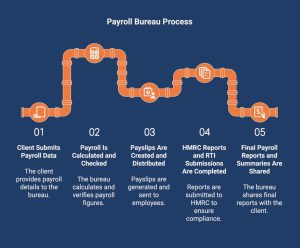
Understanding how a payroll bureau handles payroll helps businesses see what they are paying for and what support they can expect. Here is a simple overview of the typical payroll bureau process:
Step 1: The Client Submits Payroll Data
The process begins when the business shares payroll details such as hours worked, new starters, leavers, and pay adjustments. Accurate data submission ensures the bureau can process payroll correctly and prevents errors that slow down payment delivery.
Step 2: Payroll Is Calculated and Checked
The payroll bureau calculates salaries, overtime, bonuses, deductions, pensions and taxes using compliant payroll software. Expert review is carried out to verify accuracy and ensure calculations follow current HMRC rules, reducing the risk of costly compliance mistakes.
Step 3: Payslips Are Created and Distributed
Once figures are confirmed, payslips are generated and distributed to employees digitally or in print. This ensures staff receive clear and timely payment information, improving transparency, trust and payment experience across the organisation.
Step 4: HMRC Reports and RTI Submissions Are Completed
The bureau submits Real Time Information (RTI) and any required payroll reports to HMRC accurately and on time. This protects the organisation from penalties and ensures full compliance with government payroll regulations and statutory deadlines.
Step 5: Final Payroll Reports and Summaries Are Shared
After processing, the bureau provides payroll summaries, audit records and financial breakdowns for review. This gives internal teams visibility and control, supporting better planning and decision-making while keeping records organised and easily accessible.
If you want to learn more about how to optimise your business with payroll bureau services, read this guide.
What Are the Benefits of a Payroll Bureau Service?
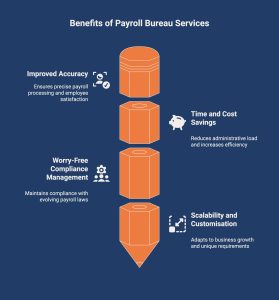
Investing in payroll bureau services provides organisations with numerous benefits that lead to smoother business operations. Let’s check these advantages one by one.
1. Improved Accuracy
One of the biggest advantages of partnering with a payroll bureau is the increased accuracy in payroll processing. With expert knowledge and advanced software, payroll bureaus significantly reduce errors and ensure reliable calculations.
They help with:
- Reliable Calculations: Accurate handling of pay, tax deductions and bonuses.
- Statutory Pay Management: Proper processing of statutory payments, such as statutory sick pay.
- Leave & Absence Tracking: Correct recording and application of leave policies.
- Timely Payments: Improved accuracy leads to better employee satisfaction.
2. Time and Cost Savings
Choosing to work with a payroll bureau can offer substantial benefits in terms of savings, both time and money, such as:
- Reduced administrative load: By outsourcing specific tasks to a payroll bureau, internal teams can be free from heavy payroll administration, enabling them to focus on strategic business initiatives.
- Economical: Bureau payroll services often prove to be more economical than hiring and maintaining an internal payroll specialist team.
- Efficiency: By leveraging the experts and advanced technologies of payroll bureaus, businesses can significantly increase operational efficiency, leading to cost savings.
3. Worry-Free Compliance Management
Payroll bureaus stay updated with changing payroll regulations and HMRC requirements, helping businesses remain compliant and avoid penalties. They support compliance by:
- Capacity Flexibility: Scale services up or down as staffing changes.
- Support for Complex Needs: Tailored handling for industry-specific payroll requirements.
- Growth Alignment: Systems expand alongside business development.
- Specialist Support: Expertise in niche areas such as CIS payroll for construction firms.
4. Scalability and Customisation
Payroll bureaus provide scalability and customisation that prove highly beneficial for businesses, particularly those growing rapidly or experiencing changes.
They are equipped to:
- Easily adjust to capacity shifts: If your employee count suddenly increases or decreases, they can swiftly adapt to handle the changes.
- Meet unique payroll requirements: They are prepared to deal with complex requirements specific to individual firms.
- Scale alongside your business: As your organisation grows or undergoes restructuring, a payroll bureau service can expand and mould its services to cater to your evolving needs.
- Provide niche legislation support: Some payroll bureaus also handle specialised legislative requirements, such as managing payments under the Construction Industry Scheme (CIS). At Direct Payroll Services, we offer dedicated CIS Payroll Services for construction businesses, ensuring full HMRC compliance through accurate reporting and careful management.
What Should You Consider When Comparing the Costs of a Payroll Bureau?
Understanding pricing helps avoid surprises and ensures you select the right partner for your size and complexity. Payroll bureau costs depend on several factors, including service level, number of employees and any special requirements. Instead of only comparing the lowest price, it is important to look at what value and time savings are included.
Key cost factors to evaluate include:
- Number of employees and number of payslips processed per month.
- Whether pension auto-enrolment, RTI submissions and year-end reports are included.
- Fees for handling special requirements, such as CIS or benefits administration.
- Support availability and whether training or account management is included.
- Technology features such as portals, automation and integration with accounting software.
When Should a Business Choose a Payroll Bureau Instead of Outsourcing Fully?
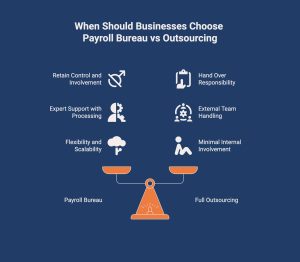
Choosing between a payroll bureau model and full outsourcing depends on how much control a business wants to retain. A payroll bureau works well for organisations that still want hands-on involvement but need expert support to handle the heavy lifting. Full outsourcing is more suitable when a company prefers to hand off responsibility entirely and rely on an external team for all payroll processes.
Here is a simple comparison to help you decide:
A payroll bureau is ideal when:
- You want to remain involved but need expert support with processing and compliance.
- Your team wants flexibility to manage data, exceptions and employee queries.
- Your organisation is growing and needs scalable support without losing control.
Full outsourcing works best when:
- You prefer to hand over responsibility completely end-to-end.
- You lack internal payroll expertise or the time to manage any part of the process.
- You want a single external team handling everything with minimal internal involvement.
If you want to learn more about switching to outsourced payroll smoothly, read this guide on how to outsource payroll.
What Are the Challenges Faced by Payroll Bureaus?
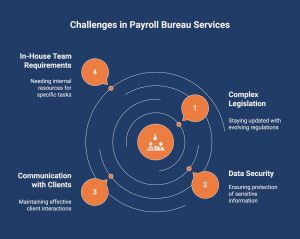
While beneficial, the operation of payroll bureau services comes with challenges as well. The following sections will talk about them.
1. Complex Legislation
Payroll bureau providers must stay updated with complex legislation such as real-time information (RTI) reporting, automatic pension enrolment, and GDPR. They are responsible for ensuring compliance with these regulations, often requiring constant monitoring and adjustments.
Bureaus typically use specialised software to manage the complexity, but keeping up with ever-changing rules can add significant challenges to the process.
2. Data Security
Since payroll involves handling sensitive information, payroll bureau providers are responsible for ensuring data security. This includes establishing secure internal processes, especially with remote work, and implementing advanced access measures like multi-factor authentication.
Reducing manual data entry also helps mitigate human error and protects sensitive data from security breaches.
3. Communication with Clients
Effective communication is essential in payroll bureau services. With client data, responding to inquiries and ensuring smooth operations can be challenging.
Meanwhile, using dedicated online systems or offering self-service portals helps streamline communications, making it easier to submit payroll data and respond promptly to client needs.
4. You Still Need an In-House Team
Although a payroll bureau service can reduce administrative workload, specific tasks still require an in-house team. For example, managing payroll data and correcting discrepancies remains the client’s responsibility.
Additionally, handling unique payroll cases and addressing employee queries requires the personal attention of an internal team.
What Factors Matter Most When Selecting a Payroll Bureau Provider?
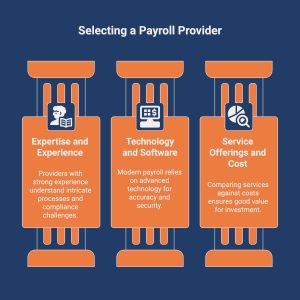
When choosing a payroll provider, businesses must consider factors like the provider’s expertise and experience, use of technology and software, and the range of services offered versus cost. Let’s look at these factors and understand why they are essential.
1. Expertise and Experience
Providers with strong experience managing complex payroll across varied industries understand intricate processes, compliance challenges and potential roadblocks. They are familiar with HMRC requirements and legislative frameworks, allowing fast issue resolution. Look for recognised accreditation, such as the CIPP Payroll Assurance Scheme, to ensure trusted expertise.
2. Technology and Software
Modern payroll relies on advanced technology. A reliable payroll bureau should use robust software for accurate calculations, automated updates aligned with legislative changes and strong data security measures. These safeguards reduce manual errors, maintain compliance, protect sensitive information and support efficient end-to-end payroll processing.
3. Service Offerings and Cost
Comparing included services against additional charges ensures good value for investment. Standard fees typically cover payslip processing, payments, expenses and HMRC reporting. Extra costs may apply for expert guidance or complex requirements. Understanding pricing transparency prevents unexpected fees and supports smarter decision-making.
If you want to learn more about HMRC rules and employer responsibilities, read HMRC Payroll: Key Information Every Employer Needs.
Is There an Alternative to Using a Payroll Bureau?
Certainly, alternatives exist to using payroll bureaus. Depending on its resources, structure, and size, a business can handle its payroll functions in-house. Many larger organisations maintain their dedicated payroll departments to streamline this crucial function.
However, managing payroll in-house requires significant investment in resources, both human and technological, and the ability to keep up with changing legislative requirements. It’s, therefore, essential to weigh each method’s pros and cons, considering your business’s unique needs and constraints before making a decision.
How Can Direct Payroll Help Simplify Your Payroll Bureau Process?
Payroll can quickly become overwhelming when deadlines, compliance checks and constant HMRC updates demand your time and attention. Switching to a payroll bureau service can be a powerful way to regain control, and Direct Payroll Services makes that transition smooth and stress-free.
Why businesses choose Direct Payroll Services:
- Accurate, compliant payroll processing you can rely on.
- Cloud-based payroll systems for complete transparency and control.
- Seamless HMRC communication managed on your behalf.
- Specialist CIS and industry-specific payroll expertise.
- Fast, friendly and dependable support from experienced payroll professionals.
With Direct Payroll Services, you benefit from the best of outsourcing while staying fully in control of your payroll data. The result is fewer errors, happier employees and more time to focus on what truly grows your business.
Get in touch with Direct Payroll Services today and enjoy a smooth, stress-free payroll experience.
Conclusion
Understanding the nuances of a Payroll Bureau is key to making informed decisions about external payroll support. While it offers a blend of outsourced expertise and internal control, its value lies in matching it to your organisation’s unique needs, resources, and growth goals.
Payroll isn’t just about timely payments; it’s also about navigating complex regulations. A payroll bureau can provide expert guidance to ensure smooth compliance. Still, outsourcing should always be based on carefully assessing your payroll needs, internal capabilities, and long-term vision.
Frequently Asked Questions
What services do payroll bureaus typically offer?
Payroll bureaus typically offer services, including processing payments and expenses, issuing payslips, preparing payroll reports for HMRC, and providing expert advice and support about payroll-related legislation and complex requirements.
How do I determine if a payroll bureau is right for my business?
Consider your business size, internal payroll expertise, the complexity of payroll, and growth plans. If your business needs expert support for payroll processes while retaining ownership of some aspects in-house, a payroll bureau service may be an ideal solution.
What does a payroll bureau do?
A payroll bureau handles payroll tasks efficiently using payroll bureau software to manage employee data, national insurance, managed payroll processes and employee experience, while payroll professionals oversee payroll management, bureau software accuracy, and help businesses avoid hidden costs.
What is the difference in payroll bureau costs for an advanced payroll bureau and an outsourced payroll bureau?
The difference in payroll bureau costs depends on the service level. An advanced payroll bureau is usually cheaper because businesses retain some control, while an outsourced payroll bureau costs more due to full end-to-end processing, compliance management, support and reduced internal workload.
How do payroll bureau costs in the UK typically compare for different business sizes?
Payroll bureau costs in the UK vary based on employee numbers, payroll complexity and service level. Smaller businesses pay less due to simpler requirements, while larger companies pay higher fees because processing demands, reporting and support needs increase significantly.
What should you look for when choosing an online payroll bureau?
Choose an online payroll bureau with secure technology, accurate processing, transparent pricing, strong support, automation, compliance expertise and a clear onboarding process. Reliable portals, smart reporting tools and flexible service levels significantly improve payroll efficiency and long-term value.
What is involved in setting up a payroll bureau for your organisation?
Setting up a payroll bureau involves onboarding, sharing payroll data, integrating current systems, confirming pay schedules, configuring pensions and HMRC reporting requirements, testing accuracy and establishing communication processes. Clear setup helps ensure smooth payroll transfer and reliable operational performance.
What software do payroll bureaus typically use for their services?
Payroll bureaus typically use specialised payroll software that supports automated calculations, RTI submissions, pension auto-enrolment, secure data management and reporting. Popular solutions include Sage, BrightPay, Xero Payroll and IRIS, depending on business size and complexity.
Why is choosing a BACS-approved payroll bureau important for secure payments?
A BACS-approved payroll bureau ensures secure and reliable employee payments directly from your business account. Approval confirms strict financial standards, data protection safeguards and secure processing systems, helping prevent delays, errors, fraud risk and payment disruption.
How can you identify the best payroll bureau for your business needs?
Identify the best payroll bureau by reviewing expertise, technology, service flexibility, pricing transparency, compliance knowledge, industry reputation and customer feedback. Look for scalable support, responsive communication and proven results delivering accuracy, efficiency and reliable payroll performance.