
Key Highlights
- Casual worker is not a legal status; rights depend on actual working arrangements, not the label used
- Most casual workers qualify as “workers” with entitlement to minimum wage and holiday pay
- Employers must operate PAYE, deduct tax and National Insurance, and issue payslips
- Accurate classification is critical to avoid legal claims and HMRC penalties
- Payroll for casual workers requires handling irregular hours and variable earnings correctly
- A structured approach, including agreements and record-keeping, ensures compliance
- Mismanagement can lead to financial risk, reputational damage, and regulatory scrutiny
- Using a payroll service helps ensure accuracy, compliance, and operational efficiency
Hiring casual workers gives businesses the flexibility to respond quickly to changing workloads, but it also raises important questions around pay, rights, and compliance. Many employers assume “casual worker” is a legal category, when in reality, obligations depend on the individual’s actual working arrangement.
Without a clear understanding, it’s easy to misclassify workers, apply incorrect payroll processes, or overlook key entitlements such as holiday pay and minimum wage. These gaps can lead to compliance issues, disputes, and unexpected costs.
This guide breaks down how casual worker employment works in the UK, covering agreements, payroll handling, and legal requirements so you can manage your workforce accurately and confidently.
What Is Casual Worker Employment and Why Does It Matter for Employers?
Hiring someone “casually” does not reduce your legal responsibilities. Casual worker employment refers to flexible, on-demand work with no guaranteed hours, but the label itself has no legal meaning in the UK.
What matters is how the working relationship operates in practice. Most casual workers are classified as “workers,” meaning they are entitled to minimum wage, holiday pay, and rest breaks. If working patterns become regular, they may be treated as employees, increasing your obligations.
For employers, this directly affects payroll, compliance, and risk. Incorrect classification can lead to unpaid wage claims, HMRC penalties, and backdated payments. Understanding what casual worker employment actually means ensures you apply the correct rights, payroll treatment, and compliance rules from the start.
What Is the Difference Between Casual Workers, Employees, and Contractors?
The key difference between casual workers, employees, and contractors lies in the level of control, obligation, and legal rights within the working relationship. Understanding this distinction helps employers apply the correct payroll treatment, avoid misclassification, and manage compliance effectively.
| Aspect | Casual Worker (Worker Status) | Employee | Self-Employed Contractor |
|---|---|---|---|
| Employment Status | Usually classified as a worker | Formal employee status | Self-employed |
| Work Obligation | No guaranteed work; can accept or decline shifts | Ongoing obligation to work | Works under contract for services |
| Control | The employer has some control over work | The employer has full control over the role and duties | Contractor controls how work is done |
| Rights | Minimum wage, fair treatment, holiday pay, rest breaks | Full employment rights (sick pay, redundancy, unfair dismissal protection) | Limited rights; mainly contractual |
| Payroll Treatment | Paid through PAYE | Paid through PAYE | Paid gross; handles own tax |
| Integration | Works occasionally within the business | Fully integrated into the organisation | Independent of business operations |
| Tax Responsibility | Employer deducts tax and NIC | Employer deducts tax and NIC | Contractor manages their own tax |
This distinction ensures you apply the correct rights, payroll, and compliance obligations, especially when dealing with flexible arrangements like zero-hour contracts and their notice periods.
What Is a Casual Worker Agreement?
A casual worker agreement is a written contract that sets out the terms under which a casual worker provides services on a flexible, as-needed basis. Casual contracts require that all workers in the UK must receive a written statement of employment particulars from day one. This document defines the working arrangement and confirms that there is no obligation to offer or accept work.
A typical agreement includes:
- Pay rate and payment frequency
- Holiday entitlement
- Working conditions
- Sick pay terms
- Confirmation of flexible, non-guaranteed hours
Providing a clear agreement helps define expectations, supports correct classification, and reduces the risk of disputes.
How Are Casual Workers Paid in the UK?
Casual workers are paid based on the hours they work, with clear legal requirements on pay rates and entitlements. They must receive at least the National Minimum Wage for all working time, including certain training or waiting periods where applicable. Employers must record hours accurately to ensure pay reflects actual work completed.
Casual workers are also entitled to paid annual leave. Holiday pay must be calculated using a compliant method based on earnings and working patterns, ensuring it reflects the hours worked rather than using fixed percentages that may lead to underpayment. These pay rules define what casual workers must receive, while payroll processes determine how payments are calculated and reported.
How Does Casual Worker Payroll Work in Practice?
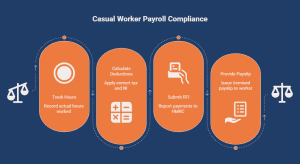
Casual worker payroll follows the same PAYE process as regular employees, with payments based on actual hours worked and reported to HMRC in real time. If you engage casual employment workers directly, they must be added to your payroll.
You are responsible for deducting income tax and National Insurance contributions and reporting payments through RTI on or before each payday. Irregular or short-term work does not remove these obligations.
1. Employer Payroll Process
Employers must ensure that payroll systems can accurately handle variable hours and earnings. This includes:
- Tracking hours worked for each shift
- Applying correct pay rates
- Calculating PAYE tax and National Insurance
- Submitting RTI reports to HMRC on time
Even one-off payments must be processed through payroll. Failure to operate PAYE correctly can lead to HMRC penalties, especially when understanding the differences between employment and tax frameworks like IR35 vs PAYE.
2. Worker Pay and Payslip Access
Casual workers must receive an itemised payslip for every payment. This should clearly show:
- Total earnings before deductions
- Tax and National Insurance deductions
- Net pay
Payslips must be accessible, either digitally or in print. Clear access helps workers verify payments and resolve issues quickly.
Accurate payroll processing ensures compliance, transparency, and reduces the risk of disputes. For a broader understanding of handling flexible workforce payments, you can also explore this guide on temporary worker payroll.
What Are the Key Compliance Requirements for Casual Workers?
Employers must meet the same core legal and payroll obligations for casual workers as they do for other workers, regardless of the casual label.
Key compliance areas include pay, payroll reporting, worker rights, and statutory protections. Failing to meet these requirements can lead to HMRC penalties and legal claims.
| Compliance Area | Employer Obligation |
|---|---|
| National Minimum Wage | Ensure all hours worked are paid at or above the legal minimum rate, ensuring proper length of service considerations. |
| Holiday Pay | Provide 5.6 weeks of paid annual leave, calculated correctly based on earnings |
| Payslips | Issue an itemised payslip for every pay period that complies with the time limits for reporting. |
| Payroll (PAYE) | Deduct tax and National Insurance and report to HMRC through RTI |
| Written Statement | Provide terms of engagement from day one |
| Working Time Regulations | Ensure rest breaks and working hour limits are followed |
| Pension Auto-Enrolment | Enrol eligible workers into a workplace pension scheme |
These requirements apply regardless of working hours or contract type, making accurate payroll and record-keeping essential for compliance. You can also review the latest updates on the minimum wage increase 2026 to ensure your pay practices remain aligned with current rates.
What Are The Common Payroll Mistakes with Casual Workers?
Casual worker payroll often breaks down at execution, not intent. Small errors in classification, tax handling, or reporting can quickly turn into compliance risks and financial penalties.
- Not running PAYE for one-off work:
Even short-term or irregular work may still require PAYE processing and reporting. - Incorrect holiday pay calculations:
Casual workers are entitled to holiday pay, and miscalculations are a common compliance issue. - Missing RTI submissions:
Failing to report payments to HMRC on time can lead to penalties and audit risks. - Wrong tax codes:
Applying incorrect tax codes results in under- or overpayments, affecting both the employer and the worker.
Most payroll issues with casual workers come from assumptions rather than rules. Clear processes and correct classification help avoid costly mistakes.
What Should Employers Do to Manage Casual Workers Effectively?
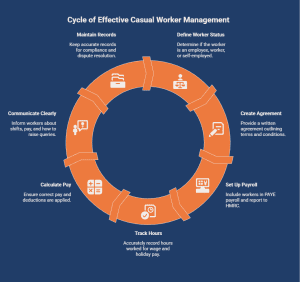
Managing casual workers requires a structured process that ensures correct classification, accurate payroll, and ongoing compliance. Relying on informal arrangements increases the risk of errors, disputes, and issues with HMRC.
Step 1: Define Worker Status
Start by determining whether the individual is an employee, worker, or self-employed. This decision affects legal rights, payroll obligations, and tax treatment. Assess the actual working relationship, including control, personal service, and any ongoing obligation to provide or accept work. Getting this wrong can lead to misclassification risks and legal claims.
Step 2: Create a Casual Worker Agreement
Provide a written agreement from day one that clearly defines the working arrangement, including hours of work. It should confirm there is no obligation to offer or accept work and outline key terms such as pay, working conditions, and entitlement to holiday pay. A clear agreement reduces ambiguity and helps prevent disputes over expectations or rights.
Step 3: Set Up Payroll Systems
Casual workers who are not self-employed must be included in your PAYE payroll. This means applying the correct tax code, deducting tax and National Insurance, and reporting payments to HMRC through RTI. Your payroll system must handle irregular hours and variable pay accurately to ensure compliance.
Step 4: Track Working Hours
Accurate tracking of hours worked is essential. It ensures correct wage calculations, supports minimum wage compliance, and forms the basis for holiday pay calculations, including considerations for parental leave. Use a reliable system, such as timesheets or digital tracking tools, to maintain clear and consistent records.
Step 5: Calculate Pay and Deductions
Calculate pay based on actual hours worked and ensure rates meet or exceed the National Minimum Wage. Apply correct tax and National Insurance deductions through PAYE. Holiday pay must also be calculated correctly based on earnings to avoid underpayment issues.
Step 6: Communicate with Workers Clearly
Provide clear information about shifts, pay schedules, and how workers can access their payslips. Workers should understand how their pay is calculated and how to raise queries. Consistent communication reduces misunderstandings and supports smoother workforce management.
Step 7: Maintain Records and Compliance
Keep accurate records of agreements, hours worked, payroll data, and communications. These records are essential for demonstrating compliance with HMRC requirements, case law, and employment regulations. Strong record-keeping also helps resolve disputes quickly and supports audit readiness.
Following a structured approach ensures that casual workers are managed consistently, that payroll is accurate, and that compliance risks are minimised.
What Are the Risks of Mismanaging Casual Workers?
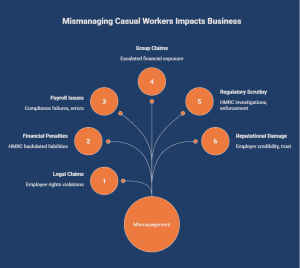
Mismanaging casual workers can lead to legal claims, financial penalties, and payroll compliance issues. Incorrect classification, underpayment, or reporting errors increase the risk of HMRC action, backdated liabilities, and operational disruption if not managed with structured processes.
Key risks include:
- Misclassification claims
Treating a worker incorrectly can result in claims under employee rights, such as unfair dismissal or redundancy pay. - Underpayment of wages
Failing to meet National Minimum Wage requirements can lead to backdated claims and financial liabilities. - Incorrect holiday pay calculations
Errors in holiday entitlement can result in claims for unpaid wages, which can extend over several years. - Payroll compliance failures
Incorrect PAYE handling, missed RTI submissions, or incorrect deductions can trigger HMRC penalties, including fines and interest. - Group claims and increased liability
If multiple workers are affected, claims can escalate into large-scale cases with significantly higher financial exposure. - Regulatory scrutiny
Non-compliance may lead to investigations by HMRC and other enforcement bodies. - Reputational damage
Poor workforce management can affect employer credibility, employee trust, and future hiring.
Addressing these risks through structured processes and accurate payroll management helps protect your business from long-term financial and legal exposure.
What Is the Business Impact of Casual Worker Employment?
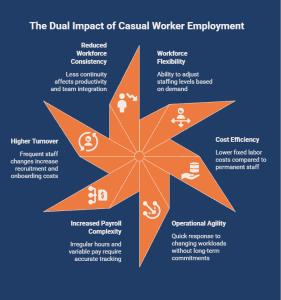
Casual worker employment can improve flexibility and cost control through casual work arrangements, but it also increases payroll complexity and workforce management challenges.
Key business impacts include:
- Workforce flexibility: Enables businesses to scale staffing levels in response to demand, especially during peak periods.
- Cost efficiency: Reduces fixed labour costs compared to maintaining a larger permanent workforce.
- Operational agility: Supports quick response to changing workloads without long-term commitments.
- Increased payroll complexity: Irregular hours and variable pay require accurate tracking and payroll systems.
- Higher turnover: Frequent staff changes can increase recruitment and onboarding costs.
- Reduced workforce consistency: Less continuity can affect productivity and team integration.
When Do Casual Workers Make Sense?
- Seasonal demand
- Unpredictable workloads
- Short-term or project-based work
When Might Casual Workers Not Be Suitable?
- Consistent working hours
- Long-term roles
- Core business functions requiring continuity
Balancing flexibility with structured payroll and workforce planning helps maximise benefits while maintaining operational stability.
How Can Direct Payroll Help Manage Casual Worker Payroll?
Managing casual worker payroll requires accurate calculations, flexible processing, and strict compliance with UK regulations. Direct Payroll Services supports businesses by ensuring casual worker payments are handled correctly, even with irregular hours and variable earnings.
Their services help businesses:
- Process casual worker wages accurately based on hours worked
- Manage PAYE, National Insurance, and HMRC reporting requirements
- Calculate holiday pay correctly for irregular working patterns
- Generate itemised payslips for each pay cycle
- Maintain compliant payroll records and reporting systems
- Reduce administrative workload across HR and finance teams
Outsourcing payroll helps businesses manage fluctuating work patterns while maintaining accuracy and compliance.
Looking to simplify casual worker payroll? Contact Direct Payroll Services today to streamline your payroll processes and ensure consistent, compliant workforce management.
Conclusion
Casual worker employment provides flexibility, but it requires a structured approach to ensure accuracy and compliance. Employers must focus on correct classification, proper PAYE processing, and meeting core legal obligations such as minimum wage and holiday pay. The label casual worker does not reduce responsibility; what matters is how the working relationship operates in practice.
By applying consistent processes, maintaining clear agreements, and managing payroll accurately, businesses can avoid risks related to the Employment Rights Act and ensure smooth operations. A well-managed approach supports both compliance and workforce efficiency, allowing employers to benefit from flexibility without exposing the business to unnecessary legal or financial issues.
Frequently Asked Questions
How should employers communicate with casual workers?
Employers should communicate clearly about different types of work availability, pay, and expectations, ensuring workers understand they can accept or decline shifts. Transparent communication builds trust, prevents misunderstandings, and helps maintain consistent and fair workforce management.
What is the definition of a casual worker under UK employment law?
A casual worker is not a defined legal category under UK employment law. It describes flexible work with no guaranteed hours, where rights and obligations depend on the individual’s actual employment status: employee, worker, or self-employed, potentially including those who run their own business.
What employment rights do casual workers have in the UK?
Casual workers usually qualify as workers, meaning they are entitled to the National Minimum Wage, paid annual leave, rest breaks, and defined weekly rest periods, along with protection from discrimination, as well as the assertion of their statutory rights, with eligibility for some statutory payments depending on earnings and working patterns.
What is a casual worker contract?
A casual worker contract is a written agreement that sets out pay, responsibilities, and working terms for individuals engaged on a flexible, as-needed basis without guaranteed hours.
What is a casual worker imperial?
Casual worker imperial typically refers to casual worker roles within Imperial College or similar institutions, where individuals are engaged on flexible, non-permanent terms depending on workload or project needs.
Is a casual worker the same as someone on a zero-hours contract?
No. A zero-hours contract is a specific type of contract with no guaranteed number of hours, while “casual worker” is a broader term describing flexible work arrangements; legal status depends on the actual working relationship, not the label, which can impact service delivery expectations.
Do casual workers get sick pay?
Casual workers may qualify for Statutory Sick Pay (SSP) and Statutory Maternity Pay (SMP) if they meet eligibility criteria, such as earning above the lower earnings limit and having a qualifying pattern of work; entitlement is assessed on a case-by-case basis, including considerations for minimum notice periods.
How does payroll work for casual workers, and what should employers be aware of?
Payroll for casual workers, including irregular hours workers, must be run through PAYE, with employers deducting tax and National Insurance based on earnings and reporting payments to HM Revenue and Customs (HMRC) via RTI. Employers must track hours accurately and ensure pay meets minimum wage and holiday pay rules.
What is casual worker employment?
Casual worker employment refers to a flexible working arrangement where individuals are engaged on an as-needed basis without guaranteed hours. They typically have limited employment rights and are paid only for the work they complete.
What is a casual worker agreement?
A casual worker agreement outlines the terms of flexible work, including duties, pay, and conditions. It does not guarantee regular hours and defines the rights and responsibilities between the business and the worker.
Do casual workers need to be on payroll?
Yes, casual workers usually need to be on payroll to ensure correct tax deductions, National Insurance contributions, and compliance with HMRC regulations in the UK.
What are HMRC casual workers’ rules?
HMRC requires casual workers to be paid through PAYE, with correct tax and National Insurance deductions. Employers must maintain accurate records and ensure compliance with employment and tax regulations.
How does paying casual workers in the UK work?
In the UK, casual workers are paid through PAYE based on hours worked. Employers calculate tax, National Insurance, and statutory payments while ensuring compliance with HMRC reporting requirements.