
Key Highlights
- CIS payroll services help contractors manage subcontractor verification, deductions, payment statements, records, and monthly CIS returns.
- HMRC verification determines whether a subcontractor is paid gross or has CIS deducted at 20% or 30%.
- CIS deductions are calculated on qualifying payment amounts rather than automatically on the subcontractor’s entire invoice.
- Contractors generally need to submit their monthly CIS return to HMRC by the 19th following each tax month.
- From 6 April 2026, contractors with no subcontractor payments must submit a nil return or tell HMRC they are inactive, where applicable.
- Construction businesses with employees and subcontractors may need to manage both CIS and PAYE processes.
- Direct Payroll Services supports UK contractors with CIS administration, including subcontractor verification, deductions, statements, and monthly reporting.
Managing subcontractor payments under the Construction Industry Scheme (CIS) can create a significant administrative workload for contractors. Before making payments, businesses may need to verify subcontractors, apply the correct deductions, maintain records, issue payment and deduction statements, and meet HM Revenue & Customs (HMRC) reporting deadlines.
CIS payroll services can help manage these recurring tasks, from subcontractor verification and deduction calculations to monthly CIS returns. This can be particularly useful for construction businesses managing a growing subcontractor workforce or running CIS alongside PAYE payroll for employees.
In this guide, we explain how CIS payroll services work in the UK, what they typically include, how CIS deductions and verification work, and the responsibilities contractors still need to manage. We also look at when outsourcing CIS payroll may make sense and what to consider when choosing a provider.
What Is CIS Payroll?
CIS payroll refers to the process of managing payments, deductions, and reporting for subcontractors covered by HMRC’s Construction Industry Scheme (CIS). Under the scheme, contractors may need to deduct money from payments for construction work and pass it to HMRC as an advance payment towards the subcontractor’s tax and National Insurance.
CIS itself is not the same as standard employee payroll. Employees are generally paid and reported through Pay As You Earn (PAYE), while qualifying subcontractors are subject to separate CIS verification, deduction, record-keeping, and reporting requirements.
Who Needs to Use CIS Payroll in the UK?
CIS generally applies to contractors that pay subcontractors for qualifying construction work. It can also apply to businesses that are not primarily in construction if their construction spending is high enough to bring them within HMRC’s deemed contractor rules.
According to HMRC guidance:
- Contractors: Businesses that pay subcontractors for construction work covered by CIS generally need to register as contractors.
- Deemed contractors: Businesses that do not primarily operate in construction can fall within CIS if they spend more than £3 million on construction during a 12-month period.
- Subcontractors: Businesses and self-employed workers carrying out construction work for contractors can register under CIS.
- Construction work covered by CIS: This can include building, demolition, repairs, decorating, and installing certain systems.
- Work generally excluded from CIS: Examples include architecture, surveying, delivering construction materials, and certain other non-construction activities.
Construction businesses can also have both employees and subcontractors. Employees are generally processed through PAYE, while qualifying subcontractor payments are handled under CIS. Correctly identifying a worker’s status is therefore important before deciding how their payments should be processed.
How Do CIS Payroll Services Work?
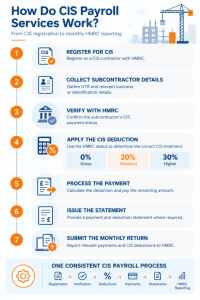
CIS payroll services help contractors manage the recurring tasks involved in paying subcontractors and meeting Construction Industry Scheme requirements. The process typically covers subcontractor details and verification, CIS deductions, payment and deduction statements, record-keeping, and monthly reporting to HMRC.
The exact responsibilities handled by a payroll provider depend on the service agreed with the contractor. A typical CIS payroll process works as follows:
1. How Do You Register for the Construction Industry Scheme?
Contractors must register for CIS before taking on their first subcontractor. Registration with HMRC establishes the business as a CIS contractor and allows it to begin meeting its responsibilities under the scheme.
2. What Subcontractor Details Do You Need to Collect?
Before processing payments, contractors need the information required to identify each subcontractor. This may include their Unique Taxpayer Reference (UTR), business or trading name, National Insurance number for sole traders, or company registration number for limited companies.
Accurate information is important because these details may be required when verifying the subcontractor with HMRC.
3. How Are Subcontractors Verified With HMRC?
New subcontractors may need to be verified with HMRC before payments are processed. HMRC confirms how the subcontractor should be paid under CIS and provides a verification reference where applicable.
A CIS payroll provider can support the verification process and maintain the relevant records as part of ongoing payroll administration.
4. How Is the Correct CIS Deduction Applied?
The subcontractor’s HMRC status determines the appropriate CIS treatment. Depending on that status, the subcontractor may be paid gross, have the standard 20% deduction applied, or be subject to the higher 30% deduction rate.
The deduction must then be calculated against the relevant amount of the subcontractor’s payment.
5. How Are Subcontractor Payments Processed?
Once the relevant invoice amounts and CIS status have been checked, the applicable deduction can be calculated. The contractor pays the remaining amount to the subcontractor and accounts for the CIS deduction through the appropriate HMRC process.
6. When Are Payment and Deduction Statements Issued?
When CIS deductions are made, contractors must provide subcontractors with payment and deduction statements. These show information such as the gross payment and the amount deducted under CIS.
Payroll providers may prepare these statements as part of the regular CIS payroll process.
7. How Are Monthly CIS Returns Submitted?
Contractors report relevant subcontractor payments and deductions to HMRC through monthly CIS returns. The payroll provider may prepare and submit these returns where this forms part of the agreed service.
Following a consistent process helps contractors keep verification, payments, deductions, statements, and HMRC reporting aligned from one reporting period to the next.
What Do CIS Payroll Services Include?
CIS payroll services can handle recurring administrative tasks involved in paying subcontractors and reporting under the Construction Industry Scheme. The exact services depend on the provider and agreed level of support.
Typical services include:
- Subcontractor verification with HMRC
- CIS deduction calculations
- Weekly or monthly payroll processing
- Payment and deduction statements
- Monthly CIS return preparation and submission
- CIS payroll records and reporting
- CIS and PAYE payroll coordination
Contractors should confirm which tasks are included and what information they need to provide before choosing a CIS payroll service.
How Do CIS Verification and Payroll Work Together?
CIS verification determines how a subcontractor should be paid under the Construction Industry Scheme. Contractors verify subcontractors with HMRC where required, and HMRC confirms the payment status and deduction rate to apply.
| HMRC Status | CIS Deduction |
|---|---|
| Gross Payment Status | 0% |
| Registered subcontractor | 20% |
| Unregistered or unmatched subcontractor | 30% |
A subcontractor with Gross Payment Status can be paid without a CIS deduction. The 20% rate generally applies to registered subcontractors, while the 30% rate applies where HMRC cannot match the subcontractor’s details, or they are not registered for CIS.
Contractors should use the status returned by HMRC rather than relying on previous payment arrangements or assumptions.
What Payments Are CIS Deductions Calculated On?
CIS deductions are not always calculated on the full value of a subcontractor’s invoice. Contractors need to identify which elements should be included or excluded before applying the relevant CIS deduction rate.
- Labour: Payments for qualifying construction work generally form part of the deduction calculation.
- Materials: Qualifying materials directly purchased by the subcontractor can generally be excluded.
- VAT: CIS deductions are calculated before VAT, so VAT charged by the subcontractor is excluded.
- Other costs: Some expenses, including certain equipment hire and fuel costs, may still be included depending on their nature.
What Does a CIS Deduction Calculation Look Like?
Suppose a registered subcontractor invoices £2,000 for labour, £500 for qualifying materials, and £500 VAT. If the £2,000 labour element is subject to the standard 20% CIS rate:
£2,000 × 20% = £400 CIS deduction
The contractor would deduct £400 under CIS. Correctly separating the relevant invoice elements helps prevent under- or over-deductions.
Need to recover CIS deductions already paid? Learn how to submit a CIS repayment claim and understand the process involved.
When Are CIS Monthly Returns Due?
CIS monthly returns are generally due to HMRC by the 19th following the end of each CIS tax month. Each reporting period runs from the 6th of one month to the 5th of the next.
The return reports relevant payments made to subcontractors and any CIS deductions taken during that period. Missing the filing deadline can result in HMRC penalties, which can increase the longer a return remains outstanding.
What Changed for CIS Nil Returns in 2026?
From 6 April 2026, contractors that make no payments to subcontractors during a CIS reporting period must submit a nil return or tell HMRC that they are inactive, where applicable. Contractors should therefore monitor every reporting period, including months when no subcontractor payments are made, to avoid missing required CIS reporting.
What Is the Difference Between CIS Payroll and PAYE Payroll?
CIS payroll is used for qualifying subcontractor payments under the Construction Industry Scheme, while PAYE payroll is used to pay employees. The two involve different deductions, documents, and HMRC reporting requirements.
| Feature | CIS Payroll | PAYE Payroll |
|---|---|---|
| Mainly applies to | Qualifying subcontractors | Employees |
| Tax system | CIS | PAYE |
| Verification | CIS verification may be required | No CIS verification |
| Reporting | Monthly CIS return | Real Time Information (RTI) |
| Payment document | Payment and deduction statement | Payslip |
| Typical deductions | CIS deductions | PAYE tax and National Insurance contributions |
Correct worker status is important because businesses cannot simply choose between CIS and PAYE based on which system is more convenient.
Can You Run CIS and PAYE Payroll Together?
Yes. Construction businesses can operate CIS and PAYE alongside each other when they engage subcontractors and employ staff.
Keeping the two processes clearly organised helps ensure employees and subcontractors are paid and reported correctly. Direct Payroll Services can support businesses that need both CIS and PAYE payroll administration through one provider.
Managing PAYE alongside CIS? Learn how to correct payroll errors in HMRC’s Basic PAYE Tools if something goes wrong.
Should You Manage CIS Payroll In-House or Outsource It?
Managing CIS payroll in-house may suit businesses with sufficient time and CIS expertise, while outsourcing can reduce administration and provide access to specialist payroll support. The right approach depends on your subcontractor numbers, internal resources, and payroll complexity.
| Managing CIS Payroll In-House | Outsourcing CIS Payroll |
|---|---|
| Greater direct control over payroll tasks | Agreed payroll tasks handled by a specialist provider |
| Requires internal CIS knowledge | Provides access to CIS payroll expertise |
| Administration stays with your team | Reduces routine payroll administration |
| Internal team monitors deadlines | Provider can support filing and reporting |
| May suit simpler CIS requirements | Can support growing or more complex workforces |
Outsourcing may become more practical as subcontractor numbers grow, CIS and PAYE need to be managed together, or payroll administration takes significant time away from other business activities.
Before outsourcing, confirm exactly which CIS responsibilities the provider will handle and which information your business will still need to supply.
Managing payroll across a more complex business structure? Learn how franchise payroll works and the challenges involved in keeping payroll consistent.
What Are the Most Common CIS Payroll Mistakes
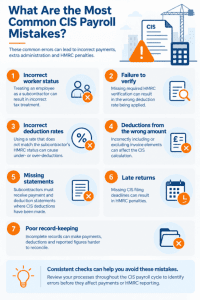
Common CIS payroll mistakes include incorrect worker status, missed verification, wrong deduction rates, inaccurate calculations, and late reporting. These errors can lead to incorrect subcontractor payments, additional administration, and HMRC penalties.
Contractors should watch for:
- Incorrect worker status: Treating an employee as a subcontractor can result in incorrect tax treatment.
- Failure to verify: Missing required HMRC verification can result in the wrong deduction rate being applied.
- Incorrect deduction rates: Using a rate that does not match the subcontractor’s HMRC status can cause under- or over-deductions.
- Deductions from the wrong amount: Incorrectly including or excluding invoice elements can affect the CIS calculation.
- Missing statements: Subcontractors must receive payment and deduction statements where CIS deductions have been made.
- Late returns: Missing CIS filing deadlines can result in HMRC penalties.
- Poor record-keeping: Incomplete records can make payments, deductions, and reported figures harder to reconcile.
Consistent checks throughout the CIS payroll process can help contractors identify errors before they affect payments or HMRC reporting.
Want to separate common misconceptions from payroll facts? Explore these common payroll myths and what businesses should know instead.
What Are the Best Practices for CIS Payroll Management?
Good CIS payroll management relies on consistent processes, accurate records, and regular checks before payments and returns are submitted. A structured approach can make errors easier to identify and help contractors manage changing subcontractor workforces.
Best practices include:
- Use a standard subcontractor onboarding process to collect the information required for CIS.
- Maintain verification records and relevant HMRC reference numbers.
- Check invoices carefully to separate labour, qualifying materials, VAT, and other costs correctly.
- Set clear payroll cut-off dates for receiving subcontractor information.
- Reconcile payments and deductions before submitting the monthly CIS return.
- Keep CIS and PAYE records organised separately when managing a mixed workforce.
- Review HMRC guidance regularly so processes reflect current CIS requirements.
Documenting these processes also helps internal teams and external payroll providers understand who is responsible for each stage of CIS payroll.
How Do You Choose the Right CIS Payroll Company?
The right CIS payroll company should understand Construction Industry Scheme requirements and provide the level of support your business actually needs. Before choosing a provider, check whether its service covers your subcontractor numbers, payment frequency, reporting needs, and any PAYE payroll requirements.
Consider:
- CIS experience: Does the provider regularly manage payroll for contractors and subcontractors?
- Service scope: Are verification, deductions, statements, monthly returns, and records included?
- Processing frequency: Can it support weekly or monthly CIS payroll?
- CIS and PAYE support: Can both be managed if you employ staff alongside subcontractors?
- HMRC support: What assistance is available with CIS reporting or payroll queries?
- Data security: How is sensitive payroll and subcontractor information protected?
- Pricing: Is it clear what is included and whether additional services cost extra?
Direct Payroll Services supports UK construction businesses with CIS administration alongside PAYE payroll, making it possible to manage both through one payroll provider.
Choosing between providers? Learn how to choose the right payroll service for your business needs.
How Can Direct Payroll Services Help With CIS Payroll?
Direct Payroll Services helps UK contractors manage the recurring administration involved in CIS payroll. Our support can cover subcontractor verification, CIS deduction calculations, payment and deduction statements, monthly returns, and payroll records.
For construction businesses with a mixed workforce, we can also manage CIS and PAYE payroll together, helping you keep subcontractor and employee payroll processes organised through one provider.
Whether you pay subcontractors weekly or monthly, our CIS payroll services can be tailored to your business requirements as your workforce changes.
Looking for support with CIS payroll? Contact Direct Payroll Services to discuss your requirements.
How Can You Keep CIS Payroll Running Smoothly?
Managing CIS payroll effectively comes down to accurate subcontractor verification, correct tax deductions, organised records, and timely HMRC reporting. A consistent payroll process can help construction companies meet their CIS obligations while reducing errors and unnecessary administrative work.
Whether CIS payroll is managed in-house or outsourced, contractors should have clear processes for each stage, from onboarding subcontractors to submitting monthly returns. For businesses with growing or more complex workforces, specialist CIS payroll support can provide greater consistency and peace of mind.
Frequently Asked Questions
What tax deductions apply to CIS subcontractors?
Under the CIS scheme, tax deductions depend on the subcontractor’s HMRC status. Registered subcontractors generally have 20% deducted, while the higher rate of 30% may apply to unregistered or unmatched subcontractors. Gross Payment Status allows payment without CIS deductions.
How can CIS payroll affect cash flow?
CIS deductions can affect cash flow because contractors deduct amounts from qualifying subcontractor payments and account for them through HMRC. Accurate cash flow management helps business owners plan for subcontractor payments, tax payments, and other financial commitments.
What does CIS cover in the construction sector?
CIS covers various types of construction work, including building, demolition, repairs, decorating, and installing certain systems. Whether a particular construction operation or construction project falls within the scheme depends on the nature of the work and CIS rules.
Do CIS subcontractors pay Income Tax and National Insurance?
CIS deductions are advance payments towards a subcontractor’s tax and National Insurance. They do not necessarily represent the subcontractor’s final tax liabilities. Subcontractors still need to manage their wider tax affairs and applicable reporting requirements.
Does CIS payroll include sick pay and pension contributions?
Generally, CIS subcontractors are not processed like employees, so employee wages, statutory sick pay, and workplace pension contributions are not normally handled through CIS payroll. However, the correct employment status and working relationship should be established before payments are processed.
How can construction payroll services reduce the administrative burden?
Construction payroll services can reduce the administrative burden by managing recurring tasks such as verification, tax deductions, monthly statements, payroll records, and CIS reporting. A more centralised payroll system can be particularly useful for construction companies managing numerous subcontractors.
What are the financial risks of getting CIS payroll wrong?
Incorrect deductions, missed returns, or failures to follow CIS obligations can create financial risks for contractors, including HMRC queries and potential financial penalties. Consistent records and checks can support CIS compliance and reduce avoidable payroll errors.
What should business owners consider when choosing CIS payroll services?
Business owners should consider the provider’s years of experience, CIS knowledge, payroll features, data security, service scope, pricing, and support for CIS and PAYE. Careful consideration can help identify a provider suited to the company’s CIS payroll obligations.