Key Highlights
- CIS tax payments are an HMRC scheme requiring contractors to deduct tax from subcontractor payments in the construction industry.
- CIS tax rates range from 20 per cent to 30 per cent, depending on registration and status.
- Subcontractors, including a limited company subcontractor, may claim a CIS tax refund if too much has been deducted.
- Contractors must verify subcontractors, submit monthly returns, and keep detailed records.
- Incorrect deductions, late submissions, and verification failures are common compliance risks.
- Professional CIS tax assistance reduces penalties, protects cash flow, and ensures accurate HMRC reporting.
If you work in construction, you have probably felt it. That moment of uncertainty when a payment comes in lower than expected. Under the UK Construction Industry Section, contractors must deduct 20 per cent or 30 per cent from the labour part of a subcontractor invoice and pay it to HMRC. When you are not fully clear on how that works, confusion builds quickly.
Many contractors and subcontractors struggle with CIS deductions, monthly reporting rules, subcontractor verification, and refund processes. Small administrative errors can trigger penalties, delayed payments, or HMRC compliance issues that disrupt cash flow and operations.
This guide breaks down what CIS tax is and how it works in practice. You will see the exact steps contractors follow each month, how invoices should be split correctly, how deduction rates apply, and how refunds are calculated and reclaimed. Whether you are a contractor managing multiple subcontractors or a subcontractor reviewing your own CIS status, this article will give you clarity and confidence.
What Is CIS Tax?
CIS tax refers to the Construction Industry Scheme, an HMRC system under which contractors deduct a percentage from subcontractor payments and pass it to HMRC as an advance payment towards the subcontractor’s tax liability.
It is not a separate tax. Instead, it is a method of collecting income tax at source within the construction sector. The deductions count towards the subcontractor’s overall tax and National Insurance position, depending on whether they are registered for CIS and their verification status.
Which Industries Fall Under CIS?
CIS applies mainly to construction activities, including:
- Building and civil engineering work
- Site preparation and demolition
- Repairs, alterations, and decorating
- Installation of systems such as heating, lighting, and ventilation
If you operate in mainstream construction, you are likely within CIS scope.
Who Needs to Register for CIS?
You must register if you are:
- A contractor paying subcontractors for construction work
- A subcontractor working under a contractor
Failing to register can result in higher deduction rates and compliance penalties.
Who Is Exempt From CIS?
Certain roles may fall outside CIS, such as:
- Architects and surveyors
- Scaffold hire without labour
- Materials only suppliers
However, grey areas are common. When in doubt, it is safer to confirm your position.
How Does CIS Tax Work?
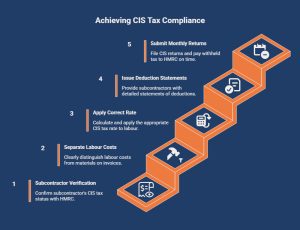
CIS tax is HMRC’s way of collecting tax at source in the construction industry. As a contractor, you deduct a percentage from a subcontractor’s labour payment and pay it to HMRC. For subcontractors, these deductions count as advance payments towards Income Tax and National Insurance. Although the process seems simple, staying compliant requires accurate verification, clear invoices, correct rate application, and timely reporting each tax month. Missing any step can lead to penalties and added stress.
1. Subcontractor Verification With HMRC
Before making the first payment, contractors must verify the subcontractor with HMRC. HMRC confirms their CIS tax status and deduction rate: 20 per cent, 30 per cent, or gross payment at 0 per cent. Verification protects you from applying the wrong rate.
2. Separating Labour From Materials
CIS tax deductions generally apply only to the labour element of an invoice, not materials or VAT. The tax amount related to CIS deductions must be clearly indicated. Clear and accurate invoice breakdowns are essential. Misclassifying materials or failing to separate costs properly is a common source of CIS tax errors.
3 Applying the Correct CIS Tax Rate
Once verification is complete and labour has been separated, the correct CIS tax rate is applied to the labour portion, ensuring all tax obligations are met. Even minor miscalculations can create compliance risks, especially when repeated across multiple subcontractors.
4. Issuing Deduction Statements
After calculating the deduction, the contractor pays the net amount and provides a deduction statement. This statement must show the gross payment, deduction rate, deduction amount, and net payment made, ensuring transparency and traceability.
5. Submitting Monthly Returns and Paying HMRC
Each tax month, contractors submit a CIS return outlining all payments and deductions made. The withheld tax must then be paid to HMRC by the deadline. Late submissions automatically trigger penalties.
When this structure is followed consistently, CIS becomes controlled rather than reactive. The next important step is understanding exactly who carries responsibility under the scheme and how those obligations affect daily operations.
What Are Contractor Responsibilities Under CIS?
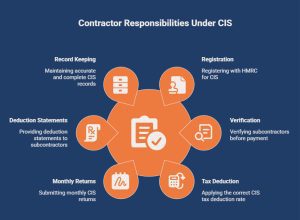
Under the Construction Industry Scheme, contractors hold the primary compliance responsibility. Even if your subcontractors are experienced, HMRC expects you to operate the scheme correctly, including providing your legal business name during registration.
Your responsibilities include:
- Registering for CIS with HMRC
- Verifying every subcontractor before payment
- Applying the correct CIS tax deduction rate
- Submitting monthly CIS returns, including nil returns where required
- Providing deduction statements
- Keeping accurate and complete CIS records
Missing a return or applying the wrong rate does not just create administrative inconvenience. It can result in penalties, interest charges, and potential HMRC scrutiny.
Because contractors carry most of the reporting burden, internal systems need to be reliable. That said, subcontractors also have obligations within the scheme.
What Are Subcontractor Responsibilities Under CIS?
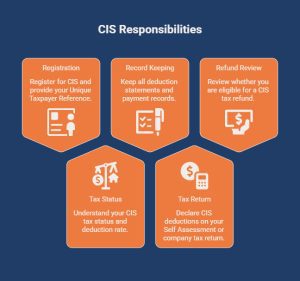
As a subcontractor, CIS directly affects your cash flow and year-end tax position. While you are not responsible for submitting monthly contractor returns, you are responsible for ensuring your details and records are correct.
Key responsibilities include:
- Registering for CIS and providing your Unique Taxpayer Reference
- Understanding your CIS tax status and deduction rate
- Keeping all deduction statements and payment records
- Declaring CIS deductions on your Self Assessment or company tax return
- Reviewing whether you are eligible for a CIS tax refund with your Government Gateway User ID.
If you are aiming for gross payment status, maintaining a strong compliance history is essential. HMRC can withdraw that status if conditions are not met.
Once both sides understand their responsibilities, the scheme becomes clearer. The real risks begin when compliance slips. Next, it is important to understand what happens if CIS rules are not followed correctly.
What Happens If You Do Not Comply?
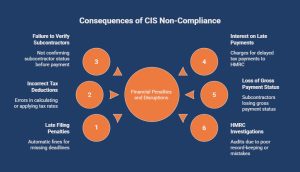
This is the part many businesses underestimate. CIS is not just a reporting formality. HMRC treats it as a live compliance obligation. If something is missed, submitted late, or calculated incorrectly, penalties are automatic, not discretionary. Whether you are a contractor managing deductions or a subcontractor failing to register correctly, non-compliance can quickly become expensive and disruptive.
Here is what that can look like in practice:
1. Late filing penalties
If you miss your monthly CIS return deadline, HMRC issues an automatic £100 penalty for being just one day late. The longer the delay continues, the higher the penalty becomes. Repeated failures increase scrutiny.
2. Incorrect CIS tax deductions
Applying the wrong CIS tax rate, miscalculating the labour portion, or failing to verify a subcontractor can result in penalties and repayment demands. HMRC may require you to correct errors and could investigate your processes.
3. Failure to verify subcontractors
If you do not verify subcontractors before payment, you risk using the wrong deduction rate. That exposes you to compliance breaches and financial corrections later.
4. Interest on late payments to HMRC
If you deduct CIS tax but fail to pay it to HMRC on time, interest is charged. Over time, these compounds increase your total liability.
5. Loss of gross payment status
For subcontractors, repeated non-compliance can result in losing gross payment status. That means future payments will be subject to deduction, which directly affects cash flow.
6. HMRC investigations and audits
Poor record-keeping or repeated mistakes can trigger deeper reviews. HMRC expects clear documentation, traceable deductions, and accurate monthly reporting.
The reality is that most CIS penalties occur not from tax avoidance but due to stretched processes, inconsistent records, or unclear responsibilities. If CIS compliance feels like a constant struggle rather than something you manage confidently, it’s a sign you need structured support.
What Exactly Is Deducted Under CIS?
Under the Construction Industry Scheme, the deduction is taken only from the labour portion of a subcontractor’s invoice, not from the full invoice value.
This means:
- Materials are not subject to CIS deduction
- VAT is excluded from the calculation
- Only the labour element is used to determine the percentage
The contractor deducts the applicable rate, typically 20 percent for registered subcontractors or 30 percent for unregistered ones, and pays that amount directly to HMRC.
The deducted amount counts as an advance payment towards the subcontractor’s annual tax and National Insurance liability. Accurate labour and material breakdowns on invoices are essential to ensure the correct amount is deducted.
Can You Claim a CIS Tax Refund?
Yes, and many subcontractors do.
A CIS refund tax refund becomes available when total deductions throughout the year exceed your final Income Tax and National Insurance liability. This situation is common because the standard 20 per cent deduction does not take into account:
- Your Personal Allowance
- Allowable business expenses
- Periods of lower income
To reclaim CIS tax, you must submit a Self Assessment tax return after the end of the tax year. HMRC then calculates your actual liability and determines whether a repayment is due through your agent services account.
For limited companies, the process works slightly differently. Overpaid CIS can often be:
- Offset against PAYE liabilities
- Reclaimed directly from HMRC
The key factor in receiving your refund smoothly is documentation. Missing deduction statements or incomplete records are among the most common causes of delay.
What Is CIS Tax Status?
CIS tax status refers to a subcontractor’s registration position within the Construction Industry Scheme and determines the rate at which deductions are made.
There are three possible statuses:
- Registered subcontractor at 20 percent
- Unregistered subcontractor at 30 percent
- Gross payment status at 0 per cent
This status directly affects how much money you receive per payment and how your tax is managed throughout the year.
Contractors must verify a subcontractor’s status with HMRC before making the first payment. Subcontractors seeking gross payment status must meet strict turnover and compliance requirements.
Maintaining the correct status is not just about tax efficiency. It reflects compliance history and financial reliability in the eyes of HMRC.
If you are exploring construction payroll services and want a clearer understanding of your options, read our blog on the different types of construction payroll services available and how they support compliance and efficiency.
What Are Common CIS Tax Mistakes?
CIS rules are straightforward in theory. In practice, they are often misapplied.
For contractors, mistakes typically arise from process gaps. For subcontractors, they usually stem from incomplete recordkeeping or a misunderstanding of allowable claims.
Some of the most common CIS tax mistakes include:
- Filing monthly returns late or failing to submit nil returns
- Applying the wrong deduction rate due to failure to verify the status
- Calculating deductions on the full invoice amount, including materials
- Poor record-keeping makes audits stressful and time-consuming
- Subcontractors failing to register and losing 30 per cent of payments unnecessarily
- Not claiming all legitimate business expenses, reducing refund entitlement
Even small errors can create a ripple effect. A missed verification today can become a compliance review tomorrow. Consistency and structure are essential.
Why Do Businesses Need CIS Tax Assistance?
CIS compliance is not just about knowing the rules. It is about applying them correctly, every month, without fail.
Contractors must:
- Verify subcontractors
- Calculate accurate CIS tax deductions
- Issue deduction statements
- Submit monthly returns to HMRC
- Maintain detailed records
For growing construction businesses, this quickly becomes an administrative burden. It consumes time, increases pressure on internal teams, and leaves room for costly mistakes.
Professional CIS tax assistance reduces that risk.
With specialist support, businesses benefit from:
- Accurate verification and deduction calculations
- Timely and compliant HMRC submissions
- Reduced exposure to penalties
- Structured record keeping for audit readiness
- More predictable cash flow management
Most importantly, it allows you to focus on delivering projects rather than worrying about compliance deadlines.
For many construction businesses, expert CIS support is not an expense. It is risk management.
How Direct Payroll Services Supports CIS Compliance
CIS compliance should not slow down your projects or expose you to penalties. At Direct Payroll Services, CIS is managed as a structured, reliable process, not an afterthought.
We support contractors by:
- Verifying subcontractors with HMRC
- Applying the correct CIS tax deduction rates
- Submitting accurate monthly CIS returns on time
- Issuing clear deduction statements
- Maintaining audit-ready records
This reduces compliance risk, protects cash flow, and removes administrative pressure from your team.
If CIS reporting feels time-consuming or uncertain, speak to us and ensure your CIS processes are accurate, compliant, and fully managed.
Conclusion
CIS tax works by placing responsibility on contractors to verify subcontractors, deduct the correct percentage from labour payments, and report those deductions to HMRC each month. For subcontractors, it acts as an advance tax, later reconciled through Self Assessment or company returns.
When verification, accurate calculations, and timely submissions are handled consistently, CIS becomes manageable. With structured processes or professional CIS tax assistance, contractors and employers can reduce risk, protect cash flow, and stay fully compliant.
Frequently Asked Questions
How do I calculate my CIS tax deduction?
Contractors must first verify the subcontractor with HMRC. The applicable rate, usually 20 per cent or 30 per cent, is applied only to the labour portion of the invoice, excluding materials and VAT. Accurate invoice breakdowns ensure the correct deduction.
What happens if my CIS tax rate is too high?
If too much has been deducted, you can reclaim the difference through your Self Assessment tax return. HMRC reviews total income, CIS deductions, and allowable expenses. Any overpayment is refunded once your final tax position is calculated.
What paperwork is required to submit a CIS return?
Contractors need the subcontractor’s verification details, payment records, labour amounts, and deduction figures. Accurate monthly records support the CIS return submission and confirm that payments and tax deductions have been reported correctly to HMRC.
Where do I find help with a CIS tax reclaim?
You can seek support from a payroll provider or tax adviser experienced with the Construction Industry Scheme. They help reconcile deductions, prepare accurate returns, and submit refund claims with the correct supporting documentation.
How do I avoid CIS deductions?
To avoid deductions, subcontractors must apply for Gross Payment Status. HMRC assesses turnover, compliance history, and registration status. If approved, contractors pay you in full without making CIS deductions at source.
How do you track CIS deductions and prepare for MTD?
Maintain accurate records of invoices, labour breakdowns, and monthly deductions using digital accounting systems. This ensures compliance with CIS reporting and supports future Making Tax Digital requirements by keeping tax data structured and accessible.
What is the construction industry scheme monthly return?
The CIS monthly return is a report contractors submit to HMRC detailing subcontractor payments and deductions made during the tax month. It must be filed every month, even if no subcontractors were paid.