
Key Highlights
- On-demand payroll allows employees to access earned wages before the official payday.
- Flexible payroll is becoming more popular as businesses respond to rising employee demand for financial flexibility.
- Payroll on-demand can improve employee well-being, retention, and payroll transparency.
- Employers must still maintain PAYE compliance, accurate payroll reporting, and payroll reconciliation processes.
- Poor payroll integration can create reporting errors, deduction issues, and employee payment disputes.
- Businesses should introduce clear wage access policies and withdrawal controls before implementation.
- Automated payroll systems can reduce manual administration and improve payroll efficiency.
- Working with an experienced payroll provider can help businesses manage flexible payroll operations more effectively.
Rising living costs are making fixed payday schedules harder for many employees to manage. Waiting until the end of the week or month for wages can create financial pressure, especially for workers dealing with unexpected expenses, changing shift patterns, or increasing household bills. As financial flexibility becomes a bigger priority, more employees are looking for faster access to wages they have already earned.
To respond to these changing expectations, businesses are exploring more flexible ways to support employees without completely changing their payroll structure. On-demand payroll is gaining attention across industries such as retail, hospitality, healthcare, and logistics, where employee retention and workforce stability remain ongoing challenges.
This guide explains what on-demand payroll is, how it works, how it differs from traditional payroll systems, and the key benefits, risks, and considerations businesses should understand before introducing flexible wage access.
What Is On-Demand Payroll?
On-demand payroll allows employees to access part of their earned pay before the official payday instead of waiting for a fixed weekly or monthly payroll cycle. Employees only withdraw wages already earned through completed work, while the remaining salary is processed normally on payday.
Unlike payday loans or salary advances, on-demand payroll uses real-time earnings data to calculate how much pay employees can access before payday. This gives workers greater financial flexibility without changing the employer’s existing payroll schedule.
Key features often include:
- early access to earned pay before payday,
- real-time earnings visibility,
- automated payroll calculations,
- digital employee access through apps or portals,
- and payroll controls to maintain reporting accuracy.
These systems are becoming more common in industries with shift-based or hourly workers, where employees may need quicker access to wages between traditional payday dates.
How Does On-Demand Payroll Work?
On-demand payroll connects with existing payroll systems to track approved working hours and calculate earned pay automatically throughout the payroll cycle.
Once employees complete shifts or working hours, they can view available earnings through a payroll app or employee portal and request access to part of their earned pay before payday. The remaining salary is then processed normally with PAYE deductions, pension contributions, and National Insurance calculations applied during the standard payroll run.
Most employers apply withdrawal limits and payroll controls to maintain payroll accuracy, reduce reporting errors, and prevent excessive early wage withdrawals.
Key Features of Earned Wage Access
Earned wage access systems are designed to give employees faster access to pay while helping employers maintain payroll control and reporting accuracy.
Common features include:
- Real-time visibility into earned pay before payday
- Early wage access without changing normal payroll cycles
- Digital access through employee apps or self-service portals
- Automated payroll calculations linked to approved working hours
- Withdrawal limits to reduce excessive early wage access
- Payroll controls that support PAYE and deduction accuracy
These features help businesses introduce payroll flexibility without disrupting existing payroll operations.
What are the Key Differences Between Payroll On Demand and Traditional Payroll Systems?
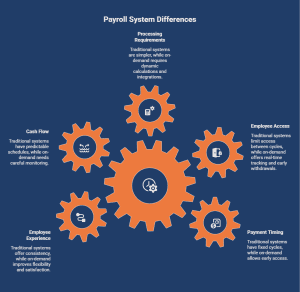
Traditional payroll systems follow fixed weekly or monthly pay cycles, while payroll on-demand allows employees to access part of their earned wages before the official payday. The main differences involve payment timing, payroll flexibility, employee access, and payroll administration.
| Feature | Traditional Payroll | Payroll On-Demand |
|---|---|---|
| Pay schedule | Fixed weekly or monthly payday | Flexible access to earned wages |
| Wage access | Employees wait until payday | Employees can withdraw wages earlier |
| Payroll visibility | Limited between pay cycles | Real-time earnings visibility |
| Employee flexibility | Lower | Higher |
| Payroll processing | Standard payroll cycle only | Real-time wage tracking and adjustments |
| Cash flow management | More predictable | Requires closer monitoring |
| Payroll administration | Simpler processing | More integration and reconciliation work |
| Financial wellbeing support | Limited | Stronger employee support potential |
Payroll on-demand gives employees faster access to earned pay, but employers need stronger payroll controls, accurate reporting processes, and reliable payroll integrations to manage flexible wage access effectively.
1. How Payment Timing Differs Between the Two Payroll Models
Traditional payroll processes employee wages on fixed weekly, fortnightly, or monthly schedules. Employees receive their full salary only on the official payday, regardless of when the work was completed.
Payroll on-demand changes this structure by allowing employees to withdraw part of their earned wages earlier. The remaining balance is then processed during the standard payroll cycle. This gives employees faster access to wages without replacing the employer’s existing payroll schedule.
2. Differences in Employee Wage Accessibility
In traditional payroll systems, employees usually have limited access to earnings information between payroll cycles. Workers often need to wait until payday to receive wages, even after completing approved shifts or working hours.
Payroll on-demand improves wage accessibility through:
- Real-time earnings tracking
- Early wage access before payday
- Digital payroll visibility
- Employee self-service platforms
- Flexible withdrawal options
This gives employees greater control over earned wages and short-term financial planning.
3. Payroll Processing and Reporting Requirements
Traditional payroll systems are generally simpler to manage because payroll calculations and deductions occur once during the normal payroll cycle.
Payroll on-demand requires more dynamic payroll management, including:
- Real-time wage calculations
- Payroll software integration
- Withdrawal tracking
- Payroll reconciliation
- Automated reporting adjustments
However, PAYE deductions, National Insurance contributions, pension calculations, and HMRC reporting obligations still apply during the official payroll process.
4. Cash Flow and Payroll Administration Considerations
Traditional payroll creates predictable payroll funding schedules because wages are processed on fixed dates.
Payroll on-demand may create additional financial and administrative responsibilities, including:
- More frequent wage access requests
- Increased cash flow monitoring
- Payroll reconciliation adjustments
- Payroll integration management
- Employee access control administration
Businesses must ensure payroll systems and financial planning can support more flexible wage access structures.
5. How Employee Experience Changes With Flexible Payroll
Traditional payroll offers consistency, but employees may experience financial pressure between payday periods, especially during unexpected expenses or rising living costs.
Payroll on-demand improves employee flexibility by providing:
- Faster access to earned wages
- Greater payroll transparency
- Improved financial flexibility
- Reduced reliance on salary advances
- Better visibility into earnings and deductions
For many employees, flexible payroll access creates a more modern and supportive payroll experience while maintaining structured payroll processing for employers.
To understand how often you should pay employees and how pay frequency affects cash flow, compliance, and satisfaction, read this guide on pay frequency options and best practices.
Why Is On-Demand Payroll Becoming More Popular in the UK?

On-demand payroll is growing across the UK as more employees look for quicker access to pay between traditional payday schedules. Rising living costs, changing workforce expectations, and the growth of earned wage access technology are pushing businesses to rethink how employees receive wages.
1. Rising Employee Demand for Faster Access to Pay
Many employees now expect more control over when they receive wages, especially in industries with shift-based work or variable income patterns.
Waiting until the end of the month can create pressure for workers managing:
- unexpected bills,
- changing household costs,
- transport expenses,
- or fluctuating working hours.
As a result, early wage access is becoming increasingly attractive for employees who want quicker access to money they have already earned.
2. Growth of Earned Wage Access Platforms
Modern earned wage access platforms have made flexible pay systems easier for businesses to introduce. Many providers now integrate directly with payroll and workforce systems to automate wage tracking, deductions, and reporting.
This has reduced many of the manual processes traditionally linked to:
- salary advances,
- payroll adjustments,
- and employee wage requests.
Digital payroll tools have also improved visibility into earned pay, making flexible pay systems easier for employees to use and employers to manage.
3. How Flexible Pay Supports Workforce Retention
Employee retention remains a major challenge across sectors with high staff turnover and competitive hiring markets. Businesses are increasingly using flexible pay options as part of broader employee support strategies to improve workforce stability.
Earlier access to earned pay can help businesses:
- improve employee satisfaction,
- reduce financial stress between paydays,
- strengthen workforce engagement,
- and improve recruitment competitiveness.
For many employees, flexible pay is now viewed as part of a modern workplace benefits package rather than an additional perk.
4. Industries Adopting Employer On-Demand Payroll Faster
Industries with hourly workers, temporary staffing, or variable shift patterns are adopting on-demand payroll faster than others.
This is particularly common across:
- hospitality,
- retail,
- healthcare,
- logistics,
- construction,
- and care services.
These sectors often face higher turnover levels and increased demand for modern payroll benefits, making earned wage access more valuable for both employers and employees.
What Are the Main Benefits of Payroll On-Demand for Employees?

Payroll on-demand gives employees faster access to earned wages, helping workers manage unexpected expenses, improve short-term budgeting, and reduce financial pressure between paydays. Flexible wage access can also improve payroll transparency and overall financial well-being.
1. Faster Access to Earned Wages During Emergencies
Unexpected expenses can create immediate financial pressure, especially for employees waiting until the end of the week or month for payday.
On-demand payroll allows employees to access wages already earned to help cover urgent costs such as:
- Emergency travel expenses
- Household utility bills
- Vehicle repairs
- Medical costs
- Family emergencies
This provides employees with faster access to financial support without requiring manual salary advances or external borrowing.
2. Reduced Dependence on Payday Loans and Overdrafts
Employees facing short-term cash shortages often rely on payday loans, overdrafts, or high-interest credit products before payday.
Earlier access to earned wages may help reduce reliance on:
- Payday lenders
- Credit card borrowing
- Unauthorised overdrafts
- Short-term high-interest loans
For many workers, payroll flexibility offers a safer alternative to expensive emergency borrowing.
3. Better Budgeting for Shift and Hourly Workers
Shift workers and hourly employees often experience changing income levels based on overtime, rota changes, or seasonal demand.
Real-time payroll visibility can help employees:
- Track earned wages more accurately
- Plan spending around completed shifts
- Manage variable income more effectively
- Improve short-term budgeting decisions
This is particularly useful in industries with fluctuating working hours.
4. Improved Financial Wellbeing and Reduced Stress
Financial pressure between paydays can affect employee well-being, concentration, and workplace performance. Faster access to earned wages may help employees feel more financially stable during difficult periods.
Potential well-being benefits include:
- Reduced financial anxiety
- Improved financial confidence
- Better control over short-term expenses
- Less stress linked to payday timing
Employees who experience lower financial stress may also feel more engaged and supported at work.
5. Greater Transparency Through Digital Payroll Tools
Most payroll-on-demand services provide digital platforms that improve employees’ visibility into earnings and payroll activity.
Employees can usually access:
- Real-time earned wage balances
- Withdrawal history
- Remaining salary projections
- Payroll deductions
- Upcoming payday information
To understand how payroll outsourcing works and what payroll companies actually do for businesses, read this guide on how payroll companies work and what services they provide.
How Can On-Demand Payroll Benefit Employers?

On-demand payroll can help businesses reduce payroll administration pressure, improve recruitment competitiveness, and support workforce retention in industries where attracting and keeping employees remains challenging. As employee expectations around pay access continue changing, many employers are using flexible pay models as part of broader workforce management strategies.
1. Improving Recruitment and Employee Retention
Recruitment pressure remains high across industries, with shift-based workers and high staff turnover. Businesses competing for hourly employees are increasingly using flexible pay access as a practical way to strengthen recruitment efforts and reduce employee churn.
Earlier access to wages can help employers:
- improve job appeal,
- reduce turnover pressure,
- strengthen workforce stability,
- and remain more competitive in difficult hiring markets.
For many workers, flexible pay is becoming part of the overall employment package rather than an additional perk.
2. Supporting Employee Support Strategies
Financial pressure outside work can affect attendance, concentration, and day-to-day performance. Some employers now include early wage access within wider employee support initiatives to help workers manage short-term financial pressure more effectively.
Rather than increasing salaries or changing payroll structures completely, businesses can offer more flexibility around when employees receive part of their pay.
3. Reducing Payroll Advance Requests
Manual salary advance requests can create additional work for payroll and HR teams, especially in businesses with large hourly workforces.
On-demand payroll systems reduce this pressure by automating controlled wage access through existing payroll processes. This can help businesses:
- reduce manual payroll requests,
- improve approval consistency,
- lower HR administration time,
- and create clearer payroll tracking.
Structured payroll access is often easier to manage than informal advance payment arrangements.
4. Improving Workforce Productivity and Attendance
Employees dealing with ongoing financial pressure may experience reduced focus, lower motivation, or increased absenteeism. Faster access to wages can help reduce some of the short-term financial strain that affects workplace performance.
Businesses introducing flexible pay systems may see improvements in:
- attendance consistency,
- employee engagement,
- workforce reliability,
- and day-to-day productivity.
The operational impact is often strongest in industries with shift-based staffing and high employee turnover.
5. Strengthening Employer Branding and Modern Benefits Packages
Modern employees increasingly expect workplace benefits that provide greater convenience and flexibility. Businesses offering early wage access can position themselves as more adaptable employers while modernising their payroll offering.
Flexible pay options can also strengthen:
- recruitment marketing,
- employer reputation,
- workforce experience,
- and overall benefits packages.
For businesses competing in tight labor markets, modern payroll benefits can provide an additional advantage when attracting skilled workers.
What Compliance Issues Should Employers Consider?

Employers using on-demand payroll must ensure early wage access does not create problems with payroll reporting, wage compliance, or employee data security. Flexible pay systems still require accurate payroll processes and full compliance with HMRC regulations.
1. PAYE and HMRC Reporting Responsibilities
On-demand payroll changes when employees receive part of their pay, but it does not change payroll reporting obligations. Employers must still calculate PAYE correctly, submit accurate RTI reports, and apply National Insurance deductions during the normal payroll cycle.
Problems usually appear when early withdrawals are not tracked properly across payroll systems. Poor payroll visibility can create reconciliation issues, deduction errors, or inaccurate HMRC reporting.
2. National Minimum Wage Compliance
Employers must ensure that deductions or transaction fees linked to early wage access do not reduce employee pay below National Minimum Wage or National Living Wage thresholds.
This risk is higher for:
- hourly workers,
- lower-paid employees,
- and staff with variable shift patterns.
Businesses should review deduction structures carefully to avoid accidental underpayment issues.
3. GDPR and Payroll Data Security
On-demand payroll platforms process sensitive employee information, including wage records, bank details, and payment history. Weak payroll security can increase the risk of payroll fraud, unauthorised access, or employee data breaches.
Before implementation, employers should confirm that payroll providers use:
- encrypted payroll systems,
- secure login controls,
- restricted user access,
- and GDPR-compliant data handling procedures.
4. Why Payroll Integration Matters
Payroll on-demand systems rely heavily on accurate real-time payroll data. If payroll software, HR systems, and wage access platforms do not sync properly, businesses may experience incorrect deductions, payroll inaccuracies, or employee payment disputes.
Testing payroll integrations before launch helps ensure payroll calculations, reporting, and employee balances remain accurate throughout the payroll cycle.
What Risks or Challenges Can Payroll On-Demand Create?
Payroll on-demand can improve wage flexibility, but it also creates operational, financial, and compliance challenges for businesses operating in a competitive job market if they introduce flexible pay systems without proper controls, payroll visibility, or integration planning in a rapidly evolving workplace. Employers must balance employee flexibility with payroll accuracy, cash flow stability, and reporting compliance.
| Risk Area | Potential Challenge | Business Impact |
|---|---|---|
| Cash flow management | Frequent wage withdrawals | Reduced short-term liquidity visibility |
| Payroll reporting | Incorrect reconciliation or deductions | HMRC reporting errors |
| Employee behaviour | Overreliance on early wage access | Ongoing financial instability |
| Payroll integration | Poor system synchronisation | Payroll inaccuracies and disputes |
| Administration | Increased payroll monitoring | Higher operational workload |
| Communication | Unclear wage access policies | Employee confusion and complaints |
| Compliance | Incorrect deduction processing | PAYE and wage compliance risks |
Businesses introducing payroll on-demand must ensure flexibility does not come at the cost of payroll accuracy, compliance, or financial control. Clear policies, reliable payroll systems, and strong reporting processes are essential for reducing operational risks while maintaining a positive employee experience.
How Should Businesses Implement On-Demand Payroll Successfully?

Businesses should introduce on-demand payroll gradually rather than treating it as a simple payroll add-on. Early wage access affects payroll reporting, cash flow visibility, and payroll accuracy, so employers need structured controls before rollout.
1. Reviewing Payroll Software and Integrations
On-demand payroll relies on accurate real-time payroll data. Before rollout, employers should check whether existing payroll systems can support flexible wage access without creating reporting or reconciliation problems.
Key areas to review include:
- payroll software compatibility,
- wage tracking accuracy,
- HMRC reporting support,
- and integration with HR systems.
Poor integrations can create duplicate payments, incorrect balances, or payroll reporting inconsistencies.
2. Running a Pilot Rollout and Testing Phase
Many businesses first launch on-demand payroll with a smaller employee group before expanding company-wide. This helps identify payroll issues early without disrupting the entire workforce.
A testing phase can help employers:
- monitor payroll accuracy,
- review deduction calculations,
- identify reporting errors,
- and assess employee usage patterns.
This approach reduces implementation risk before wider rollout.
3. Creating Clear Employee Wage Access Policies
Employees need clear guidance before using flexible pay systems. Many payroll disputes happen because workers misunderstand withdrawal rules, payday balances, or payroll deductions.
Policies should clearly explain:
- employee eligibility,
- withdrawal frequency,
- payroll cut-off dates,
- and any access restrictions.
Clear rules help businesses maintain payroll consistency while reducing employee confusion.
4. Setting Withdrawal Limits and Approval Controls
Unlimited wage access can create financial pressure for both employees and employers. Most businesses apply controls to maintain payroll stability and improve cash flow visibility.
Common controls include:
- percentage-based withdrawal limits,
- approval workflows,
- access frequency restrictions,
- and maximum withdrawal caps.
These controls help prevent excessive early withdrawals.
5. Communicating Payroll Changes and Employee Training
Employees should understand how on-demand payroll works before launch. Without proper communication, businesses may face payroll disputes or increased payroll queries.
Before implementation, employers should explain:
- when wages become available,
- how deductions are applied,
- what remains payable on payday,
- and where employees can track balances.
Simple employee training improves confidence and reduces payroll misunderstandings.
6. Working With Experienced Payroll Providers
Implementing flexible payroll systems often requires specialist payroll support, particularly for businesses managing large workforces or complex payroll structures.
An experienced payroll provider can help with:
- payroll integration,
- HMRC reporting,
- reconciliation management,
- and payroll compliance oversight.
This helps businesses introduce flexible wage access without disrupting existing payroll operations.
How Can Direct Payroll Services Support Businesses With Flexible Payroll?
Managing on-demand payroll requires accurate reporting, reliable payroll systems, and strong compliance controls. Without proper oversight, flexible pay structures can create payroll errors, reporting inconsistencies, and unnecessary administration pressure.
Direct Payroll Services supports businesses with payroll solutions designed to improve payroll accuracy, reduce administration pressure, and maintain compliance as payroll operations become more flexible.
Support can include:
- Payroll processing and payroll administration support
- PAYE and HMRC reporting management
- Payroll software integration assistance
- Electronic payslip management
- Payroll reconciliation and payroll accuracy checks
- Employee payroll communication support
- Ongoing payroll compliance management
- Support for changing payroll structures and workforce needs
Working with an experienced payroll provider can help businesses reduce payroll risks while maintaining accurate, compliant, and efficient payroll operations as employee expectations around pay flexibility continue evolving. Speak with Direct Payroll Services to discuss flexible payroll support for your business.
Conclusion
On-demand payroll is changing how businesses and HR professionals manage employee pay flexibility by giving workers earlier access to wages they have already earned in the gig economy. As employee expectations continue evolving, many businesses are exploring flexible payroll models to improve retention, attract the best talent, strengthen financial well-being support, and modernise payroll operations.
However, successful implementation requires more than faster wage access alone. Businesses must maintain accurate payroll reporting, strong compliance controls, reliable payroll integrations, and clear employee communication to ensure flexible payroll systems operate effectively. Employers that combine payroll flexibility with structured payroll management are better positioned to improve employee experience without creating operational or compliance risks.
Frequently Asked Questions
What does on-demand payroll mean, and how does it work?
On-demand payroll allows employees to access part of their requested amount of earned wages before payday, providing a financial safety net and helping them avoid late payment penalties. The system tracks completed work in real time and lets workers withdraw earned pay early while the remaining salary is processed through the normal payroll cycle.
How can employers implement on demand payroll in their company?
Employers can implement on-demand payroll by integrating flexible wage access software with existing payroll systems, setting withdrawal limits, creating clear payroll policies, ensuring HMRC compliance, and communicating payroll rules clearly to employees before launch, in accordance with regulations set forth by the federal government.
Can small businesses use on demand payroll solutions effectively?
Yes. Small businesses can use on-demand payroll solutions effectively if they have reliable payroll software, clear wage access policies, and proper cash flow planning. Many providers offer scalable systems designed to support smaller workforces without increasing payroll administration complexity.
How does on demand payroll affect payroll processing and administrative tasks?
On-demand payroll can increase payroll administration if systems are poorly integrated. Employers may need to manage real-time wage tracking, payroll reconciliation, and withdrawal monitoring, although automated payroll software can reduce manual processing and improve payroll efficiency.
How Long Does On-Demand Payment Take?
On-demand payments are usually processed within minutes or a few hours after approval, depending on the payroll provider and banking system. Some services offer instant pay wage access, while others process payments into your bank account on the same working day.
How does on-demand pay work for global teams?
On-demand pay for global teams works through payroll platforms that support multiple currencies, local tax regulations, and international payroll systems. These demand pay providers enable employees to access earned wages early while employers maintain country-specific payroll compliance, reporting, and payment processing requirements.
Are there any risks or challenges associated with on demand payroll?
Yes. On-demand payroll can create challenges around cash flow management, payroll reconciliation, HMRC reporting, and payroll system integration. Without clear policies and accurate payroll tracking, businesses may also face employee confusion, deduction errors, or increased administrative workload.
What are some examples of on demand payroll providers?
Examples of on-demand payroll providers include Wagestream, ZayZoon, DailyPay, Payactiv, and Earnin. Many payroll software companies also offer earned wage access features integrated into broader payroll and workforce management systems.