
Key Highlights
- PAYE provides a simple, low-maintenance structure with automatic tax deductions and statutory employment benefits
- A limited company offers greater control over income, with potential tax efficiency through salary and dividends
- PAYE involves minimal administration, while a limited company requires ongoing compliance and financial management
- IR35 status plays a critical role in determining whether a limited company remains financially beneficial
- Limited companies allow broader expense claims, which can improve overall net earnings
- Additional costs, such as accountancy, insurance, and filing obligations, must be considered when operating a company
- PAYE suits short-term or lower-risk arrangements, while a limited company is more suitable for long-term, higher-value contracting
- The decision should be based on income stability, contract type, and willingness to manage administrative responsibilities
Deciding how you get paid isn’t just a technical choice. It shapes how you manage your income, your time, and your responsibilities as a contractor. In the UK, most professionals find themselves weighing two clear paths: staying on PAYE for simplicity or operating through a limited company for greater control.
Each option comes with distinct trade-offs. PAYE keeps things predictable, with taxes handled automatically and fewer administrative demands. A limited company, on the other hand, opens the door to more flexible income planning but requires active management, compliance, and ongoing oversight.
Understanding these differences early can save you from unnecessary costs, compliance risks, and administrative pressure later. This guide breaks down how PAYE and LTD structures work in practice, compares their financial impact, and helps you decide which approach aligns best with your contracting goals.
What Should You Know Before Choosing PAYE or LTD?
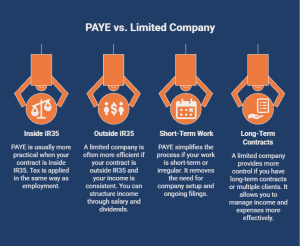
Before choosing between PAYE and a limited company, focus on the conditions that directly affect how you will be taxed and paid. The decision is driven by contract status, income level, and how much administration you are prepared to manage.
Use these scenarios to guide your decision:
- If your contract is inside IR35, PAYE is usually more practical.
Tax is applied in the same way as employment, so operating through a limited company offers little financial advantage. - If your contract is outside IR35 and income is consistent, a limited company is often more efficient.
You can structure income through salary and dividends, which may improve overall take-home pay. - If your work is short-term or irregular, PAYE simplifies the process.
It removes the need for company setup, ongoing filings, and administrative overhead. - If you have long-term contracts or multiple clients, a limited company provides more control.
It allows you to manage income, expenses, and financial planning more effectively.
Rather than focusing on one option as better, the decision should be based on how your contracts are structured and whether the financial benefit outweighs the administrative responsibility.
What Is PAYE and How Does It Work?
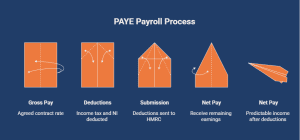
PAYE (Pay As You Earn) is the UK system where income tax and National Insurance contributions are deducted from your earnings before you receive your pay. It is the standard payroll method used by employers to ensure tax compliance.
How Does PAYE Work?
- You are paid through an employer, such as a recruitment agency or an umbrella company
- Your gross pay is calculated based on your agreed contract rate
- Income tax and National Insurance are deducted automatically through payroll
- The employer submits these deductions directly to HMRC
- You receive your net pay after all deductions are applied
- Payslips and payroll records are generated for each pay period
- You may receive statutory benefits such as holiday pay or sick pay, depending on your employment arrangement
What this means for you:
- No need to manage tax calculations or filings
- Predictable income after deductions
- Lower administrative responsibility and compliance risk
PAYE provides a structured approach where tax and reporting are handled through payroll, making it a practical option for contractors who prefer simplicity over financial control.
What Is a Limited Company and How Does It Work?
A limited company is a separate legal structure where income is earned by the business rather than you personally, allowing you to control how that income is taxed and distributed.
For contractors, this means operating as a business entity that invoices clients and manages its own finances, rather than being paid through payroll.
How Does a Limited Company Work?
- You register a company with Companies House and act as its director
- The company invoices clients and receives payments into a business account
- Company income is treated as profit, not personal salary
- Corporation Tax is paid on company profits
- You withdraw income through a combination of salary and dividends
- Allowable business expenses are deducted before tax is calculated
- You must file annual accounts and tax returns with HMRC and Companies House
- Liability is limited to the company, protecting personal assets
What this means for you:
- You can structure income to reduce National Insurance through dividends
- Tax efficiency becomes more relevant at higher and consistent income levels
- The financial benefit depends on income after costs such as accountancy and compliance
- You are responsible for ongoing reporting, record-keeping, and deadlines
A limited company gives you control over income and tax structure, but the advantage depends on maintaining sufficient earnings and managing the administrative requirements effectively.
What Are the Key Differences Between PAYE and LTD?
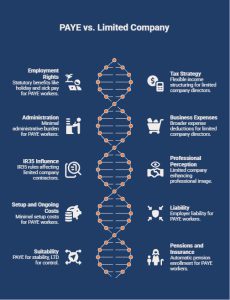
Understanding the differences between PAYE and a limited company goes beyond simple definitions. Each structure affects how you are paid, taxed, and managed, along with the level of responsibility you take on. These differences shape your financial outcomes, compliance requirements, and overall approach to work.
The sections below break down each key area, helping you compare the two options clearly and make a more informed decision.
1. Employment Rights
PAYE workers automatically receive statutory employment rights, including holiday pay, sick pay, and parental leave, as these are provided and managed by the employer through the payroll system.
In contrast, limited company directors are not entitled to these benefits by default. They must arrange their own protections, such as insurance or income cover, which adds both cost and administrative responsibility.
2. Tax Strategy
Under PAYE, income tax and National Insurance contributions are deducted automatically from each payment, leaving little scope for tax planning or adjustment.
In contrast, limited company directors can structure how they take income, typically combining a modest salary with dividend payments. Because dividends are taxed differently, this approach can improve overall take-home pay, particularly for contractors operating outside IR35.
3. Administration
Under PAYE, administration is minimal because the employer or agency manages payroll, tax deductions, and reporting, ensuring compliance with HMRC requirements.
In contrast, running a limited company involves ongoing administrative responsibilities, including maintaining financial records, filing annual accounts, submitting corporation tax and personal tax returns, and ensuring all reporting obligations are met on time.
4. Business Expenses
Under PAYE, expense claims are limited to specific work-related costs that are not reimbursed by the employer, and strict rules apply to what qualifies.
In contrast, a limited company can deduct a broader range of allowable business expenses, such as travel, equipment, and training, directly from its profits. This reduces the company’s taxable income and can improve overall net earnings.
5. IR35 Influence
Under PAYE, IR35 does not apply because you are already taxed as an employee through payroll. For limited company contractors, each contract must be assessed against IR35 rules. If a contract falls within IR35, income is taxed in the same way as employment income, reducing the tax advantages of operating through a company. If it falls outside IR35, you retain the ability to structure income more efficiently, but each engagement requires careful review to ensure compliance.
6. Professional Perception
Operating through a limited company can position you as a separate business entity, which may appeal to clients seeking independent contractors and can support access to higher-value or longer-term engagements.
In contrast, PAYE workers are generally treated as employees for contractual and tax purposes, which may limit opportunities with clients that prefer to engage directly with businesses or company-based contractors.
7. Setup and Ongoing Costs
Under PAYE, there are no setup costs, and ongoing expenses are minimal, as payroll, tax deductions, and reporting are handled by the employer or agency. If you use an umbrella company, a small margin is typically charged for these services.
In contrast, operating through a limited company involves initial incorporation costs, ongoing accountancy fees, insurance, and administrative expenses. These costs need to be factored into your overall financial planning.
8. Liability
Under PAYE, you are employed by an organisation, so any business risks or liabilities sit with the employer, and your personal assets are not affected if the business faces financial difficulty.
In contrast, a limited company provides limited liability, meaning your personal assets are protected, and your exposure is generally limited to your investment in the company. However, the company itself is responsible for its debts and operational risks, which must be managed carefully.
9. Suitability
PAYE is suited to contractors who prefer stability, straightforward administration, and access to statutory employment benefits. It works well for short-term roles or for those who want a low-maintenance arrangement with minimal responsibility for tax and compliance.
A limited company is better suited to experienced contractors working on higher-value or longer-term engagements, particularly those with multiple clients. It offers greater control over income and expenses, along with potential tax efficiency, but requires ongoing management and compliance with reporting obligations.
10. Pensions and Insurance Arrangement
Under PAYE, workers are typically automatically enrolled in a workplace pension, with contributions managed through payroll, and may also benefit from employer-arranged insurance schemes.
In contrast, limited company directors must set up their own pension arrangements and organise any required insurance cover independently. While this allows greater flexibility, it also entails additional costs and responsibilities.
Together, these differences provide a clear comparison of PAYE and LTD, helping you understand which structure aligns best with your financial goals and working preferences.
How Do PAYE and LTD Compare Financially?
The financial difference between PAYE and a limited company depends on how income is taxed, structured, and distributed. PAYE offers predictable earnings after deductions, while a limited company allows more control over how income is taken, which can influence overall take-home pay.
The table below highlights the key financial differences between PAYE and a limited company.
| Financial Factor | PAYE | Limited Company |
|---|---|---|
| Tax Treatment | Income tax and National Insurance are deducted automatically | Corporation tax on profits, then personal tax on salary/dividends |
| Take-Home Pay | Fixed after deductions, limited flexibility | Potentially higher through small salary and dividends |
| National Insurance | Applied to full earnings | Not applied to dividends |
| Income Control | No control over how income is structured | Full control over salary and dividend split as a director of a limited company |
| Tax Planning | Minimal flexibility | Greater scope for tax efficiency with planning |
The comparison shows how PAYE prioritises simplicity, while a limited company offers flexibility in managing income and tax.
Real Example: PAYE vs LTD Earnings
To understand the actual difference, consider a contractor earning £400 per day (£8,000 per month).
Scenario 1: Inside IR35 (PAYE)
- Gross monthly income: £8,000
- Income tax + National Insurance: approx. £2,800–£3,200
- Estimated take-home pay: £4,800–£5,200
Tax is applied like employment income, leaving a limited scope for optimisation.
Scenario 2: Outside IR35 (Limited Company)
- Gross monthly income: £8,000
- Corporation tax (approx. 19–25% on profit)
- Salary + dividend structure applied
- Lower National Insurance exposure
- Estimated take-home pay: £5,500–£6,200 (after costs)
Tax efficiency improves through dividends, but it depends on expenses, accountancy fees, and compliance costs.
Overall, PAYE provides predictable income with minimal involvement, while a limited company can improve take-home pay when operating outside IR35 and earning at a level where the additional costs are justified.
What Are the Pros and Cons of PAYE vs LTD?
Choosing between PAYE and a limited company involves understanding the trade-offs between simplicity, control, and financial outcomes. Each structure offers clear advantages but also comes with limitations that affect how income is taxed, managed, and reported over time.
PAYE: What You Gain vs What You Lose
- You gain:
- Simple setup with no need to manage tax or filings
- Predictable income after deductions
- Access to statutory benefits (depending on employment arrangement)
- You lose:
- Ability to structure income for tax efficiency
- Opportunity to increase take-home pay at higher earnings
- Control over how and when income is withdrawn
This works best if your contracts are inside IR35 or you prefer minimal administration and lower risk.
Limited Company: What You Gain vs What You Lose
- You gain:
- Control over income through salary and dividends
- Potential for higher net income, especially outside IR35
- Ability to claim business expenses and manage finances actively
- You lose:
- Time spent on administration, filings, and compliance
- Additional costs such as accountancy, insurance, and company setup
- Automatic access to employment benefits
This works best if your contracts are outside IR35, income is consistent, and the financial benefit outweighs the added responsibility.
Trade-Off Summary
- You gain simplicity with PAYE, but lose flexibility
- You gain control with a limited company, but take on responsibility
- You gain tax efficiency with LTD, but only when income and contract structure support it
In practice, the right choice depends on whether the financial gain from a limited company justifies the added cost and administration, or whether the simplicity of PAYE better suits your working model.
When Should You Choose PAYE or a Limited Company?
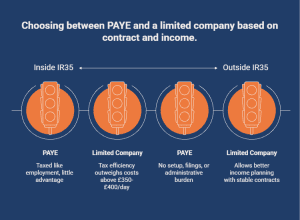
Choosing between PAYE and a limited company depends on how your contracts are structured, how much you earn, and whether the financial benefit justifies the added responsibility. The decision becomes clearer when you apply practical thresholds rather than general comparisons.
Final Decision Framework
Use these thresholds to decide:
- If your contract is inside IR35, PAYE is usually the better option
Income is taxed like employment, so a limited company offers little advantage - If your contract is outside IR35 and you earn above £350–£400 per day, a limited company becomes more viable
This is where tax efficiency can begin to outweigh accountancy and compliance costs - If your work is short-term or inconsistent, PAYE reduces complexity
No setup, filings, or ongoing administrative burden - If your contracts are long-term and stable, a limited company allows better income planning
Particularly when working with multiple clients or retaining profits
In practice, PAYE is the safer choice when income or contract status is uncertain, while a limited company becomes more effective when earnings are stable, contracts are outside IR35, and the financial gain outweighs the additional responsibility.
How Can Direct Payroll Services Help?
Direct Payroll Services takes the stress out of managing PAYE and LTD finances. Our experts handle all your payroll, tax, and compliance needs, ensuring your deductions, submissions, and payments are accurate and on time.
Why Choose Us?
- Acts like a one-stop accountant, handling payroll, tax affairs, and National Insurance for PAYE and LTD contractors.
- Manages VAT, self-assessment, and CIS filings for limited companies.
- Takes care of invoicing and payment tracking so you never miss a payment.
- Keeps you compliant and up to date with all HMRC regulations.
- Saves you time by taking over the admin and paperwork.
Want payroll done right and worry-free? Contact Direct Payroll Services today for a free consultation and get back to focusing on your business.
Conclusion
Choosing between PAYE and a limited company is not about identifying a single better option, but understanding which structure aligns with your working style and financial goals. PAYE offers consistency, reduced risk, and minimal administrative involvement, making it suitable for contractors who prioritise simplicity. A limited company provides greater flexibility and potential financial benefits, but requires active management and compliance.
The most effective approach is to assess your contract type, income level, and IR35 status before making the best option for your decision. By evaluating both the financial impact, including potential tax savings, and the level of responsibility involved, you can select a structure that supports both your short-term needs and long-term contracting strategy.
Frequently Asked Questions
Is it possible to switch from PAYE to a limited company, and how does it affect earnings?
Yes, you can switch from PAYE to your own limited company by setting up a company and contracting independently. Earnings may increase through tax-efficient salary and dividend structures, but this depends on income level, IR35 status, and added administrative costs.
What is the role of umbrella companies in PAYE vs limited company setups?
Umbrella companies act as intermediaries, employing contractors under PAYE while allowing them to work on multiple contracts, ultimately servicing long term relationships with the end client. They handle payroll, tax deductions, and compliance, offering a middle option between the simplicity of PAYE and the administrative responsibilities of a limited company.
How can I choose between PAYE and a limited company for my business needs in the UK?
Choose based on your income, contract type, and willingness to manage administration as UK contractors do. PAYE suits short-term or low-maintenance work, while a limited company suits higher, stable earnings and independent contracting, especially if you can manage pension contributions, compliance, and operate outside IR35.
Are there any changes expected in 2025 regarding agency PAYE versus limited company options for contractors?
Yes, there are no single major reforms that completely change PAYE vs Ltd decisions in 2025, but several important regulatory and tax updates are shaping how contractors choose between the two.
Is it more tax-efficient to work through a limited company or under PAYE?
A limited company can be more tax-efficient than PAYE, as income can be structured through salary and dividends, which are taxed at a lower rate differently. However, the main advantages depend on income level, IR35 status, and costs, while PAYE offers simpler, fixed taxation.