
Key Highlights
- Payroll outsourcing cost in the UK can commonly range from around £4 to £12 per employee per month, although actual pricing varies by provider and service.
- Providers may charge per employee, per payslip, per payroll run, through a fixed monthly fee, or using bespoke pricing.
- Employee numbers, payroll frequency, complexity, and the level of support required can affect the total cost.
- Setup, additional payroll runs, corrections, pension administration, integrations, and other services may cost extra.
- Weekly payroll may cost more than monthly payroll because it involves more processing cycles.
- Compare the total annual cost and services included rather than relying only on the advertised monthly or per-employee rate.
- Direct Payroll Services provides flexible payroll outsourcing support for UK businesses with different workforce and payroll requirements.
Managing payroll in-house involves more than paying for payroll software. Staff time, training, compliance responsibilities, payroll administration, and maintaining internal expertise can all contribute to the true cost, making it difficult to know whether outsourcing offers better value.
So, how much does it cost to outsource payroll in the UK? Payroll outsourcing can commonly cost around £4 to £12 per employee per month, although actual fees vary by provider. Employee numbers, pay frequency, payroll complexity, and whether you choose part-managed or fully managed support can all affect the final price.
In this guide, we break down payroll outsourcing costs in the UK, including common pricing models, services typically included, potential additional charges, and example costs for different workforce sizes. We also explain how to calculate the true cost and compare outsourcing with managing payroll in-house.
How Is Payroll Outsourcing Usually Priced?
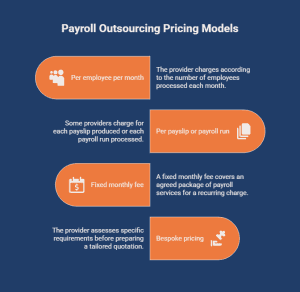
Payroll outsourcing is commonly priced per employee, per payslip or payroll run, through a fixed monthly fee, or using bespoke pricing. The model used can affect how your costs change as employee numbers or payroll requirements grow.
1. How Does Per Employee Per Month Pricing Work?
Under a per employee per month (PEPM) model, the provider charges according to the number of employees processed each month.
For example, at £6 per employee, payroll for 30 employees would cost £180 per month. Some providers may offer lower per-employee rates at higher volumes.
2. How Does Per Payslip or Payroll Run Pricing Work?
Some providers charge for each payslip produced or each payroll run processed. Businesses running weekly payroll may therefore pay more over the year than those running monthly payroll because there are more processing cycles.
Additional or off-cycle payroll runs may also carry separate charges.
3. How Does Fixed Monthly Payroll Pricing Work?
A fixed monthly fee covers an agreed package of payroll services for a recurring charge. This can make costs easier to predict, particularly for businesses with relatively stable employee numbers.
Services outside the agreed package may still cost extra.
4. When Is Bespoke Payroll Pricing Used?
Bespoke pricing may apply to businesses with more complex requirements, such as multiple PAYE schemes, different pay frequencies, specialist reporting, or HR and accounting system integrations.
The provider assesses these requirements before preparing a tailored quotation.
| Pricing Model | How It Works | May Suit |
|---|---|---|
| Per employee per month | Based on employees processed | Growing businesses |
| Per payslip/payroll run | Based on payslips or processing cycles | Predictable payrolls |
| Fixed monthly fee | Set fee for an agreed package | Smaller, stable workforces |
| Bespoke pricing | Tailored to specific requirements | Complex payrolls |
When comparing the cost to outsource payroll, look at what each pricing model includes rather than choosing a provider based solely on the headline rate.
Wondering what you actually gain by handing payroll over to a specialist? Discover how outsourced payroll services work and what they can offer your business.
What Does the Cost of Outsourcing Payroll Include?
The cost of outsourcing payroll usually covers the core processing and reporting tasks required to pay employees and manage routine payroll obligations. However, exactly what is included varies between providers and service packages.
A typical payroll outsourcing service may include:
- Payroll calculations: Calculating gross pay, deductions, and net pay.
- Payslips: Preparing and issuing employee payslips.
- PAYE and National Insurance: Calculating applicable Income Tax and National Insurance deductions.
- HMRC reporting: Completing Real Time Information (RTI) submissions, including Full Payment Submissions (FPS) and Employer Payment Summaries (EPS), where applicable.
- Statutory payments: Processing eligible statutory payments, including Statutory Sick Pay and statutory parental pay.
- Employee changes: Processing starters, leavers, salary changes, bonuses, and other adjustments.
- Payroll records and reports: Maintaining payroll information and providing routine reports.
- P45s and P60s: Preparing relevant payroll documents for employees and leavers.
Some providers may charge separately for workplace pension administration, additional payroll runs, bespoke reports, historical corrections, integrations, or payment services. Before comparing outsourced payroll costs, check the service schedule alongside the quotation so you know exactly what the regular fee covers.
What Factors Affect Payroll Outsourcing Cost?
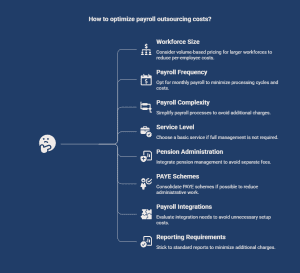
Payroll outsourcing cost depends on your workforce size, pay frequency, payroll complexity, service level, and other processing requirements. Providing accurate information about your payroll helps providers prepare a more relevant quotation.
1. How Does the Number of Employees Affect Cost?
A larger workforce generally means more payroll records to process. Total costs may therefore increase with employee numbers, although some providers may offer volume-based pricing that reduces the average cost per employee.
2. Does Payroll Frequency Affect the Price?
Yes. Weekly or fortnightly payroll involves more processing cycles than monthly payroll, which can increase the overall cost of outsourcing payroll.
3. Does Payroll Complexity Increase Costs?
Variable hours, overtime, bonuses, commissions, multiple pay rates, benefits, and frequent employee changes can require additional processing and checks, potentially increasing the price.
4. Does the Level of Payroll Support Affect Cost?
A basic processing service generally costs less than a fully managed service because fewer responsibilities are transferred to the provider. The wider the service scope, the more the quotation may increase.
5. Can Pension Administration Affect Payroll Costs?
Yes. Workplace pension assessments, contributions, enrolment changes, and related administration may increase costs when they are not included within the standard payroll package.
6. Do Multiple PAYE Schemes Affect Pricing?
Businesses operating several PAYE schemes may require separate payroll processing, submissions, and records, which can increase the administrative workload and affect pricing.
7. Can Payroll Integrations Affect the Cost?
Integrating payroll with HR, accounting, time-tracking, or other business systems may involve setup or ongoing work depending on the provider and systems involved.
8. Can Additional Reporting Increase Payroll Costs?
Standard reports may be included, while bespoke reports, departmental breakdowns, or other detailed reporting requirements may involve additional work and charges.
Understanding these factors can help you provide more accurate information when requesting quotes and compare payroll outsourcing costs in the UK more effectively.
Thinking about outsourcing your payroll? Discover how outsourced payroll services can reduce admin and support your business.
Are There Any Additional or Hidden Payroll Outsourcing Costs?
Yes, some payroll services may involve charges beyond the regular processing fee. These are not necessarily hidden costs, but they can increase the total price if they are not included in your agreed payroll package.
Potential additional costs include:
- Setup and migration: Transferring employee and payroll data to the new provider.
- Additional payroll runs: Processing unscheduled or supplementary pay runs.
- Late corrections: Making changes after the agreed payroll cut-off.
- Pension administration: Managing pension assessments, contributions, and related administration.
- Year-end services: Completing certain year-end payroll tasks and documentation.
- Bespoke reports: Producing reports outside the standard reporting package.
- Employee payments or BACS: Facilitating salary payments where this is offered as an additional service.
- Software integrations: Connecting payroll with HR, accounting, or time-recording systems.
- Historical corrections: Correcting payroll records from previous pay periods.
- Exit or data transfer fees: Providing data or migration support when changing payroll providers.
Before signing an agreement, ask for an itemised quotation showing what is included in the regular fee and what may be charged separately. This provides a clearer picture of the total cost of outsourcing payroll services.
How Much Does It Cost to Outsource Payroll for Different Business Sizes?
The cost to outsource payroll generally increases with employee numbers, although the exact price depends on the provider, pricing model, and payroll requirements. Using an illustrative rate of £6 per employee per month (PEPM) shows how costs could scale:
| Employees | Example PEPM | Indicative Monthly Cost | Indicative Annual Cost |
|---|---|---|---|
| 5 | £6 | £30 | £360 |
| 25 | £6 | £150 | £1,800 |
| 50 | £6 | £300 | £3,600 |
| 100 | £6 | £600 | £7,200 |
For example, a business with 50 employees paying £6 PEPM would spend approximately £300 per month or £3,600 per year on payroll processing.
These figures are illustrative only and are not Direct Payroll Services prices. Actual quotations depend on payroll complexity, services included, minimum charges, and additional requirements. Request a tailored quote to understand the likely cost for your business.
Think you know how payroll really works? Discover common payroll myths and the facts businesses should know.
Does Weekly Payroll Cost More Than Monthly Payroll?
Yes, weekly payroll will generally cost more to outsource than monthly payroll when pricing is affected by the number of processing cycles. Weekly payroll can involve up to 52 regular runs each year, compared with 12 for monthly payroll.
Each run can involve collecting payroll information, calculating pay, completing relevant submissions, and producing payroll records. More frequent processing can therefore increase the annual payroll outsourcing cost.
| Factor | Weekly Payroll | Monthly Payroll |
|---|---|---|
| Payroll runs | Up to 52 per year | 12 per year |
| Processing frequency | Higher | Lower |
| Changes and submissions | More frequent | Less frequent |
| Likely outsourcing cost | Generally higher | Generally lower |
The exact difference depends on the provider’s pricing model. If you run weekly payroll, check whether charges are based on each payroll run, each payslip, employee numbers, or another agreed pricing method.
Is Fully Managed Payroll More Expensive Than Part-Managed Payroll?
Yes, fully managed payroll will generally cost more than part-managed payroll because the provider takes responsibility for a wider range of payroll tasks. However, the higher fee may reduce the amount of payroll administration your internal team needs to handle.
| Feature | Part-Managed Payroll | Fully Managed Payroll |
|---|---|---|
| Payroll calculations | ✓ | ✓ |
| HMRC submissions | Depends on service | ✓ |
| Pension administration | Depends on service | Often available |
| Employee payroll queries | Usually handled internally | May be provider-managed |
| Internal workload | Higher | Lower |
| Typical cost | Lower | Higher |
Part-managed payroll may suit businesses that have internal payroll expertise but want support with specific processing tasks. Fully managed payroll may be more suitable when you want to transfer a greater share of day-to-day payroll administration to an external provider.
When comparing the cost of outsourcing payroll services, consider the responsibilities included in each package rather than comparing the headline price alone.
Supporting clients with payroll? Discover how payroll outsourcing for accountants can reduce administration and streamline payroll management.
Is Outsourcing Payroll Cheaper Than Managing It In-House?
Outsourcing payroll can cost less than managing it internally, but this depends on your workforce, payroll complexity, and existing resources. A fair comparison should include the full cost of running payroll in-house, not just payroll software or an employee’s processing time.
| Cost Area | In-House Payroll | Outsourced Payroll |
|---|---|---|
| Payroll staff | Salary or employee time | Provider fee |
| Payroll software | Licences, maintenance, and updates | Often included within the service |
| Training | Ongoing staff training | Generally handled by provider |
| Staff absence | Internal cover may be required | Service continuity provided |
| Compliance administration | Managed internally | Provider support within agreed scope |
| IT and payroll systems | Maintained internally | Provider manages its payroll systems |
| Payroll corrections | Uses internal staff time | May be included or charged separately |
| Setup and integrations | Internal implementation costs | Setup or integration fees may apply |
For example, an in-house payroll may appear cheaper when only the software subscription is considered. However, employee time, training, system maintenance, absence cover, and payroll administration can significantly affect the actual annual cost.
The most useful approach is to calculate the total annual cost of each option. Compare your complete in-house payroll expenses with the provider’s annual fees, including setup and additional charges, to determine which approach better suits your business.
How Can You Calculate the True Cost of Outsourcing Payroll?
To calculate the true cost of outsourcing payroll, combine the regular provider fee with any monthly add-ons and annual charges. This gives you a more accurate figure than comparing advertised monthly or per-employee rates alone.
What Is the Effective Monthly Payroll Outsourcing Cost?
Use this formula:
Monthly provider fee + monthly add-ons + (annual fees ÷ 12) = effective monthly outsourcing cost
For example, suppose a business with 25 employees pays:
- £150 monthly provider fee
- £20 in monthly add-ons
- £240 in annual fees
The calculation would be:
£150 + £20 + (£240 ÷ 12) = £190 per month
How Do You Calculate Payroll Outsourcing Cost Per Employee?
Once you know the effective monthly cost, divide it by the number of employees:
Effective monthly outsourcing cost ÷ number of employees = effective payroll cost per employee
Using the example above:
£190 ÷ 25 employees = £7.60 per employee per month
Calculating the effective cost in this way makes it easier to compare payroll providers on a like-for-like basis and understand the total amount your business is likely to spend.
How Can You Reduce the Cost to Outsource Payroll?
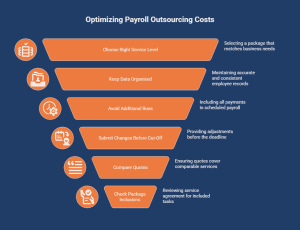
You can help control payroll outsourcing costs by choosing the right service level, keeping payroll data organised, meeting processing deadlines, and avoiding unnecessary additional work. The aim should be to get the support you need without paying for services your business does not use.
1. How Can Choosing the Right Service Level Reduce Costs?
Choose a package that reflects the responsibilities you actually want to outsource. If your team can manage certain payroll tasks internally, you may not need a fully managed service.
2. Why Should You Keep Payroll Data Organised?
Maintain accurate employee records and provide payroll information in a consistent format. This can reduce unnecessary queries and corrections during processing.
3. How Can You Avoid Additional Payroll Runs?
Where practical, include bonuses, commissions, adjustments, and other payments in your scheduled payroll rather than requesting separate or emergency runs that may cost extra.
4. Why Should You Submit Payroll Changes Before the Cut-Off?
Provide starters, leavers, overtime, salary changes, and other adjustments before the provider’s agreed deadline. Late changes may require additional processing and could result in extra charges.
5. Why Should You Compare Like-for-Like Payroll Quotes?
Make sure competing quotes cover comparable services. A lower headline price may exclude tasks that another provider includes within its regular fee.
6. Why Should You Check What Your Payroll Package Includes?
Review your service agreement before requesting additional work. Routine reports or administration may already be included in your package.
7. When Should You Review Your Payroll Service?
Review your package as employee numbers, pay frequencies, or payroll requirements change. This helps ensure you are still paying for a service level that matches your business needs.
Regularly reviewing your payroll requirements and provider fees can help keep outsourced payroll costs under control without reducing the support your business needs.
Are your payroll records accurate and up to date? Learn what payroll records employers need to keep and why good record-keeping matters.
What Should You Check When Comparing Payroll Outsourcing Quotes?
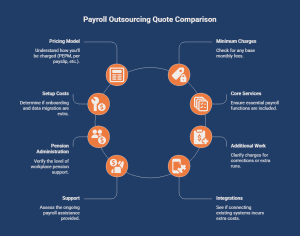
When comparing quotes, look beyond the headline price and check:
- Pricing model: PEPM, per payslip, per payroll run, or fixed fee.
- Minimum charges: Whether a minimum monthly fee applies.
- Setup: Whether onboarding and data migration cost extra.
- Core services: Whether RTI submissions, P45s, P60s, and routine reports are included.
- Pension administration: What workplace pension support is covered.
- Additional work: Charges for corrections or extra payroll runs.
- Support: What ongoing payroll assistance is included.
- Integrations: Whether connecting existing systems costs extra.
Compare the complete service and annual cost to understand which quote best matches your payroll requirements.
When Is Payroll Outsourcing Worth the Cost?
Payroll outsourcing may be worth the cost when managing payroll internally takes significant time, expertise, or resources away from other business priorities.
It may be worth considering when:
- Payroll takes too much internal time.
- Your workforce is growing.
- You run weekly or complex payrolls.
- Internal payroll expertise is limited.
- Payroll errors require frequent corrections.
- You need greater continuity during staff absence or turnover.
Consider the cost alongside the time saved, expertise provided, and reduction in internal administration when deciding whether outsourcing suits your business.
How Can Direct Payroll Services Help With Payroll Outsourcing?
Direct Payroll Services supports UK businesses with flexible payroll outsourcing tailored to their workforce and requirements. Services include managed payroll, small business payroll, payroll for accountants, CIS payroll, and directors’ payroll.
Whether you need support with routine payroll processing or a more comprehensive managed service, the level of support can be matched to your business needs.
Want to know what payroll outsourcing could cost your business? Contact Direct Payroll Services to discuss your requirements and request a tailored quotation.
Conclusion
Payroll outsourcing costs vary depending on employee numbers, pay frequency, payroll complexity, service level, and additional requirements. The headline price alone does not show the full cost, so check what each package includes and whether additional fees apply.
Compare providers on a like-for-like basis, calculate the total annual cost, and choose a service that provides the right level of payroll support for your business.
Frequently Asked Questions
How do UK payroll providers set their prices?
UK payroll providers use different pricing structures, including per employee, per payslip, fixed monthly fees, and bespoke pricing. Key factors include team size, pay frequency, the complexity of your payroll, and the level of service required.
Does payroll outsourcing include pension contributions?
A payroll service provider may calculate and process employee and employer pension contributions as part of a managed payroll service. However, pension administration or additional support for your pension plan may carry an extra cost depending on the package.
Can payroll outsourcing work with accounting software?
Yes. Some payroll companies can integrate payroll processes with compatible accounting software, HR systems, or time-recording platforms. Availability and costs vary, so ask whether HR integration or other system connections are included in the quoted price.
Can small business owners outsource basic payroll?
Yes. Business owners can outsource basic payroll tasks such as payroll calculations, payslips, HMRC reporting, and National Insurance contributions. The appropriate service depends on team size, internal resources, and the complexity of your payroll.
Can outsourcing reduce the risk of payroll errors?
Outsourcing can provide specialist support, structured payroll processes, and compliance checks, which may help reduce the risk of errors. However, employers still need to provide complete and accurate payroll information to their provider.
Do I need a dedicated HR or payroll team if I outsource payroll?
Not necessarily. A managed payroll service can reduce the administrative tasks handled by an internal payroll team or dedicated HR function. However, businesses still need appropriate internal processes for supplying employee changes and approving payroll payments.
Do payroll outsourcing costs include employer National Insurance?
No. Employer National Insurance contributions are an employment cost rather than the provider’s payroll processing fee. When comparing the overall cost of payroll, separate statutory employment costs from fees charged by the payroll company.
Are advanced payroll features more expensive?
They can be. Advanced features such as bespoke reporting, HR integration, multiple pay structures, or support for complex payroll needs may increase the price. Check which features are included before choosing a payroll service provider.
How often do payroll outsourcing fees change or increase?
Payroll outsourcing fees may change when employee numbers, pay frequency, service requirements, or payroll complexity changes. Providers may also review their pricing periodically. Check your agreement for price-review terms and ask how future changes could affect your overall payroll costs.