Key Highlights
- Recruitment agencies often manage temporary workers, contractors, umbrella employees, and CIS subcontractors within the same payroll cycle.
- Weekly payroll deadlines and changing worker assignments increase reporting pressure and reduce the margin for payroll errors.
- Outsourced payroll services help agencies automate calculations, improve reporting accuracy, and reduce manual administration.
- Recruitment payroll providers support RTI submissions, CIS reporting, pension administration, and holiday pay management.
- Payroll failures such as late payments, incorrect deductions, and worker misclassification can create compliance and operational risks.
- Integrated payroll systems improve visibility across worker payments, payroll records, deductions, and client-specific reporting.
- Recruitment agencies should prioritise payroll providers with recruitment industry experience, scalable systems, and structured compliance support.
- Outsourcing payroll allows internal teams to focus more on placements, workforce management, and client relationships during periods of growth.
Recruitment agencies rarely operate with straightforward payroll structures. Between weekly payroll cycles, contractor payments, temporary workers, umbrella arrangements, and client-specific timesheets, payroll processing quickly becomes operationally demanding. Even small payroll inaccuracies can disrupt worker payments, create reconciliation issues, and place additional pressure on finance and recruitment teams already working within tight deadlines.
As agencies grow, payroll management often becomes harder to control internally. Higher placement volumes increase the complexity of PAYE calculations, RTI submissions, holiday pay accruals, pension deductions, and CIS reporting requirements. Delayed payments or reporting errors can affect contractor relationships, damage workforce trust, and expose recruitment businesses to HMRC compliance risks.
This is why many recruitment companies turn to specialist payroll services for recruitment agencies to improve operational efficiency and reduce payroll administration pressure. Outsourced payroll services help agencies manage workforce payments, maintain reporting accuracy, and support compliance across multiple worker categories. This guide explains how recruitment payroll outsourcing works, the compliance responsibilities agencies need to manage, and what businesses should look for when choosing a payroll provider.
What Are Payroll Services for Recruitment Agencies?
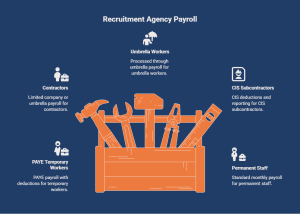
Payroll services for recruitment agencies are specialist solutions that manage worker payments, payroll deductions, compliance reporting, and contractor payroll for recruitment businesses. These services help agencies process payroll accurately across temporary workers, contractors, umbrella employees, and CIS subcontractors while meeting HMRC reporting requirements.
How Recruitment Agency Payroll Differs From Standard Payroll
Traditional payroll typically relies on fixed monthly salaries and stable employee structures. Recruitment payroll is more variable because agencies regularly manage:
- Temporary workers
- Contractors and umbrella workers
- Weekly payroll cycles
- Changing pay rates and assignments
- Multiple client billing structures
This creates a faster payroll environment where timesheet accuracy, reporting speed, and payment consistency become critical.
What Functions Do Recruitment Agency Payroll Services Handle?
Recruitment payroll providers typically manage:
- PAYE payroll processing
- Contractor and umbrella payroll
- CIS deductions and reporting
- Tax and National Insurance calculations
- Pension and holiday pay administration
- RTI submissions to HMRC
- Digital payslips and payroll reports
- Payroll record management
Many providers also integrate payroll systems with timesheet and billing software to reduce manual processing errors.
Which Types of Workers Do Recruitment Agencies Typically Manage?
Recruitment agencies often process payroll for several worker categories at the same time.
| Worker Type | Payroll Structure |
|---|---|
| PAYE Temporary Workers | PAYE payroll with deductions |
| Contractors | Limited company or umbrella payroll |
| Umbrella Workers | Processed through umbrella payroll |
| CIS Subcontractors | CIS deductions and reporting |
| Permanent Staff | Standard monthly payroll |
Managing multiple worker types within the same payroll cycle increases reporting complexity and compliance responsibilities, particularly for growing recruitment businesses.
Why Does Recruitment Payroll Become Difficult to Manage?
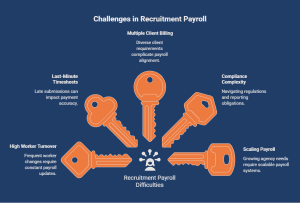
Recruitment payroll becomes difficult when agencies must manage rapid workforce changes, client-specific requirements, and growing administrative demands without disrupting payment accuracy or compliance.
As agencies scale, payroll teams often face operational challenges that extend beyond basic payroll processing. Frequent worker movement, changing assignment details, and increasing reporting obligations can place significant pressure on internal systems and resources.
1. High Worker Turnover
Recruitment agencies regularly onboard and offboard workers across multiple assignments. New starters, contract extensions, and worker departures require constant updates to payroll records, tax information, and payment details.
Without structured processes, frequent workforce changes can increase administrative workload and create opportunities for payroll errors.
2. Last-Minute Timesheets and Payroll Changes
Payroll deadlines often coincide with late timesheet approvals, overtime adjustments, and assignment changes. Even minor updates submitted shortly before payroll processing can affect payment calculations and reporting accuracy.
When payroll relies on manual intervention, these last-minute changes become harder to manage consistently.
3. Multiple Client Billing Structures
Many recruitment agencies support clients with different pay rates, approval workflows, and invoicing requirements. Payroll records must align accurately with client billing data to ensure workers are paid correctly and invoices reflect agreed rates.
As client portfolios expand, maintaining this accuracy becomes increasingly challenging.
4. Compliance Complexity
Recruitment agencies must manage RTI submissions, pension contributions, holiday pay calculations, worker classifications, and payroll reporting simultaneously. These responsibilities become more demanding when agencies process high volumes of temporary workers and contractors.
Keeping pace with changing regulatory requirements also requires ongoing oversight and attention to detail.
5. Scaling Payroll During Growth
Payroll processes that work effectively for a smaller agency may struggle to support larger workforce volumes. More placements often mean more reporting requirements, worker records, payment calculations, and client-specific administration.
Without scalable systems and structured payroll support, payroll operations can quickly become a bottleneck to business growth.
How Do Outsourced Payroll Services Solve Recruitment Payroll Challenges?
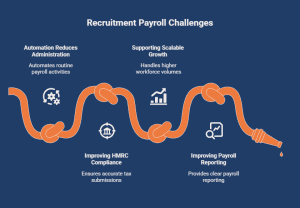
Outsourced payroll services help recruitment agencies reduce administrative pressure, improve reporting accuracy, and manage compliance more efficiently through automated systems and structured payroll processes.
As placement volumes grow, many agencies struggle to manage contractor payments, timesheets, RTI submissions, and payroll reporting internally. Outsourcing replaces manual workflows with dedicated systems designed to handle high-volume recruitment and payroll more consistently.
1. How Automation Reduces Payroll Administration
Manual payroll processes often require teams to spend significant time collecting timesheets, calculating deductions, answering payroll queries, and managing reporting deadlines. As worker volumes increase, these tasks can quickly become difficult to manage efficiently.
Outsourced payroll providers use automated systems to handle routine payroll activities, including:
- PAYE and contractor payments
- Tax and National Insurance calculations
- Holiday pay and pension deductions
- CIS adjustments and reporting
- Payslip generation and payroll records
By reducing manual intervention, agencies can process payroll more efficiently while allowing finance and operations teams to focus on recruitment activity, client relationships, and workforce management.
2. Improving HMRC Compliance and Reporting Accuracy
Recruitment agencies must manage RTI submissions, tax code updates, pension deductions, and CIS reporting accurately to remain compliant.
Outsourced payroll providers use updated systems and structured reporting processes to reduce filing errors and missed deadlines.
3. How Outsourced Payroll Supports Compliance
| Compliance Area | How Outsourcing Helps |
|---|---|
| RTI Reporting | Supports accurate and timely HMRC submissions |
| CIS Reporting | Manages subcontractor deductions and returns |
| Tax Code Updates | Applies updated HMRC tax codes automatically |
| Year-End Reporting | Handles P60s and payroll documentation |
4. Supporting Scalable Recruitment Growth
Payroll complexity often increases alongside recruitment growth. More placements create additional reporting requirements, worker payments, deductions, and client-specific payroll administration.
Outsourced payroll systems are designed to handle higher workforce volumes without increasing internal payroll workload significantly. This helps agencies scale operations more efficiently while maintaining payroll consistency.
5. Improving Payroll Reporting and Visibility
Recruitment agencies need clear payroll reporting to monitor labor costs, contractor payments, and client profitability accurately.
Outsourced payroll systems provide better visibility through:
- Digital payroll reporting
- Payment tracking
- Workforce summaries
- Audit-ready payroll records
- Client-specific payroll reporting
Improved reporting visibility helps agencies identify discrepancies faster and maintain stronger operational control as payroll volumes increase.
How Does Recruitment Agency Payroll Outsourcing Work Step by Step?
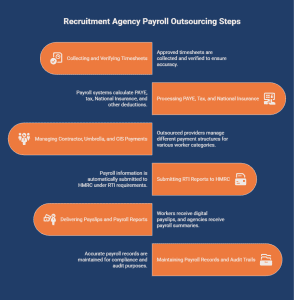
Recruitment payroll outsourcing follows a structured process that moves approved worker data through payroll calculations, compliance checks, payments, and reporting. Outsourced providers use automated systems to reduce manual administration while improving accuracy across high-volume payroll cycles.
Rather than relying on spreadsheets and disconnected workflows, outsourced payroll systems standardize each stage of the process. This becomes particularly important for agencies managing weekly payroll, contractor payments, and multiple client accounts simultaneously.
1. Collecting and Verifying Timesheets
The process usually begins with approved timesheets submitted by workers or clients. Incorrect hours, missing approvals, or late submissions are some of the most common causes of payroll delays in recruitment businesses.
Many outsourced providers use integrated timesheet systems that automatically flag missing information and reduce manual data entry. This helps payroll teams identify discrepancies before calculations begin.
2. Processing PAYE, Tax, and National Insurance
Once timesheets are verified, payroll systems calculate:
- PAYE tax and National Insurance
- Pension deductions
- Holiday pay accruals
- Overtime and adjustment payments
- Statutory deductions
Automated calculations help agencies maintain payment accuracy during high-volume payroll runs while reducing the risk of manual processing errors.
3. Managing Contractor, Umbrella, and CIS Payments
Recruitment agencies often process different payment structures within the same cycle. Outsourced providers manage contractor payroll, umbrella arrangements, and CIS deductions using separate compliance workflows for each worker category.
This is particularly important for agencies placing construction subcontractors or managing high contractor volumes across multiple assignments.
4. Submitting RTI Reports to HMRC
Under RTI requirements, payroll information must be submitted to HMRC whenever workers are paid. Agencies operating weekly payroll cycles may need to complete reporting every week.
Outsourced systems automate RTI submissions as part of the payroll process, helping agencies reduce missed deadlines and reporting inconsistencies.
5. Delivering Payslips and Payroll Reports
After payroll is processed, workers receive digital payslips while agencies receive payroll summaries, deduction reports, and client-specific payment data.
Real-time reporting also gives finance teams faster visibility into contractor costs, payroll discrepancies, and reconciliation issues during each payroll cycle.
6. Maintaining Payroll Records and Audit Trails
Recruitment agencies must maintain accurate payroll records for compliance, reporting, and audit purposes. Outsourced payroll systems store payment history, deductions, worker details, and reporting records within a structured audit trail.
This makes it easier to retrieve payroll information during HMRC reviews, worker disputes, or internal financial reconciliation processes.
Recruitment Agency Payroll Outsourcing Process:-
| Payroll Stage | What Happens | Operational Benefit |
|---|---|---|
| Timesheet Verification | Worker hours and approvals checked | Reduces payroll discrepancies |
| Payroll Calculations | PAYE, deductions, and adjustments processed | Improves payment accuracy |
| Contractor & CIS Payments | Different worker payment models managed | Supports compliance |
| RTI Reporting | Payroll data submitted to HMRC | Reduces reporting risk |
| Payroll Reporting | Payslips and summaries generated | Improves financial visibility |
What Compliance Requirements Must Recruitment Agencies Follow?
Recruitment agencies must comply with HMRC reporting rules, National Minimum Wage requirements, pension auto-enrolment regulations, GDPR obligations, and CIS rules where applicable. Failing to meet these requirements can lead to penalties, reporting issues, and worker disputes.
Key compliance responsibilities include:
- RTI Reporting: Submit payroll information to HMRC accurately and on time whenever workers are paid.
- National Minimum Wage and Holiday Pay: Ensure workers receive the correct pay rates and holiday entitlements across different assignments and working patterns.
- Pension Auto-Enrolment: Assess eligible workers, manage contributions, and maintain pension records in line with workplace pension requirements.
- GDPR and Payroll Data Protection: Protect sensitive payroll information, including worker records, bank details, and National Insurance data.
- CIS Compliance: Verify subcontractors, apply the correct CIS deductions, and maintain accurate reporting records for construction-related placements.
| Compliance Area | Primary Responsibility |
|---|---|
| RTI Reporting | Submit payroll data to HMRC |
| Holiday Pay & NMW | Manage worker pay and entitlements |
| Auto-Enrolment | Assess eligibility and pension contributions |
| GDPR | Protect payroll and worker data |
| CIS Reporting | Manage subcontractor deductions and reporting |
This approach keeps the section concise, avoids excessive detail, and gives readers a clear overview of the main payroll compliance responsibilities recruitment agencies must manage.
What Are the Benefits of Outsourced Payroll Services for Recruitment Agencies?
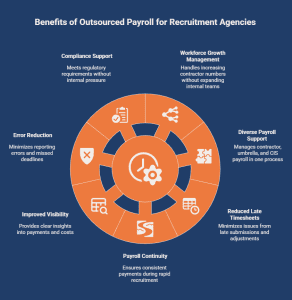
The biggest advantage of outsourced payroll is that it helps recruitment agencies manage workforce growth without increasing payroll administration at the same pace. As contractor numbers, client accounts, and reporting obligations increase, outsourced payroll provides the operational support needed to maintain consistent payment processing.
Key benefits include:
- Managing weekly payroll cycles without expanding internal payroll teams
- Supporting contractor, umbrella, and CIS payroll within the same process
- Reducing the impact of late timesheets and last-minute payroll adjustments
- Maintaining payroll continuity during periods of rapid recruitment growth
- Improving visibility across worker payments, deductions, and client costs
- Reducing the risk of reporting errors and missed payroll deadlines
- Supporting compliance requirements without increasing internal administrative pressure
For many recruitment agencies, outsourced payroll is less about reducing costs and more about maintaining operational control as workforce complexity, client demands, and reporting requirements continue to grow.
In-House vs Outsourced Payroll: What Is the Practical Difference?
Recruitment agencies often reach a stage where managing payroll internally becomes harder to sustain efficiently. As contractor volumes, compliance reporting, and weekly payroll cycles increase, internal teams may struggle to maintain the same level of accuracy and operational control without expanding administrative resources.
This is where agencies typically compare in-house payroll management with outsourced payroll services. While in-house payroll provides direct oversight, outsourced payroll offers structured systems, specialist support, and scalable processes designed to handle recruitment payroll complexity more consistently.
| Area | In-House Payroll | Outsourced Payroll |
|---|---|---|
| Payroll Management | Managed internally by finance or payroll teams | Managed by a dedicated payroll provider |
| Administrative Workload | High manual involvement in payroll processing and reporting | Reduced internal administration through automated workflows |
| Compliance Responsibility | Agency handles RTI submissions, deductions, and reporting internally | Provider manages reporting processes and compliance administration |
| Payroll Accuracy | Greater risk of manual calculation and reporting errors | Automated systems improve processing consistency |
| Scalability | Internal workload increases as placement volumes grow | Systems designed to handle higher worker volumes efficiently |
| Payroll Technology | Requires ongoing software management and updates | Payroll systems and updates are included within the service |
| Contractor & CIS Payroll | May require additional internal expertise | Structured workflows for contractor, umbrella, and CIS payroll |
| Reporting Visibility | Depends on internal reporting systems | Access to digital payroll reports and audit records |
| Data Security | Managed internally through agency systems | Secure payroll platforms with controlled data access |
| Operational Flexibility | Limited by internal team capacity | Easier to scale during recruitment growth periods |
| Risk Exposure | Agency carries full responsibility for payroll errors | Operational risk reduced through specialist payroll support |
For many recruitment businesses, outsourced payroll becomes less about reducing costs and more about maintaining operational stability, reporting accuracy, and payroll consistency as workforce complexity increases.
What Are the Most Common Payroll Failures in Recruitment Agencies?
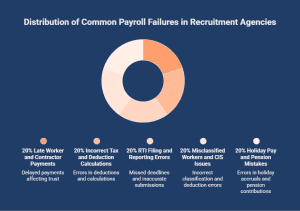
Payroll failures in recruitment agencies often result from manual processing errors, weak reporting controls, and inconsistent workforce data. These issues can disrupt worker payments, create compliance risks, and damage client relationships if they are not identified quickly.
- Late Worker and Contractor Payments: Delayed timesheets, approval backlogs, and payroll processing errors can prevent workers and contractors from being paid on time, affecting workforce trust and retention.
- Incorrect Tax and Deduction Calculations: Errors in PAYE deductions, pension contributions, overtime adjustments, holiday pay, or CIS deductions can create payroll disputes and additional reconciliation work.
- RTI Filing and Reporting Errors: Missed RTI deadlines or inaccurate payroll submissions can trigger HMRC penalties and create discrepancies in payroll records, particularly during high-volume payroll periods.
- Misclassified Workers and CIS Issues: Incorrect worker classification or CIS deduction errors can create tax complications, reporting issues, and subcontractor payment disputes.
- Holiday Pay and Pension Mistakes: Incorrect holiday accruals, missed pension enrolments, and inaccurate contribution calculations often occur when agencies manage temporary workers with irregular assignments, particularly when handling complex payroll calculations.
- Poor Payroll Communication With Workers: Limited visibility into payslips, deductions, payment dates, and payroll adjustments can increase worker queries and slow dispute resolution during busy payroll cycles.
Without structured payroll systems and reporting controls, these issues often become more difficult to manage as recruitment operations scale and workforce volumes increase.
How Can Direct Payroll Services Support Recruitment Agencies?
Direct Payroll Services helps recruitment agencies manage complex payroll operations and tax calculations through dedicated payroll support and structured reporting processes.
Key services include:
- Weekly and monthly payroll processing
- PAYE, contractor, umbrella, and CIS payroll
- RTI submissions and HMRC reporting
- Pension and holiday pay administration
- Digital payslips and payroll reporting
- Timesheet and payroll workflow support
- Secure payroll record management
- Scalable payroll support for growing agencies
Whether you’re managing temporary workers, contractors, or high-volume payroll cycles, Direct Payroll Services provides the systems and support needed to maintain accurate payments, compliance, and operational consistency.
Looking for recruitment-focused payroll support? Contact Direct Payroll Services to discuss your payroll requirements.
Conclusion
Managing payroll within a recruitment agency becomes increasingly complex as worker volumes, contractor placements, and compliance responsibilities grow. Weekly payroll cycles, changing pay structures, and the involvement of payroll professionals in RTI reporting, pension administration, and CIS deductions all place additional pressure on internal payroll processes. Without structured systems and consistent reporting controls, payroll administration can quickly become a source of operational risk.
Outsourced payroll services help recruitment firms and agencies maintain accurate worker payments, improve reporting consistency, and reduce manual administration through automated systems and specialist support. For agencies managing temporary workers, contractors, and multiple client accounts, the right payroll provider can support long-term operational stability while helping businesses maintain compliance and scale more efficiently.
Frequently Asked Questions
Can payroll services handle payments for temporary and contract workers?
Recruitment payroll services can process payments for temporary workers, contractors, umbrella employees, and CIS subcontractors while managing deductions, timesheets, RTI reporting, and compliance requirements accurately.
What are the typical costs associated with payroll services for recruitment agencies?
Payroll costs vary based on workforce size, payroll frequency, contractor numbers, CIS requirements, reporting complexity, and payroll software integration needs. Agencies managing weekly payroll cycles often require more advanced payroll software processing and compliance support.
What is the process for switching to a new payroll service provider?
Switching payroll providers usually involves transferring worker records, payroll history, tax details, and reporting data. Most providers manage onboarding, system setup, and payroll migration to minimize disruption during the transition.
What should recruitment agencies look for when choosing a payroll service provider?
Recruitment agencies should choose providers with a track record of recruitment payroll experience, contractor and CIS support, integrated payroll systems, transparent reporting, strong data security, and scalable processes capable of handling high-volume workforce payments accurately.
Do recruitment agencies need CIS payroll support?
Agencies supplying subcontractors to construction-related projects may need CIS payroll support. This includes subcontractor verification, CIS deductions, monthly reporting, and maintaining accurate payment records for HMRC compliance.
Do payroll services for recruitment agencies support compliance with UK employment laws?
Recruitment payroll services help agencies manage RTI reporting, pension auto-enrolment, holiday pay, National Minimum Wage requirements, and CIS obligations while supporting ongoing compliance with UK payroll regulations.
Are there any risks involved with outsourcing payroll for recruitment agencies?
The main risks include choosing a provider with limited recruitment payroll experience, poor reporting processes, or inadequate data security. These risks can be reduced by selecting a provider that offers professional services, strong compliance support, transparent reporting, and industry expertise.