Key Highlights
- Construction payroll services manage employees and subcontractors under CIS rules
- CIS verification, deductions, and HMRC submissions are critical for compliance
- Payroll complexity increases with project-based work and variable pay cycles
- Different service models suit different construction business sizes
- The right payroll setup reduces errors, penalties, and admin workload
- Specialist providers improve accuracy, reporting, and scalability
- Choosing the wrong system can lead to costly compliance risks
Payroll in construction has a way of getting messy fast. One week, you are paying employees as usual, the next, you are dealing with subcontractors, CIS deductions, and deadlines that are easy to miss but costly to ignore. It is not that the process is unclear. It is that it is constantly changing based on projects, people, and payment structures.
Most construction businesses are not doing anything wrong. They are just using systems that were never built for how construction payroll actually works. When you are juggling employees and subcontractors together, even small mistakes can turn into compliance issues or payment delays.
That is where construction payroll services come in. In this guide, we will break down how they work, what makes them different, and how to choose the right setup so payroll stops being a problem you have to keep fixing.
What Are Construction Payroll Services?
Construction payroll services are specialised payroll solutions that manage employee wages and subcontractor payments under the Construction Industry Scheme (CIS), including deductions and HMRC reporting.
They are designed for construction-specific payroll requirements rather than standard salary processing. The focus is on handling mixed workforces and ensuring that payments and deductions are applied correctly.
What Makes Them Different from Standard Payroll?
Construction payroll is not just about paying employees. It must handle both PAYE employees and CIS subcontractors within the same system.
What makes it different:
- Payments vary based on project work, not fixed salaries
- CIS deductions must be applied, verified, and reported to HMRC
- Subcontractor status affects tax treatment and compliance
- Payroll depends on timesheets, site approvals, and project timelines
This creates a level of variability and compliance complexity that standard payroll systems are not designed to handle.
In Practice, These Services Help Businesses:
- Process employee and subcontractor payments in one system
- Apply CIS deductions as per HMRC rules
- Maintain structured payroll records for reporting
- Reduce manual intervention in calculations
Construction payroll services are built to manage variability, not just process payments.
Why Does Construction Payroll Require A Different Approach?
The difference comes from how risk, operations, and calculations interact in construction payroll. Each layer creates a different type of challenge that standard payroll systems are not built to handle.
1. CIS And Regulatory Compliance Requirements (Legal Risk)
CIS is not just a process; it is a compliance obligation with direct financial consequences. Contractors must verify subcontractors, apply correct deduction rates, and submit monthly returns to HMRC.
What this creates:
- Risk of penalties for incorrect deductions
- Exposure during HMRC audits
- Legal consequences for late or inaccurate reporting
Even small errors can escalate into compliance issues quickly.
2. Workforce Structure Across Job Sites (Operational Confusion)
Construction payroll involves a mix of employees and subcontractors working across multiple sites. Each group follows different rules for payment and reporting.
What this creates:
- Difficulty tracking who is paid under PAYE vs CIS
- Disconnected data across job sites
- Misalignment between site activity and payroll records
Without structure, payroll becomes fragmented and hard to manage.
3. Variable Pay And Project-Based Payments (Calculation Errors)
Payments in construction are rarely fixed. They depend on hours worked, project milestones, and changing site conditions.
What this creates:
- Frequent calculation adjustments
- Higher risk of incorrect payments
- Disputes over pay accuracy
Payroll must process changing inputs without introducing errors.
Construction payroll is not just complex; it carries legal risk, operational challenges, and calculation pressure at the same time. That is what makes a different approach necessary.
How Do Construction Payroll Services Work Step By Step?
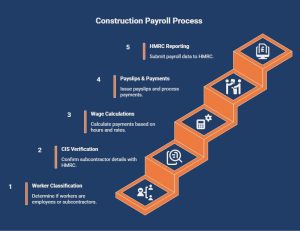
Construction payroll follows a structured process where each step directly affects compliance, accuracy, and reporting. The sequence matters because errors at any stage carry forward into payments, deductions, and HMRC submissions.
1. Worker Classification
Workers are classified as employees or subcontractors, which determines how they are taxed and reported. This is the foundation of payroll.
Why this matters: Classification decides whether PAYE or CIS rules apply.
What goes wrong: Misclassification leads to incorrect tax treatment, compliance breaches, and potential HMRC penalties.
2. CIS Verification
Subcontractors must be verified with HMRC before payment to confirm the correct deduction rate.
Why this matters: Verification ensures the correct percentage is applied from the start.
What goes wrong: Skipping or delaying verification can result in wrong deductions, rejected filings, or compliance issues during audits.
3. Wage Calculations And Payroll Processing
Payments are calculated based on hours worked, rates, and applicable deductions, including PAYE, National Insurance, and CIS.
Why this matters: This is where accuracy directly impacts what workers are paid.
What goes wrong: Incorrect inputs, missed adjustments, or manual errors lead to underpayments, overpayments, and disputes.
4. Payslips And Payments
Once processed, payments are released, and workers receive payslips or CIS deduction statements.
Why this matters: Payslips create transparency and serve as official records.
What goes wrong: Missing or unclear breakdowns lead to confusion, disputes, and lack of audit-ready documentation.
5. HMRC Reporting And Data Submission
Payroll data, including CIS returns, must be submitted to HMRC within strict deadlines.
Why this matters: Reporting keeps the business compliant and records aligned.
What goes wrong: Late or incorrect submissions result in penalties, corrections, and increased scrutiny from HMRC.
What Types Of Construction Payroll Services Can You Choose From?
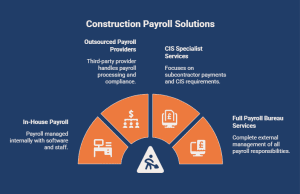
The type of payroll service you choose depends on how your business operates. Factors like workforce size, subcontractor reliance, and internal expertise influence whether you need control, support, or a fully managed solution.
1. In-House Payroll
Payroll is managed internally using software and staff resources. This offers full control over processes but requires strong knowledge of tax laws and compliance requirements. It is more suitable for smaller teams with limited payroll complexity.
2. Outsourced Payroll Providers
A third-party provider handles payroll processing, submissions, and compliance. This reduces internal workload while maintaining oversight. It is commonly used by growing businesses that need support without fully giving up control of payroll operations.
3. CIS Specialist Services
These services focus specifically on subcontractor payments and CIS requirements. They are designed for businesses where subcontractor management is a core part of operations, ensuring deductions and reporting are handled correctly at scale.
4. Full Payroll Bureau Services
A complete solution where all payroll responsibilities are managed externally. This includes calculations, reporting, and compliance. It suits larger firms with complex payroll needs that require consistency without relying on internal resources.
| Type | Best For | Control Level | Complexity Handling |
|---|---|---|---|
| In-House | Small firms | High | Low |
| Outsourced | Growing businesses | Medium | Medium |
| CIS Specialist | Contractors | Medium | High |
| Bureau Services | Large firms | Low | Very High |
Choose in-house if your payroll is simple and you have internal expertise, outsourced if you need support with growing complexity, CIS specialists if subcontractors dominate, and bureau services if payroll is high-volume and compliance-heavy.
The right choice depends on balancing control with accuracy, ensuring your setup can handle both operational demands and compliance risks.
What Features Should A Construction Payroll Service Include And Why Do They Matter?
In construction, features only matter if they solve real operational and compliance problems. A strong payroll system should not just process payments; it should prevent errors, reduce risk, and improve visibility across projects.
1. CIS Deduction And Reporting Support → Prevents Compliance Penalties
The system must automatically calculate CIS deductions and submit accurate reports to HMRC. Without this, manual errors often lead to incorrect filings, rejected submissions, and financial penalties that are difficult to correct later.
2. Subcontractor And Workforce Tracking → Removes Operational Confusion
Construction teams work across multiple sites with mixed worker types. A system that clearly tracks employees and subcontractors ensures payments, roles, and project costs remain organised and audit-ready, avoiding mismatches and reporting gaps.
3. Automated Payroll Calculations → Reduces Payment Errors And Disputes
Variable pay structures require constant adjustments. Automation ensures wages, taxes, and deductions are calculated accurately each cycle, preventing underpayments, overpayments, and the disputes that follow.
4. Payroll Data And Reporting → Improves Cost Control And Audit Readiness
Structured payroll data gives visibility into labour costs across projects. This allows better budgeting, faster reporting, and easier responses to HMRC checks without scrambling for records.
5. Integration With Accounting And Project Systems → Aligns Financial Reporting
When payroll connects with financial systems, labour costs align with project budgets. Without this, payroll operates in isolation, leading to inconsistent reporting and poor financial visibility.
The right payroll system does not just add features. It removes risk, improves accuracy, and gives construction businesses control over both compliance and costs.
What Can Go Wrong Without The Right Payroll Setup?
Payroll issues in construction rarely stay isolated. Small errors in calculations or reporting can quickly affect compliance, cash flow, and workforce trust. Without structured systems, these risks compound across projects and become harder to control over time.
1. Incorrect Wage Calculations
Errors in pay rates, deductions, or overtime calculations directly impact worker payments. Inaccurate wages can lead to disputes, rework, and delays. Over time, repeated miscalculations reduce trust and create operational friction across teams and subcontractors.
2. Missed Regulatory Requirements
Construction payroll is closely tied to compliance. Missing tax filings, CIS submissions, or certified payroll reports can result in penalties. These issues are often not immediate, but when they surface, they require time and resources to correct.
3. Poor Data Management
Unstructured payroll data affects reporting accuracy and decision-making. When records are inconsistent or incomplete, it becomes difficult to track labour costs, verify compliance, or respond to audits with confidence.
4. Inefficient Processes
Manual data entry and repetitive tasks slow down payroll cycles. They increase dependency on individuals and raise the likelihood of errors. As the workload increases, these inefficiencies start affecting overall business operations.
| Risk Area | Impact | Outcome |
|---|---|---|
| Wage Errors | Payment disputes | Rework and delays |
| Compliance Gaps | Penalties | Financial loss |
| Data Issues | Inaccurate reporting | Poor decisions |
| Manual Processes | Low efficiency | Increased errors |
Without the right setup, payroll becomes reactive instead of controlled. This is where construction payroll services bring structure and consistency.
How Do You Choose The Best Payroll Service For Construction Companies?
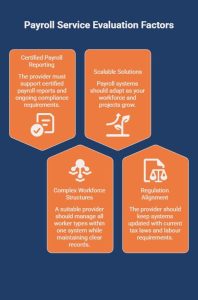
Choosing a payroll provider is not about features alone. It is about whether the system can handle construction-specific complexity while maintaining compliance. The focus should be on capability, scalability, and alignment with how your workforce operates.
Do They Handle Certified Payroll Reporting?
The provider must support certified payroll reports and ongoing compliance requirements. This includes accurate reporting, timely submissions, and maintaining records that meet regulatory standards without requiring constant manual intervention.
Can They Support Complex Workforce Structures?
Construction payroll involves employees, subcontractors, and multiple job sites. A suitable provider should manage all worker types within one system while maintaining clear records and consistent payment structures across projects.
Do They Offer Scalable Solutions?
Payroll systems should adapt as your workforce and projects grow. A scalable solution ensures that increasing complexity does not require a complete system change or additional manual processes.
Is Their System Aligned With Industry Regulations?
Regulations change over time. The provider should keep systems updated with current tax laws and labour requirements to ensure continued compliance without requiring constant internal adjustments.
Best Fit If:
- You manage multiple job sites
- Payroll complexity is increasing
- Compliance requirements are difficult to manage
Not Ideal If:
- Payroll is simple and fixed
- No subcontractors are involved
| Evaluation Factor | What To Look For |
|---|---|
| Compliance | Certified payroll and CIS support |
| Workforce Handling | Multi-type worker management |
| Scalability | Ability to grow with projects |
| Regulation Alignment | Updated systems and processes |
The right choice depends on how complex your payroll needs are today. A structured evaluation helps avoid switching systems later.
How Do Construction Payroll Services Compare To General Payroll Systems?
Not all payroll systems are built for construction. The difference lies in how they handle compliance, workforce variability, and reporting requirements. Standard systems are designed for fixed payroll, while construction requires flexibility and regulatory depth.
| Capability | Construction Payroll | Standard Payroll |
|---|---|---|
| CIS Handling | Yes | No |
| Certified Payroll Reporting | Yes | No |
| Workforce Complexity | High | Low |
| Compliance Depth | Advanced | Basic |
This distinction becomes critical as payroll complexity increases. Construction payroll services are designed to handle requirements that standard systems cannot.
When Should You Outsource Construction Payroll?
Outsourcing is not always necessary at the start. However, as operations grow, internal systems may struggle to keep up. Recognising the right moment to outsource helps prevent errors and reduces operational pressure.
1. Growing Workforce And Projects
As projects expand, the number of workers and payment variations increases. Managing this internally requires more time and coordination, which can slow down payroll processes.
2. Increasing Compliance Requirements
More projects lead to more reporting obligations. Staying compliant requires consistent accuracy, which becomes difficult without dedicated systems or expertise.
3. Limited Internal Resources
Without a dedicated payroll function, responsibilities are often shared across teams. This increases the risk of errors and delays, especially during peak workloads.
| Trigger Point | Impact | Need for Outsourcing |
|---|---|---|
| Workforce Growth | Increased complexity | High |
| Compliance Pressure | Risk of penalties | High |
| Limited Expertise | Higher error rates | Medium to High |
Outsourcing shifts payroll from a manual task to a managed process. It improves accuracy while allowing teams to focus on core operations.
How Direct Payroll Supports Construction Businesses
Direct Payroll Services understands the unique challenges faced by construction professionals. Their approach focuses on delivering accurate, compliant, and scalable payroll solutions.
They support businesses by:
- Managing CIS and certified payroll reporting
- Handling subcontractor payments and tax forms
- Providing detailed reports for financial management
- Ensuring compliance with tax laws and industry regulations
By reducing administrative burden and improving payroll accuracy, Direct Payroll Services helps businesses achieve greater peace of mind. Speak to a payroll expert today to simplify your construction payroll.
Conclusion
Construction payroll is far more complex than standard payroll systems. It requires managing subcontractors, handling variable pay structures, and maintaining compliance with strict regulations.
Using the right construction payroll services allows businesses to streamline payroll management, reduce errors, and improve overall efficiency.
If your current payroll process is slowing down operations or increasing risk, it may be time to adopt a more specialised approach. The right system not only ensures compliance but also supports long-term growth and stability.
Frequently Asked Questions
What are the main benefits of using construction payroll services?
Construction payroll services improve accuracy, reduce compliance risks, and streamline payroll processes. They handle CIS deductions, reporting, and mixed workforce management, allowing businesses to save time while maintaining consistent and compliant payroll operations.
How do construction payroll services handle CIS (Construction Industry Scheme)?
They verify subcontractors with HMRC, apply correct deduction rates, and submit monthly CIS returns. This ensures all payments and reports meet compliance requirements without manual errors or missed deadlines.
What features should I look for when choosing payroll software for construction?
Look for CIS support, subcontractor management, automated tax calculations, reporting tools, and system integration. These features ensure payroll is accurate, compliant, and scalable as your workforce and projects grow.
Can construction payroll services integrate with HR management systems?
Yes, most modern solutions integrate with HR and accounting systems. This allows seamless data flow between payroll, workforce management, and financial reporting, reducing duplication and improving overall efficiency.
What are the cost considerations when selecting a construction payroll service?
Costs depend on workforce size, payroll complexity, and service level. Providers typically offer scalable pricing based on employees and subcontractors, making it important to balance cost with compliance and operational needs.
Why is construction payroll more challenging than standard payroll?
Construction payroll involves subcontractors, CIS deductions, variable payments, and ongoing reporting. These factors increase complexity, making standard payroll systems less effective without specialised processes or tools.