Key Highlights
- Salary sacrifice pension tax relief helps reduce both Income Tax and National Insurance contributions through a lower taxable salary.
- Employees can increase pension contributions more tax efficiently without heavily affecting take-home pay.
- Employers may also reduce employer National Insurance costs through salary sacrifice arrangements.
- Salary sacrifice pension contributions are processed as employer contributions through payroll.
- Pension tax relief is usually applied automatically, so separate HMRC claims are often unnecessary.
- Businesses must monitor payroll accuracy, pension reporting, HMRC compliance, and annual allowance limits carefully.
- Direct Payroll Services helps businesses manage salary sacrifice pension schemes through compliant payroll processing and pension administration support.
Workplace pension contributions are becoming harder to navigate as payroll regulations, tax rules, and pension compliance requirements continue to change. Many employees remain unsure whether they are receiving the full benefit of pension tax relief, while employers often struggle to manage salary sacrifice arrangements correctly.
Much of the confusion comes from how salary sacrifice affects taxable income, National Insurance contributions, take-home pay, and pension deductions. Without proper payroll processes and employee communication, businesses can face compliance risks, reporting errors, and missed tax-saving opportunities.
This guide explains how salary sacrifice pension tax relief works, how much employees and employers could potentially save, when salary sacrifice becomes financially beneficial, and what payroll considerations businesses must understand before introducing a scheme.
What Is Salary Sacrifice Pension Tax Relief?
Salary sacrifice pension tax relief is a workplace pension arrangement where employees agree to reduce part of their gross salary, and the employer redirects that amount into their pension scheme.
Because the sacrificed salary is removed before tax calculations, employees usually pay lower Income Tax and National Insurance while increasing pension contributions more tax efficiently.
Salary sacrifice and pension tax relief can improve pension efficiency for both employees and employers when implemented correctly. However, businesses must ensure payroll calculations, pension deductions, and salary sacrifice agreements remain compliant to avoid reporting errors, payroll issues, and HMRC complications.
How Much Can Employees Save Through Salary Sacrifice Pension Contributions?
Salary sacrifice pension contributions can reduce both Income Tax and National Insurance contributions, helping employees increase pension savings more efficiently. The actual savings depend on salary level, contribution amount, and tax band, but the structure often reduces the overall cost of contributing to a pension.
Example: Basic-Rate Taxpayer
An employee earning £40,000 a year sacrifices £3,000 into their pension.
Without salary sacrifice:
- Tax and National Insurance are calculated on £40,000
- Estimated Income Tax + NI: ~£8,300
With salary sacrifice:
- Taxable salary reduces to £37,000
- Estimated Income Tax + NI: ~£7,550
- Full £3,000 goes into pension as employer contribution
Estimated annual savings:
- ~£750 saved in tax and National Insurance
- Plus £3,000 added to pension
Example: Higher-Rate Taxpayer
An employee earning £70,000 sacrifices £5,000 into their pension.
Without salary sacrifice:
- Tax and National Insurance are calculated on £70,000
- Estimated Income Tax + NI: ~£24,500
With salary sacrifice:
- Taxable salary reduces to £65,000
- Estimated Income Tax + NI: ~£22,800
- Full £5,000 goes into pension as employer contribution
Estimated annual savings:
- ~£1,700 saved in tax and National Insurance
- Plus £5,000 added to pension
Why the Savings Can Add Up Over Time?
Salary sacrifice becomes more powerful over the long term because it combines:
- Lower Income Tax each year
- Lower National Insurance contributions
- Larger pension growth through consistent contributions
- Possible employer National Insurance savings added to pension schemes
Over several years, this can significantly increase retirement savings while still keeping the take-home pay impact lower than standard pension deductions.
Pros and Cons of Salary Sacrifice Pension Tax Relief
| Pros | Cons |
|---|---|
| Reduces Income Tax and National Insurance | May reduce mortgage borrowing capacity |
| Increases pension savings efficiently | Can lower statutory benefits like SMP and SSP |
| Employer NI savings may boost pension contributions | Risk of exceeding annual pension allowance |
| Simple payroll process once set up | Not suitable for employees near the minimum wage |
| Helps build retirement savings faster | Requires careful payroll and compliance management |
| Can improve overall tax efficiency | May not suit those needing higher take-home pay |
Salary sacrifice pension tax relief is most effective when used consistently over time, but employees should still consider salary-related factors like pension limits, borrowing checks, and statutory pay before choosing higher contribution levels.
Who Benefits From Salary Sacrifice Pension Tax Relief and How?
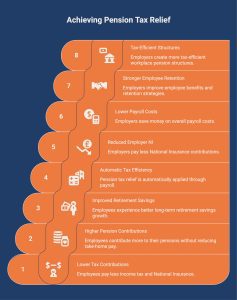
Salary sacrifice pension tax relief can benefit both employees and employers by improving pension contribution efficiency and reducing payroll-related tax costs. The financial advantages often become more noticeable as pension contributions increase and payroll structures become more complex.
How Employees Benefit From Salary Sacrifice Pension Contributions
- Lower Income Tax and National Insurance contributions through reduced taxable salary.
- Higher pension contributions without significantly reducing take-home pay.
- Improved long-term retirement savings growth.
- Automatic pension tax efficiency through payroll without separately claiming relief from HMRC.
How Employers Benefit From Salary Sacrifice Pension Schemes
- Reduced employer National Insurance liabilities.
- Lower overall payroll costs across larger workforces.
- Stronger employee benefits and retention strategies.
- More tax-efficient workplace pension structures.
How Does Salary Sacrifice Pension Tax Relief Actually Work?
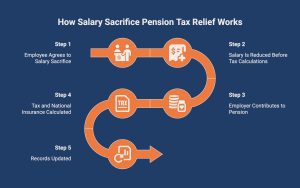
Salary sacrifice pension tax relief works by reducing an employee’s contractual gross salary and redirecting that amount into a workplace pension scheme through employer contributions. Because the sacrificed amount is removed before tax calculations, employees usually pay lower Income Tax and National Insurance while increasing pension contributions more efficiently.
The process usually follows the steps below.
Step 1: The Employee Agrees
The employee agrees to give up part of their salary and have that amount paid into their pension instead. Because salary sacrifice changes contractual pay, the arrangement should be agreed to by both the employee and employer before it is put in place.
Step 2: Salary Is Reduced
The agreed sacrifice amount is taken from the employee’s gross salary before payroll calculates deductions. This lowers the salary used for tax and National Insurance calculations, which is one of the main reasons salary sacrifice can be more tax efficient than standard pension contributions.
Step 3: The Employer Contributes to the Pension
The employer pays the sacrificed amount directly into the workplace pension scheme. These payments are treated as employer pension contributions rather than employee contributions, helping increase pension savings while keeping the process simple and automatic through payroll.
Step 4: Tax and National Insurance Are Calculated
Income Tax and National Insurance are calculated using the employee’s lower salary after the sacrifice has been applied. Because deductions are based on a reduced amount of pay, employees can often pay less tax and National Insurance than they otherwise would.
Step 5: Records Are Updated
Payroll records, pension contributions, and payslips are updated to reflect the salary sacrifice arrangement. Keeping records accurate helps ensure the correct pension payments are made and reduces the risk of payroll errors, reporting issues, or compliance problems later on.
Each stage of the salary sacrifice process affects payroll calculations, pension contributions, and tax reporting. Proper administration is essential to ensure employees receive the correct pension tax relief while businesses remain compliant with payroll and HMRC requirements.
What Tax Rules, Limits, and Eligibility Requirements Apply to Salary Sacrifice Pension Tax Relief?
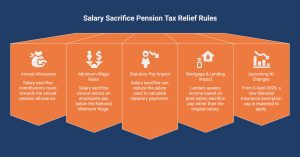
Salary sacrifice pension tax relief can reduce Income Tax and National Insurance, but it must follow strict HMRC rules. It also affects pension limits, minimum pay rules, statutory benefits, and even lending checks, so employers need to manage it carefully for each employee.
1. Annual Allowance
Salary sacrifice pension contributions count towards the annual pension allowance, which is usually £60,000 per year. This includes all employer and employee contributions combined. If total contributions go above this limit, employees may face an HMRC tax charge, reducing the overall tax benefit of salary sacrifice.
This is especially important for higher earners, directors, and employees receiving bonuses or large employer pension top-ups. Careful tracking is needed when multiple pension inputs are involved.
2. Minimum Wage Rules
Salary sacrifice cannot reduce an employee’s pay below the National Minimum Wage. This is a key compliance rule for employers, especially for lower-paid staff.
If salary sacrifice is applied too aggressively, employees may unintentionally fall below legal wage limits. This can happen during reduced hours, overtime changes, or variable pay periods, so payroll must be monitored regularly.
3. Statutory Pay Impact
Salary sacrifice can reduce the salary used to calculate statutory payments. This means benefits like Statutory Maternity Pay or Statutory Sick Pay may be based on the lower post-sacrifice salary rather than the original pay.
It can also affect redundancy pay calculations and other salary-linked entitlements. Employees should understand that while tax savings increase, some statutory benefits may be lower depending on earnings.
4. Mortgage & Lending Impact
Many lenders assess income based on post-salary sacrifice pay rather than the original salary. This can reduce mortgage affordability in some cases, even if overall compensation has not changed.
It may also affect life insurance, redundancy cover, and other financial assessments linked to salary levels. Employers should make this clear so employees understand the wider financial impact.
5. Upcoming NI Changes
From 6 April 2029, a new National Insurance exemption cap is expected to apply. Salary sacrifice pension contributions above £2,000 per year may become subject to employee and employer National Insurance contributions.
This could reduce some of the current NI savings for higher pension contributions. Businesses that rely heavily on salary sacrifice for cost efficiency may need to reassess payroll and pension strategies as rules evolve.
However, businesses must maintain accurate payroll processing, compliant documentation, and clear employee communication to avoid payroll errors, pension reporting problems, and potential HMRC complications.
Salary Sacrifice vs Relief at Source vs Net Pay: Which Pension Tax Relief Method Is Better?

Different pension tax relief methods affect employee pay, tax savings, and payroll calculations in different ways. While all three structures support pension contributions, salary sacrifice pension tax relief is often considered more tax efficient because it can reduce both Income Tax and National Insurance contributions simultaneously.
What Is Relief at Source?
Under relief at source, pension contributions are deducted from an employee’s net pay after tax. The pension provider then claims basic-rate tax relief directly from HMRC and adds it to the pension pot.
Higher-rate and additional-rate taxpayers may still need to claim extra pension tax relief separately through self-assessment tax returns.
What Is a Net Pay Arrangement?
Under a net pay arrangement, pension contributions are deducted from gross salary before Income Tax calculations are made. This reduces taxable income automatically through payroll.
However, employee National Insurance contributions are still calculated on the full salary, which means NIC savings usually do not apply.
Comparison Table: Salary Sacrifice vs Other Pension Tax Relief Methods
| Aspect | Salary Sacrifice | Relief at Source | Net Pay Arrangement |
|---|---|---|---|
| Pension Contribution Type | Employer contribution | Employee contribution | Employee contribution |
| Income Tax Relief | Applied automatically through a reduced salary | Basic-rate relief added by the provider | Applied automatically through payroll |
| National Insurance Savings | Employee and employer NIC savings possible | No NIC savings | No employee NIC savings |
| Higher-Rate Tax Relief Claim | Usually not required separately | An additional claim is often required | Usually automatic |
| Impact on Contractual Salary | Salary reduces | No salary change | No salary change |
| Employer NI Savings | Usually reduced | No employer NI savings | No employer NI savings |
| Payroll Complexity | Higher | Lower | Moderate |
The most suitable option depends on factors such as income level, payroll structure, pension contribution size, and how salary reductions affect statutory benefits or borrowing affordability.
While all three pension contribution methods provide tax advantages, salary sacrifice pension contributions tax relief often delivers the strongest combined payroll and tax efficiency. Businesses should still assess employee suitability carefully, especially where lower earnings, statutory payments, or pension allowance limits may affect the long-term financial benefit.
What Are the Potential Drawbacks, and When Is Salary Sacrifice Suitable?
Salary sacrifice pension schemes offer tax and National Insurance savings, but they can also affect borrowing power, benefits, and pension limits. Suitability depends on income level and financial goals.
Mortgage Impact
Some lenders assess affordability using post-salary sacrifice salary. This can reduce borrowing capacity even though total compensation remains unchanged.
Statutory Pay Impact
Payments such as Statutory Maternity Pay (SMP) and Statutory Sick Pay (SSP) may be based on the reduced salary, which can lower entitlement.
Pension Allowance Risk
Higher earners may reach the annual pension allowance more quickly when salary sacrifice is combined with employer contributions, potentially triggering tax charges.
Minimum Wage Rule
Salary sacrifice cannot reduce earnings below the National Minimum Wage, making it less suitable for lower-paid or variable-income employees.
When is Salary Sacrifice May or May Not Be Suitable?
Salary sacrifice pension schemes can be very beneficial, but they are not suitable for everyone. Whether it is the right choice depends on income level, financial plans, and how much flexibility a person needs with take-home pay, borrowing, and statutory benefits.
Salary Sacrifice May Be Suitable If:
- You are a higher-rate taxpayer
- You make regular pension contributions
- You have stable monthly earnings
- You are comfortable reducing contractual salary for tax efficiency
Salary Sacrifice May Not Be Suitable If:
- You are close to the minimum wage thresholds
- You are planning a mortgage application soon
- You rely heavily on statutory benefits
- You are near your annual pension allowance limit
What Employers Must Consider Before Introducing Salary Sacrifice Pension Schemes
Introducing salary sacrifice pension schemes requires careful planning. Employers must ensure contracts, payroll, pensions, and compliance processes are properly set up before making any changes. A clear step-by-step approach helps avoid errors and keeps everything aligned with HMRC rules.
Step 1: Review Eligibility
Employers should first check which employees are eligible for salary sacrifice. This includes reviewing pay levels, National Minimum Wage rules, and whether salary reductions could impact statutory benefits or affordability for lower-paid staff.
Step 2: Update Contracts
Employment contracts must be updated to reflect the new salary structure. Salary sacrifice reduces contractual gross pay, so changes must be formally documented and agreed with employees before implementation.
Step 3: Communicate to Employees
Employers need to clearly explain how salary sacrifice works, including its impact on take-home pay, tax, National Insurance, and pensions. Written agreements help ensure employees fully understand the arrangement.
Step 4: Configure Payroll
Payroll systems must be set up to correctly apply salary reductions, calculate tax and National Insurance on the adjusted salary, and send accurate pension contribution data to providers without errors.
Step 5: Monitor Compliance
After implementation, employers must regularly check payroll accuracy, pension submissions, and HMRC reporting. Ongoing monitoring helps prevent compliance issues and ensures the scheme continues to run correctly.
Salary sacrifice and pension tax relief arrangements can improve pension efficiency and payroll cost management when implemented correctly. However, employers should ensure payroll administration, employee communication, and pension reporting processes are fully structured before introducing salary sacrifice schemes across the workforce.
How Can Payroll Providers Help Manage Salary Sacrifice Pension Schemes?
Direct Payroll Services helps businesses manage salary sacrifice pension schemes with complete accuracy and ease. From setting up the arrangement to processing payroll, we ensure salary reductions are applied correctly before tax, and National Insurance are calculated.
This keeps pension contributions accurate, compliant, and fully aligned with HMRC rules. We also handle payroll records, payslips, pension submissions, and reporting, reducing admin work and the risk of errors.
With expert support and ongoing management, we help employers run salary sacrifice schemes smoothly, stay compliant, and focus on their business while employees receive the correct pension and tax benefits.
Get in touch with Direct Payroll Services today to simplify your salary sacrifice pension management.
Conclusion
Salary sacrifice pension tax relief can improve pension contribution efficiency while reducing Income Tax and National Insurance costs for both employers and employees. However, accurate payroll processing and compliant pension administration remain essential to avoid reporting issues and compliance risks. Direct Payroll Services helps businesses manage salary sacrifice pension schemes through reliable payroll support, pension contribution management, and HMRC-compliant reporting.
Frequently Asked Questions
Will I lose pension tax relief by using salary sacrifice instead of personal contributions?
No, you don’t lose pension tax relief. In fact, a salary sacrifice arrangement is often more efficient. The tax savings are applied automatically through your payroll by reducing your taxable salary, so you get your relief immediately without needing to claim anything from HMRC, unlike the usual way for higher-rate taxpayers.
How does salary sacrifice affect my take-home pay and payslip?
Your payslip will show a lower gross or taxable salary. Because of this and the resulting national insurance savings, your take-home pay may actually increase, even though a significant contribution is going into your pension. The changes are processed directly through your employer’s payroll system each pay period.
What is the difference between relief at source and salary sacrifice for pension tax relief?
With a relief at source scheme, your contribution is taken from your net pay, and the pension provider claims basic rate tax relief. In a salary sacrifice scheme, you exchange part of your gross salary for a pension contribution, reducing your taxable income and giving you full tax and NI relief upfront.
Can I claim tax relief on salary sacrifice pension contributions?
Most employees cannot separately claim tax relief on salary sacrifice pension contributions because the tax efficiency is already applied through reduced taxable salary and employer pension contributions.
How do the recent reforms affect tax relief through salary sacrifice pension contributions?
Recent reforms may limit National Insurance savings by capping relief on salary sacrifice contributions and tightening compliance rules. While tax relief remains, higher contributions could face reduced NI advantages in future.
Is there a change to my take-home pay when I use salary sacrifice for pension contributions?
Yes, take-home pay usually reduces because gross salary is lowered, but you save on Income Tax and National Insurance while part of your salary is paid directly into your pension.
Is a salary sacrifice pension better than relief at source?
Salary sacrifice is often more tax-efficient as it reduces both Income Tax and National Insurance, while relief at source only provides income tax relief without any National Insurance savings benefit.
Is pension income taxed as salary income?
No, pension income is not taxed as salary. It is treated as regular income in retirement and taxed at your applicable income tax rate when you withdraw your pension benefits.