
Key Highlights
- A zero-hour contract is an employment agreement with no guaranteed minimum number of hours.
- You are only paid for the hours you actually work, but you must receive the National Minimum Wage.
- Workers on these contracts have key employment rights, including entitlement to paid holiday pay and statutory sick pay.
- UK employment law bans exclusivity clauses, meaning you are free to work for other employers.
- Upcoming changes to employment law may give you the right to request a more predictable working pattern.
You’re waiting for your weekly rota to drop. Rent is due. Bills are lined up. But your name is not on the schedule this week, and no one is required to explain why.
That uncertainty is the reality for many workers on zero-hour contracts. One week can be packed with shifts. The next can bring silence. Understanding how these contracts actually work and what rights you still have can make the difference between feeling powerless and staying protected.
This guide will walk you through how these contracts work, what your legal protections are under UK employment law, and the pros and cons of this flexible working arrangement.
What Is a Zero Hour Contract?
A zero-hour contract is a flexible employment arrangement where no minimum working hours are guaranteed. Work is offered only when required, meaning hours can change weekly. Pay is based solely on hours worked, making this model common in industries with fluctuating demand.
Here’s what defines a zero-hour contract in practice:
- Employers do not have to offer regular hours. Schedules can change week to week.
- You are paid only for the hours you work. There is no guaranteed income.
- Your status may be “worker” or “employee.” This affects your legal rights.
- Workers receive core rights, such as minimum wage and paid holiday. They have fewer protections than employees.
- Employees may qualify for added rights, including protection from unfair dismissal. This depends on the contract and working pattern.
- Employers must confirm your status and terms in writing. This prevents confusion and supports legal compliance.
Understanding how zero-hour contracts work helps both employers and individuals manage expectations, rights, and payroll obligations more effectively.
How Do Zero-Hour Contracts Work in Practice?
In day-to-day use, zero-hour contracts give employers flexibility to offer work only when demand exists. Individuals are not guaranteed shifts and can usually accept or decline work. Pay varies based on hours worked, making income unpredictable and closely tied to business needs.
In practical terms, this usually means:
- The employer identifies a short-term or fluctuating staffing need, such as covering busy weekends, seasonal demand, or staff absences.
- A shift or task is offered to the individual, for example, a restaurant requesting extra staff for a fully booked Friday evening.
- The individual decides whether to accept or decline the work without penalty, depending on availability or personal commitments.
- If accepted, the individual works only those agreed hours, such as a four-hour evening shift or a single-day assignment.
- The employer records the actual hours worked, including any required waiting or on-site standby time.
- Payment is calculated based solely on those hours, ensuring that at least the National Minimum Wage is paid.
- The process repeats each time work is needed, meaning weekly hours and pay can increase or decrease over time.
This step-by-step structure shows how zero-hour contracts function in real life, balancing employer flexibility with individual choice.
Need to understand employee sick pay rules? Learn everything about Statutory Sick Pay (SSP) and how it affects your workforce and payroll obligations.
Are Zero-Hour Contracts Legal in the UK?
Yes, zero-hour contracts are legal in the United Kingdom. Even without guaranteed hours, you still have basic rights, including minimum wage, paid holiday, and protection from discrimination.
The Small Business, Enterprise and Employment Act 2015 made it unlawful for employers to include exclusivity clauses in zero-hour contracts. This means your employer cannot prevent you from working for someone else.
These rules set clear boundaries on how zero-hour contracts can be used while protecting core worker rights.
What Are the Recent and Upcoming Changes to Zero-Hour Contract Law?
If you regularly work the same shifts but remain on a zero-hour contract, you may soon be able to request a more predictable contract.
Under the proposed Employment Rights Bill, workers on insecure contracts could gain the legal right to ask for a contract that reflects the hours they actually work. The proposal suggests this right would apply after a qualifying period, likely around 26 weeks with the same employer.
For you, this could mean:
- A clearer pattern of hours.
- More predictable income.
- Less last-minute scheduling.
The bill also proposes updates to Statutory Sick Pay, aiming to improve support for people with irregular hours.
These changes have been proposed but are not yet in force. The timeline has shifted, and while earlier expectations pointed to 2025, the exact start date is still to be confirmed. Until then, current zero-hour contract rules remain in place.
What Are an Employer’s Responsibilities Under Zero-Hour Contract Law?
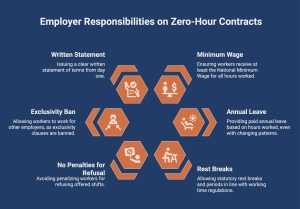
Employers using zero-hour contracts must follow specific legal obligations to ensure fair treatment and compliance. These responsibilities protect individuals from unfair practices while setting clear expectations around pay, rights, and working arrangements from the start.
From a legal and practical standpoint, employers must:
- Pay at least the National Minimum Wage for every hour worked, including any required waiting, training, or on-site standby time.
- Provide paid annual leave, calculated based on hours worked, even when working patterns change week to week.
- Allow statutory rest breaks and daily or weekly rest periods in line with working time regulations.
- Avoid penalising individuals for refusing offered shifts, as zero-hour contracts cannot force acceptance of work.
- Allow individuals to work for other employers, since exclusivity clauses in zero-hour contracts are legally banned.
- Issue a clear written statement of terms explaining pay, employment status, rights, and expectations from day one.
Meeting these responsibilities helps employers stay compliant while creating a transparent and fair working relationship for everyone involved.
What Rights Do Workers Have on a Zero-Hour Contract?
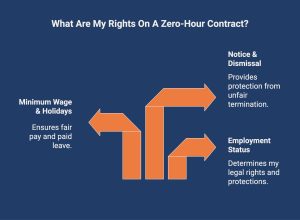
If you are working under a zero-hour contract, UK law still provides you with important legal protections. Although your hours may be irregular and not guaranteed, this type of contract does not remove your core rights. These protections are mainly determined by your employment status and are designed to prevent unfair treatment in flexible working arrangements.
Below is a structured, easy-to-scan breakdown of your key rights.
1. Employment Status: Employee, Worker, or Self-Employed
Your employment status is the single most important factor in determining your legal rights on a zero-hour contract. Most individuals on zero-hour contracts are legally classed as workers, not employees. This status sits between full employment and self-employment, providing essential protections without the full range of employee-only rights.
- Worker status: Entitles you to minimum wage, paid holiday, and protection from discrimination.
- Employee status: May apply in limited cases and includes additional rights such as unfair dismissal protection.
- Self-employed status: Usually does not apply if the employer controls your work, hours, or duties.
Employers are legally responsible for correctly assessing and clearly stating your status in writing from the start of the working relationship.
2. Right to Minimum Wage, Paid Holidays, and Sick Pay
Starting a job on a zero-hour contract does not mean giving up your basic rights. From your first shift, you are legally entitled to core protections, even if your hours change from week to week.
Let’s take a closer look at how those rights apply in practice.
- National Minimum Wage: You must be paid at least the legal minimum for every hour worked, without exception.
- Holiday pay: Paid leave accrues based on hours worked, rather than a fixed annual allowance.
- Statutory Sick Pay: May apply if your average earnings meet the required threshold.
Because pay and hours can vary, holiday entitlement is calculated based on your actual working pattern over time.
The same applies to sick pay, which is assessed using your average earnings rather than a fixed schedule.
3. Notice Periods and Protection from Dismissal
Zero-hour contracts operate differently from traditional employment contracts when it comes to notice and dismissal. Since there is no obligation to provide or accept work, notice requirements are usually minimal or not required at all.
- Notice periods: In most cases, workers can stop accepting shifts without giving formal notice.
- Unfair dismissal protection: Generally applies only to employees, not workers.
- Legal safeguards: Employers cannot penalise you for refusing shifts or asserting statutory rights.
Some contracts may end automatically after long periods of inactivity, but employers must still act fairly and cannot terminate arrangements as retaliation for exercising legal protections.
Knowing these rights helps you understand where you stand legally and ensures you can recognise when your protections are not being properly upheld under a zero-hour contract.
What Are the Advantages and Disadvantages of Zero-Hour Contracts?
Zero-hour contracts offer both benefits and drawbacks, depending on individual circumstances and priorities. While flexibility is the main attraction, the lack of guaranteed hours can create uncertainty. Understanding both sides helps individuals decide whether this type of work suits their lifestyle and financial needs.
Below is a balanced, easy-to-scan breakdown of the key pros and cons.
1. Benefits for Zero-Hour Contract Workers
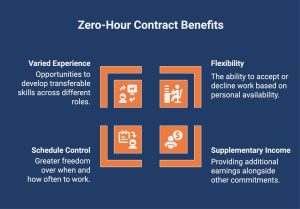
One of the strongest advantages of a zero-hour contract is the flexibility it provides. Unlike fixed-hour roles, this arrangement allows individuals to accept work that fits around their existing commitments, making it appealing to those who value control over their schedule rather than long-term job certainty.
- Work-life balance: Shifts can be accepted or declined based on personal availability, family needs, or study schedules.
- Supplementary income: Provides a practical way to earn additional money alongside another job, freelancing, or education.
- Schedule control: Workers are not tied to a fixed rota, giving greater freedom over when and how often they work.
- Varied experience: Opportunities to work across different roles or employers can help develop transferable skills.
This level of flexibility often suits students, carers, semi-retired individuals, or anyone prioritising adaptability over a fixed employment structure.
2. Challenges and Risks of Zero-Hour Contracts
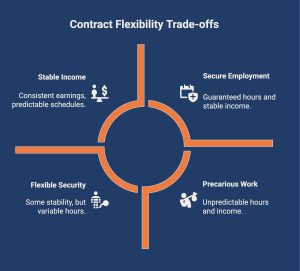
Despite the benefits, zero-hour contracts also present notable challenges, particularly around financial stability and long-term security. Because hours are not guaranteed, income can change significantly from one pay period to the next, making consistent budgeting more difficult.
- Unpredictable income: Earnings may fluctuate weekly or monthly, making it hard to plan expenses or save reliably.
- Lack of job security: Shifts can be reduced or withdrawn at short notice without long-term guarantees.
- Planning difficulties: Irregular schedules can make it challenging to organise personal commitments or holidays.
- Limited employment benefits: Workers may have fewer protections and benefits compared to permanent employees.
For individuals relying on this work as their primary income, the uncertainty can be stressful and disruptive, particularly when shifts are offered or cancelled with little notice.
Understanding both the advantages and disadvantages of zero-hour contracts allows individuals to make informed decisions about whether flexibility outweighs the potential financial and security trade-offs.
How Holiday Pay is Calculated on a Zero-Hour Contract?
One of the most common questions from workers on zero-hour contracts is about holiday pay. You are legally entitled to paid time off. Your holiday entitlement accrues from your first day of work, based on the hours you complete.
Since your working hours are not fixed, the calculation method is different from that for salaried employees. For workers on a zero-hour contract, there is a different formula.
The standard way to calculate holiday pay for irregular hours is to use the 12.07% method. This means your holiday entitlement is 12.07% of the number of hours you have worked.
This figure is derived from the statutory 5.6 weeks of paid holiday, divided by the remaining 46.4 weeks of the year.
Your employer should use your average number of hours worked over a reference period to determine your pay for any holiday you take.
To learn more about how holiday entitlement works, including how it is calculated for irregular hours, read this guide.
Do Zero-Hour Contract Workers Get Pensions and Other Workplace Benefits?
Beyond hourly pay and holiday entitlement, many zero-hour contract workers want to understand whether they qualify for pensions or additional workplace benefits. UK law provides some statutory protections, but access to benefits can vary depending on earnings, age, and the specific terms set by the employer.
1. Workplace Pensions on a Zero-Hour Contract
Zero-hour contract workers may still qualify for a workplace pension under UK auto-enrolment rules. Eligibility is assessed each pay period, meaning pension access can change as earnings fluctuate, which is common with irregular or on-demand work patterns.
- Auto-enrolment eligibility: Based on age and earnings in each pay period, not contract type.
- Earnings threshold: Employers must enrol you if your pay exceeds the legal minimum.
- Employer contributions: Once enrolled, employers are legally required to contribute.
- Ongoing assessment: Eligibility can start or stop as income rises or falls.
Understanding how auto-enrolment works helps zero-hour workers avoid missing out on long-term pension savings.
2. Other Workplace Benefits You May Receive
While statutory benefits apply, additional workplace perks are not automatically included for zero-hour contract workers. These benefits are optional and depend entirely on the employer’s policies and the terms set out in the contract.
- Enhanced sick pay: Not guaranteed beyond statutory entitlements.
- Private healthcare or insurance: Usually reserved for permanent employees.
- Bonuses or incentives: Offered at the employer’s discretion, if at all.
- Written confirmation: Any extra benefits must be clearly stated in your contract.
Zero-hour contracts can differ. Knowing exactly what applies to you helps you plan your income, savings, and next steps with confidence.
Can Zero-Hour Contract Workers Have Second Jobs?
A key protection under UK employment law is the right for zero-hour contract workers to work for more than one employer. This rule ensures flexibility works in both directions and prevents workers from being restricted from earning enough income.
1. Ban on Exclusivity Clauses
Exclusivity clauses in zero-hour contracts are legally banned in the UK. Employers cannot require you to work only for them or penalise you for seeking work elsewhere.
- Exclusivity restrictions: Not legally enforceable in zero-hour contracts.
- No penalties allowed: Employers cannot reduce shifts for taking other work.
- Legal protection: Designed to prevent unfair income restriction.
This safeguard ensures zero-hour contracts do not trap workers into unpaid availability.
2. Freedom to Work for Multiple Employers
Zero-hour contract workers are free to accept work from multiple employers at the same time. This allows individuals to manage income, availability, and workload more effectively.
- Shift flexibility: You can choose which employer’s work to accept.
- Income stability: Multiple roles can help smooth earnings fluctuations.
- No approval required: Employers cannot demand permission for second jobs.
- Contract review: Any clause limiting this right is legally invalid.
If a contract appears to restrict your ability to work elsewhere, seeking professional advice can help clarify and protect your rights.
Understanding exclusivity rules ensures you can use zero-hour contracts as a flexible tool rather than a financial limitation.
What Are the Alternatives to Zero-Hour Contracts?
While zero-hour contracts suit businesses with unpredictable demand, they are not always the best option. When work patterns are more consistent, alternative employment arrangements can provide greater income stability for individuals while still offering employers the flexibility they need to manage staffing efficiently.
- Part-time contracts provide guaranteed weekly hours, offering predictable income while still allowing employers to manage staffing efficiently.
- Fixed-term contracts suit short-term projects or seasonal work, with clear start and end dates and defined working hours.
- Annualised hours contracts set total working hours for the year but allow them to be spread flexibly across busy and quiet periods.
- Agency workers can be used for temporary cover, helping businesses manage peaks in demand without long-term commitments.
- Freelance or self-employed contractors work on a project basis, offering flexibility but operating under a different legal status.
- Casual contracts with minimum hours can provide limited guarantees while maintaining some flexibility for both parties.
These alternatives can offer clearer expectations and more stability when workloads are predictable, making them practical options alongside or instead of zero-hour contracts.
Looking for Reliable Payroll Services in London?
Direct Payroll Services is a trusted payroll partner for businesses across London, supporting organisations of all sizes with accurate, compliant, and stress-free payroll management.
From small businesses and care homes to accountants and contractors, our services are built to adapt to your operational needs.
We also support zero-hour contract payroll, ensuring irregular hours, variable pay, and worker entitlements are processed accurately and in line with UK regulations.
With a dedicated in-house team and flexible systems, we simplify payroll while keeping you compliant. Trusted by over 250 companies nationwide, we focus on precision, reliability, and personal service.
Book an appointment today to discuss how Direct Payroll Services can manage your payroll with confidence, including zero-hour and flexible workforce requirements.
Conclusion
Understanding zero-hour contracts is crucial for both employers and workers navigating today’s flexible job market. While these contracts offer unparalleled flexibility, it’s essential to be aware of your rights and responsibilities as a worker. From knowing the legalities surrounding minimum wage and paid holidays to recognising your employment status, being informed enables you to make the best decisions for your career. Weighing the pros and cons of zero-hour contracts can help you determine if this working arrangement aligns with your lifestyle and needs.
Frequently Asked Questions
Can I refuse shifts or work offered on a zero hour contract?
Yes, you can refuse shifts on a zero-hour contract. Employers are not required to provide minimum hours, and workers are not obligated to accept work offered, allowing flexibility without penalties in most standard zero-hour arrangements.
What happens if I want to leave my zero hour contract job?
Usually, you can leave a zero-hour contract without a formal notice period by stopping acceptance of shifts. However, checking your contract is advised, as some employers may request reasonable notice as good practice.
How common are zero-hour contracts in the UK workforce?
Zero-hour contracts are widely used in the UK, particularly in hospitality, retail, care, and gig-based roles. They form a notable part of the flexible labour market and are common across many service-driven industries.
Have there been any recent changes or bans affecting zero-hour contracts in the UK?
There is no ban on zero-hour contracts in the UK. Recent government proposals focus on improving fairness, transparency, and worker protections, but zero-hour arrangements remain legal and commonly used across various industries.
What legal protections do zero-hour contract workers have?
Zero-hour contract workers have basic employment rights, including National Minimum Wage, paid holiday entitlement, rest breaks, protection from discrimination, and whistleblowing rights, even though they are not guaranteed minimum working hours.
Can I refuse shifts on a zero-hour contract?
Yes, workers on zero-hour contracts can usually refuse shifts without penalty. However, this depends on contract wording, availability clauses, and whether a consistent pattern of accepting work has created implied obligations.
Can you quit immediately on a zero-hour contract?
In many cases, yes. Zero-hour contracts often allow immediate resignation due to no guaranteed hours, but some contracts include notice periods, so reviewing your agreement before leaving is strongly recommended.