Key Highlights
- Keeping in touch days allow employees on maternity leave to work up to 10 days without ending their leave or losing statutory maternity pay
- Each KIT day counts as a full day of work, even if only a few hours are completed
- Keeping in touch during maternity must be mutually agreed upon and cannot be enforced by employers
- Payments for KIT days must align with statutory maternity pay to avoid payroll errors and compliance risks
- Exceeding the 10-day limit can affect leave status and create HMRC reporting issues
- Accurate tracking and payroll coordination are essential to manage KIT days without compliance gaps
On paper, maternity leave feels simple. In reality, it rarely is. The moment keeping in touch days come into the picture, things start to get a bit confusing. Can someone work without ending their leave? Do you have to pay them differently? And how does this show up in payroll without causing issues later?
This is where small decisions start creating bigger problems. A single training session can accidentally count as a full KIT day. One incorrect payment can affect statutory maternity pay calculations. What seems like a minor oversight can quickly turn into payroll errors, compliance risks, or HMRC issues.
That is why this guide exists. We are going to walk through keeping in touch days in a simple, practical way. No jargon, no overcomplication. Just clear answers on what they are, how they work during maternity and parental leave, how payments should be handled, and what you need to do to get it right the first time.
What Are Keeping in Touch Days?
Keeping in touch days are up to 10 optional work days that employees on statutory maternity leave can use to carry out work without ending their leave or losing their entitlement to statutory maternity pay.
These days are meant to maintain reasonable contact during a long absence and support a gradual return to work, not replace maternity leave itself.
A common misunderstanding is that KIT days extend maternity leave or reset entitlements. They do not. They simply sit within the existing leave period.
What Activities Count as a KIT Day?
A KIT day can include activities such as:
- Attending training sessions or workshops
- Joining meetings with team members
- Contributing to ongoing projects
- Participating in team or social events
Even a small amount of work counts as a full day. There is no concept of a half-day. This is often misunderstood and can lead to incorrect payroll tracking if not handled properly.
Are KIT Days Optional?
Yes, KIT days must be mutually agreed.
Employers can maintain reasonable contact during maternity leave, but they cannot require employees to work. Employees can also decline without any negative consequences.
Another common misconception is that informal check-ins or small tasks do not count. In reality, if work is performed, it may qualify as a KIT day, which is why clear agreement and documentation are important.
What Are the Official Rules for KIT Days in the UK?
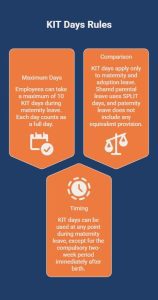
Keeping in touch days are governed by legal rules under the Employment Rights Act, allowing employees on statutory maternity leave to work up to 10 days without affecting their leave or statutory payments.
The rules are clear on paper, but most errors happen in how they are applied day to day.
How Many Keeping in Touch Days Are Allowed?
Employees can take a maximum of 10 KIT days during maternity leave. Each day counts as a full day, even if only a small amount of work is done.
What businesses get wrong is assuming partial work can be split across days. It cannot. Miscounting here often leads to exceeding the limit and creating payroll or compliance issues.
When Can KIT Days Be Taken?
KIT days can be used at any point during maternity leave, except for the compulsory two-week period immediately after birth.
What businesses get wrong is scheduling work informally without tracking timing. This can result in work being assigned during restricted periods or recorded incorrectly in payroll.
How Do KIT Days Compare to Other Types of Family Leave?
KIT days apply only to maternity and adoption leave. Shared parental leave uses SPLIT days, and paternity leave does not include any equivalent provision.
What businesses get wrong is mixing these categories. Treating all leave types the same can lead to incorrect entitlements, misreported days, and compliance risks.
How Do KIT Days Affect Employee Pay?
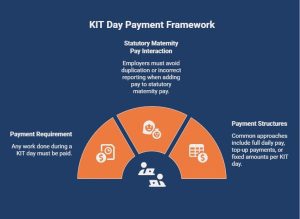
Keeping in touch days must be paid, but there is no fixed statutory rate. Employers must ensure that payments comply with national minimum wage requirements and align correctly with statutory maternity pay.
This is where payroll complexity increases.
Is Payment Required for KIT Days?
Yes. Any work done during a KIT day must be paid.
The payment should reflect the type of work, the employee’s contract, and minimum legal thresholds such as minimum wage. Failing to apply this correctly can lead to compliance issues and disputes.
How Does KIT Pay Interact with Statutory Maternity Pay?
Employees continue to receive statutory maternity pay during leave. When KIT days are worked, employers may add pay on top, but must avoid duplication or incorrect reporting.
A common mistake is paying a full day’s salary without adjusting how it interacts with statutory maternity pay. This can lead to overpayment or incorrect payroll records, which may require corrections later.
What Payment Structures Do Employers Typically Use?
Common approaches include full daily pay, top-up payments, or fixed amounts per KIT day. The structure should be agreed and documented in advance.
For example, if an employee attends a short training session and is paid a full day without it being recorded as a KIT day, it may go untracked. Later, when additional KIT days are used, the business may unknowingly exceed the 10-day limit, creating both payroll and compliance issues.
How Should KIT Days Be Handled in Payroll?
Keeping in touch days must be accurately tracked, recorded, and processed to ensure compliance with statutory maternity pay rules and HMRC reporting requirements.
How Should Employers Track KIT Days?
Tracking is about limit control. Employers must ensure the 10-day allowance is not exceeded.
This means maintaining a clear record of each KIT day across the maternity period, keeping it separate from other leave or pay types, and aligning HR approvals with payroll entries. Without this, businesses risk overuse without realising it.
How Should KIT Payments Be Processed?
Payments are about calculation accuracy. KIT pay must align correctly with statutory maternity pay without duplication.
Employers need to ensure correct top-up logic, meet minimum wage requirements where applicable, and reflect earnings accurately in payroll. Small errors here can distort pay calculations and require later corrections.
What Are the Most Common Payroll Errors with KIT Days?
Errors are about real consequences. Most issues stem from misalignment between HR, payroll, and actual work done.
Typical problems include untracked KIT days, incorrect pay on top of SMP, or wrong categorisation in payroll systems. These often lead to compliance risks, employee disputes, and time-consuming fixes later.
What Happens If You Exceed the KIT Day Limit?
Exceeding the 10-day limit is not a grey area. It creates a clear shift in how work is treated during maternity leave. This is where businesses often assume flexibility exists, but the rules are far more rigid than expected.
Does Exceeding 10 Days Affect Leave Status?
Once the 10-day threshold is crossed, additional work may be treated as a formal return to work. This can interrupt maternity leave and impact statutory maternity pay entitlement. The distinction matters because even a single extra day can change how leave is classified and reported.
What Are the Payroll and Legal Implications?
Exceeding the limit can disrupt payroll accuracy and statutory reporting obligations. Employers may need to reassess statutory maternity pay calculations, correct payroll submissions, and ensure compliance with employment law requirements. In complex cases, resolving these issues may require formal adjustments and specialist guidance.
Exceeding limits is not just a policy issue. It creates downstream payroll and compliance consequences that are harder to fix later.
Managing different types of workers? Temporary staff come with their own payroll rules, risks, and compliance requirements. If you want to avoid costly mistakes, read our guide on temporary worker payroll.
When Should Businesses Use KIT Days?
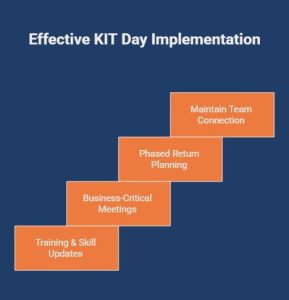
KIT days are most effective when used with intent, not convenience. They should support continuity without undermining the purpose of maternity leave. The focus should be on value, not volume, ensuring each day serves a clear purpose.
When Should KIT Days Be Used for Training and Skill Updates?
KIT days are useful for keeping employees aligned with new systems, tools, or internal processes. This helps reduce the learning curve when they return. The goal is not workload contribution, but maintaining familiarity with changes that directly impact their role.
When Should KIT Days Be Used for Business-Critical Meetings?
These days can be used when employee input is genuinely needed for key decisions or updates. This ensures continuity without requiring full reintegration. However, participation should remain selective and relevant, not routine or operational in nature.
How Do KIT Days Support Phased Return Planning?
KIT days can act as a bridge between leave and full return. Employees can re-engage gradually, test workloads, and adjust schedules. This reduces transition pressure and allows both the employer and employee to plan a smoother reintegration.
How Do KIT Days Help Maintain Team Connection?
Limited participation in team interactions can help employees stay connected without feeling isolated. This may include occasional updates or check-ins. The intent is to maintain relationships, not reintroduce regular responsibilities or expectations.
Used correctly, KIT days support transition. Used casually, they risk becoming unstructured work during protected leave.
What Are the Compliance Risks Employers Should Watch?
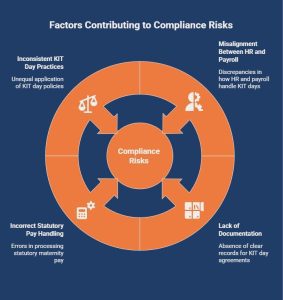
The real risk with KIT days is not misunderstanding the rules, but misapplying them across teams. Most issues arise when HR decisions and payroll execution are not aligned, creating gaps that affect compliance and reporting.
How Does Misalignment Between HR and Payroll Create Risk?
When HR approves KIT days but payroll processes them differently, inconsistencies emerge. This can lead to incorrect payments, misreported statutory pay, and inaccurate records. Alignment between both functions is essential to ensure decisions translate correctly into payroll actions.
Why Does Lack of Documentation Increase Compliance Issues?
Without clear records of agreed KIT days, payment terms, and usage, employers expose themselves to disputes and audit risks. Documentation provides traceability and ensures that all decisions can be justified if reviewed by HMRC or challenged by employees.
What Happens When Statutory Pay Is Handled Incorrectly?
Errors in handling statutory maternity pay are among the most common compliance issues. Misalignment with KIT payments can lead to overpayments, underpayments, or incorrect reporting. These errors often require time-consuming and administratively complex corrections.
Can Inconsistent KIT Day Practices Lead to Unfair Treatment?
Applying KIT day policies inconsistently across employees can create perceived or actual unfair treatment. This may increase the risk of disputes or claims. A structured and consistent approach helps ensure fairness and reduces legal exposure.
Compliance risks rarely stem from a single major mistake. They build through small inconsistencies across the process, documentation, and payroll handling.
How Can Employers Manage KIT Days Effectively?
Managing KIT days effectively requires more than awareness of the rules. It depends on having structured processes, clear communication, and consistent execution across HR and payroll functions. Without this, even well-intentioned policies can fail in practice.
How Should Employers Set Clear Internal Policies for KIT Days?
Employers should define how KIT days are requested, approved, and paid within a formal policy. This should outline expectations, limits, and payment structures. Including these guidelines within employment terms ensures clarity and reduces ambiguity during maternity leave.
How Can Employers Track KIT Usage Consistently?
A centralised tracking system is essential to monitor KIT day usage accurately. This helps ensure the 10-day limit is not exceeded and provides clear visibility across teams. Consistent tracking reduces the risk of errors and supports accurate payroll reporting.
How Should Employers Communicate During KIT Arrangements?
Communication should remain clear, proportionate, and respectful of leave boundaries. Employers should avoid excessive contact while ensuring employees are informed about relevant opportunities to use KIT days. The focus should be on clarity, not frequency.
Why Is Advance Planning Important for KIT Days?
Planning KIT usage early helps avoid last-minute decisions that lead to errors or misalignment. It allows both employer and employee to agree on timing, purpose, and payment structure in advance, ensuring smoother execution across HR and payroll.
Strong processes reduce reliance on judgment calls. That is what ultimately prevents errors and ensures consistent compliance.
How Can Direct Payroll Services Help You Manage KIT Days Without Risk?
Most issues with keeping in touch days do not come from unclear rules. They come from execution gaps like untracked KIT days, incorrect SMP adjustments, and misalignment between HR approvals and payroll processing.
Direct Payroll Services focuses on fixing exactly these problem areas.
This includes:
- Tracking KIT days accurately against the 10-day limit to prevent overuse
- Aligning KIT payments correctly with statutory maternity pay to avoid calculation errors
- Ensuring payroll records remain consistent and compliant with HMRC requirements
Instead of relying on manual tracking or disconnected systems, the focus is on structured payroll handling that removes ambiguity.
If your current process feels unclear or prone to small errors, this is usually where things start to break. Direct Payroll Services helps bring control, accuracy, and consistency back into how KIT days are managed.
Conclusion
Keeping in touch days are simple in principle, but the risk lies in how they are managed in practice. Clear policies, accurate tracking, and correct payroll handling are what separate compliance from costly errors. When used properly, they support smoother returns without disrupting maternity leave.
If you want to avoid miscalculations and reporting issues, the next step is to ensure your payroll processes are aligned, structured, and fully compliant from the start.
Frequently Asked Questions
What are keeping in touch days during maternity leave, and how do they work?
Keeping in touch days allow employees on maternity leave to work up to 10 days without ending their leave or losing statutory maternity pay. These days must be agreed in advance and are used to maintain a connection with the workplace.
How many days of keeping in touch are allowed during maternity leave?
Employees can take a maximum of 10 keeping in touch days during maternity leave. Each day counts as a full working day, regardless of hours worked, and the limit cannot be extended or carried forward.
Are keeping in touch days optional for employees?
Yes, keeping in touch days are completely optional during the maternity leave period. Employers cannot require employees to work during maternity leave, and employees can decline requests without any impact on their rights or statutory entitlements.
What types of work activities count as keeping in touch days?
Any work activity counts as a keeping in touch day, including attending meetings, training sessions, or contributing to projects. related to the new baby. Even minimal work counts as a full day, so accurate tracking is important for compliance.
How are we keeping in touch during the days paid during maternity leave?
Keeping in touch days must be paid, but there is no fixed statutory rate. Employers may offer full pay, top-up payments, or agreed rates, ensuring compliance with minimum wage and correct alignment with statutory maternity pay, particularly for those who may back out last minute due to unforeseen circumstances.
What happens if you exceed the allowed number of keeping in touch days?
If more than 10 keeping in touch days are used, additional work may affect maternity leave status and statutory pay, including any additional pay. It can also create payroll and compliance issues, requiring corrections in reporting and payment calculations.
Can employers require employees to attend keeping in touch days?
No, employers cannot require employees to attend keeping in touch days. These days are entirely voluntary and, as a good practice, must be mutually agreed. Employees have the right to decline without any negative impact on their maternity leave, pay, or employment rights.
Are keeping in touch days available for other types of parental leave besides maternity?
Yes, but the structure differs by leave type. KIT days apply to maternity and adoption leave (up to 10 days), while shared parental leave uses SPLIT days (up to 20 days). Paternity leave does not include any equivalent provision.