
| Quick Answer: Outsourced payroll services for recruitment agencies help manage worker payments, PAYE deductions, National Insurance, payslips, and HMRC reporting. They simplify payroll for temporary and permanent workers, reduce administrative work, and support compliance. By outsourcing payroll, recruitment agencies can focus more on candidate placements, client relationships, and business growth. |
|---|
Key Highlights
- Outsourced payroll services for recruitment agencies help manage worker payments, statutory deductions, and HMRC reporting.
- Recruitment agency payroll involves changing assignments, variable working hours, and frequent payment deadlines.
- Outsourcing can reduce administrative burdens while providing access to experienced payroll professionals.
- Payroll software for recruitment agencies can automate calculations, manage timesheets, and improve reporting accuracy.
- Agencies can choose between in-house payroll, outsourced services, managed payroll, and hybrid arrangements.
- A reliable payroll provider should offer compliance support, secure systems, transparent pricing, and responsive communication.
- Direct Payroll Services can support recruitment businesses looking to simplify their payroll operations.
Running a recruitment payroll differs from standard payroll because workers often move between assignments, work variable hours, and receive different pay rates. Agencies must also manage temporary and permanent workers under different employment arrangements, including those involving umbrella companies.
These arrangements make payroll more complex. Recruitment agencies must collect approved timesheets, calculate wages and holiday pay, identify PAYE responsibilities, and meet HMRC reporting deadlines. Errors or delays can affect worker payments, compliance, and relationships with clients.
Outsourced payroll services for recruitment agencies can help by managing agreed responsibilities such as wage calculations, statutory deductions, payslips, pension administration, and HMRC submissions. However, the agency must still provide accurate worker information and maintain appropriate oversight.
This guide explains how recruitment payroll outsourcing works, when it makes sense, its benefits, and how to choose a provider that supports your workforce arrangements and business needs.
What Are Outsourced Payroll Services for Recruitment Agencies?
Outsourced payroll services for recruitment agencies involve appointing an external provider to manage agreed payroll tasks, including wage calculations, statutory deductions, payslips, and HMRC reporting.
Unlike standard payroll, recruitment agencies often handle temporary workers across multiple assignments, changing pay rates, weekly payments, and different employment arrangements.
A typical outsourced recruitment payroll service may include:
- Timesheet processing: Using approved timesheets to calculate wages across different assignments and pay rates.
- PAYE administration: Calculating Income Tax, National Insurance, and applicable statutory deductions.
- Holiday pay: Managing holiday pay calculations according to workers’ contractual and statutory entitlements.
- Worker onboarding: Setting up payroll records for new starters and updating details when assignments change.
- Payroll reporting: Preparing payslips, payment reports, and HMRC submissions.
- Payroll corrections: Resolving discrepancies involving working hours, pay rates, or deductions.
A clear workflow is essential. The agency typically collects and approves timesheets, the provider processes payroll, and an authorised person reviews and approves payments before they are released.
The exact responsibilities depend on the service agreement and worker arrangements, including whether an umbrella company operates PAYE. Outsourcing reduces administrative work, but it does not automatically transfer the agency’s legal obligations to the provider.
Why Is Payroll Management Challenging for Recruitment Agencies?
Recruitment agency payroll involves coordinating information from workers, clients, and recruitment consultants while managing changing assignments, frequent starters and leavers, and different employment arrangements. Agencies must also meet payment deadlines and comply with applicable employment regulations.
How Do Changing Assignments and Pay Rates Affect Payroll?
Temporary workers may work for different clients during the same pay period, with varying hours, pay rates, and overtime arrangements. Payroll teams must match each timesheet to the correct client, assignment, and agreed rate before calculating wages.
Key information to verify includes:
- Client and assignment details.
- Approved working hours and dates.
- Agreed hourly or daily rates.
- Overtime and holiday pay arrangements.
Incorrect assignment details can result in payment discrepancies and inaccurate client billing.
Why Do Weekly Payroll Deadlines Create Pressure?
Many recruitment agencies pay temporary workers weekly, leaving limited time to collect timesheets, obtain client approval, and process wages. Late timesheet submissions or delayed client approvals can affect payroll calculations and payment schedules.
Setting clear timesheet cut-off times, assigning approval responsibilities, and establishing procedures for late submissions can help agencies maintain consistent payment schedules.
How Do Frequent Starters and Leavers Complicate Payroll?
Recruitment agencies regularly onboard new temporary workers and process leavers as assignments end. Each new starter may require identity checks, tax information, bank details, and relevant pension assessments. When workers leave, agencies must manage final payments, outstanding holiday pay, and applicable PAYE reporting.
Frequent workforce changes increase the importance of maintaining accurate, updated payroll records.
How Do AWR and Umbrella Company Arrangements Affect Compliance?
Recruitment agencies must consider the Agency Workers Regulations (AWR), including applicable equal treatment rights after the qualifying period of 12 weeks in the same role with the same hirer. Agencies also need to understand who operates PAYE when workers are employed through umbrella companies. Responsibilities depend on the contractual arrangements and applicable legislation.
Maintaining clear records of assignments, worker status, and payroll responsibilities helps agencies identify compliance requirements and coordinate payments correctly.
How Do Outsourced Payroll Services Work for Recruitment Agencies?
Recruitment agency payroll outsourcing follows a structured process that begins with worker onboarding and ends with payments, payslips, and statutory reporting. The agency and provider agree on responsibilities, deadlines, and approval procedures before payroll processing begins.
The process typically involves the following stages.
How are workers added to the payroll system?
When a worker joins an agency, the payroll provider needs accurate information to establish their payroll record. This may include personal details, tax information, bank details, assignment terms, and pension information.
The recruitment agency collects the required information and transfers it securely to the provider. Both parties should confirm who is responsible for checking missing or incorrect details. Clear onboarding procedures help avoid problems when a worker receives their first payment.
How are timesheets and wages processed?
Once workers complete their assignments, the agency collects and approves timesheets. The provider then uses the approved information to calculate gross pay, applicable tax deductions, and net wages.
The payroll manager or authorised agency representative reviews the payroll reports before final approval. This process creates an opportunity to identify incorrect hours, missing workers, or unusual payments before they are processed.
Who manages payments and HMRC reporting?
Depending on the service agreement, the provider may prepare payment files, arrange agreed payment administration, and issue payslips. The agency may retain responsibility for authorising or making payments. The provider may also submit PAYE information to HMRC through Real Time Information (RTI).
According to HMRC’s payroll guidance, employers generally report employee pay and deductions on or before payday. Agreeing on these responsibilities from the beginning helps prevent confusion during each payroll cycle.
What Are the Benefits of Outsourcing Recruitment Agency Payroll?
Outsourcing recruitment payroll can reduce administrative work, provide specialist expertise, improve payment accuracy, and support changing workforce demands. The benefits depend on the provider’s capabilities and the responsibilities included in the agreement.
How Does Outsourcing Reduce Administrative Work?
An external provider can manage wage calculations, statutory deductions, payslips, and HMRC submissions. This reduces routine processing tasks, allowing recruitment teams to focus on candidate placements and client relationships.
How Does Outsourcing Provide Access to Payroll Expertise?
Specialist payroll professionals can support PAYE, National Insurance, holiday pay, pension calculations, and HMRC reporting. Agencies should look for providers with recruitment payroll experience and appropriately trained staff. The Chartered Institute of Payroll Professionals (CIPP) offers professional qualifications and training that can help agencies assess payroll expertise.
Can Outsourced Payroll Support Business Growth?
Recruitment agencies often experience fluctuating worker numbers as contracts begin or end. An outsourced provider can help accommodate increased payroll volumes without requiring additional internal payroll staff.
Agencies should confirm processing capacity and pricing before expanding their services.
How Can Outsourcing Improve Payroll Accuracy and Data Security?
Established payroll procedures, automated calculations, and approval checks can help reduce processing errors. Providers should also use secure systems, restricted access, and appropriate data protection measures to safeguard worker details, bank information, and National Insurance numbers.
However, agencies must still supply accurate information and review payroll reports before approving payments.
What Types of Payroll Solutions Are Available for Recruitment Agencies?
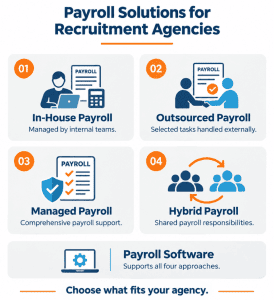
Recruitment agencies can manage payroll in-house, outsource selected tasks, use a fully managed service, or combine internal and external support. Each approach offers different levels of control, responsibility, and specialist assistance.
| Payroll solution | How it works | Suitable for |
|---|---|---|
| In-house payroll | Internal staff manage calculations, payments, and HMRC reporting. | Agencies with experienced payroll teams. |
| Outsourced payroll | An external provider handles specific tasks, such as payroll calculations, payslips, and submissions. | Agencies wanting to reduce routine administration while retaining internal oversight. |
| Managed payroll | A provider takes responsibility for a broader, agreed payroll process, including ongoing administration and reporting. | Agencies seeking comprehensive operational support. |
| Hybrid payroll | Internal staff and external specialists share responsibilities. | Agencies wanting flexibility and control over selected tasks. |
Payroll software supports these approaches rather than operating as a separate service model. Agencies can use software internally or work with providers that use integrated payroll platforms.
The main distinction between outsourced and managed payroll is the scope of responsibility. Outsourcing may cover selected processing tasks, while managed payroll typically provides more comprehensive day-to-day administration.
Agencies should choose an arrangement based on workforce size, payroll complexity, internal expertise, and the level of support required.
How Can Recruitment Agencies Maintain Payroll Compliance?
Recruitment agencies must manage PAYE, National Insurance, holiday pay, workplace pensions, and worker classification while meeting HMRC reporting requirements. They must also consider the Agency Workers Regulations (AWR) and the umbrella-company PAYE rules introduced on 6 April 2026.
These obligations require careful attention even when payroll processing is outsourced.
How Do PAYE and National Insurance Apply to Agency Workers?
Under the agency legislation, recruitment agencies may be required to operate PAYE for workers supplied to clients, even when those workers are not employees for all employment law purposes.
Where applicable, the responsible party must:
- Deduct Income Tax and employee National Insurance.
- Account for employer National Insurance contributions.
- Submit payroll information through Real Time Information (RTI).
- Pay HMRC within the relevant deadlines.
The correct treatment depends on the working arrangements and applicable legislation. Agencies should consult HMRC’s employment intermediary guidance when determining their responsibilities.
What Holiday Pay and Pension Responsibilities Apply?
Agency workers are generally entitled to statutory paid annual leave, but calculation methods depend on their working patterns.
- Regular-hours workers: Holiday pay is calculated using the applicable statutory rules and normal remuneration requirements.
- Eligible irregular-hours and part-year workers: Different holiday accrual rules apply, and rolled-up holiday pay may be used where legally permitted.
The GOV.UK holiday entitlement guidance explains these requirements.
Employers must also assess eligible workers for workplace pension automatic enrolment. A payroll provider may calculate contributions and process deductions, but this does not automatically transfer the employer’s wider pension compliance responsibilities.
How Do Agency Workers Regulations Affect Payroll?
The Agency Workers Regulations (AWR) provide qualifying agency workers with certain equal treatment rights.
After completing 12 qualifying weeks in the same role with the same hirer, agency workers generally become entitled to equal treatment concerning basic working and employment conditions, including relevant pay and annual leave provisions.
Recruitment agencies should track assignment histories, qualifying periods, and applicable pay arrangements to support compliance.
Why Is Worker Classification Important?
Recruitment agencies may supply workers through direct employment, agency arrangements, or umbrella companies. These arrangements affect who operates payroll, makes statutory deductions, and fulfils employment obligations.
Worker classification must reflect the actual contractual and working arrangements rather than simply the description used in an agreement.
Agencies should establish the responsible payroll party before processing payments.
What Has Changed in Umbrella Company PAYE Responsibilities?
From 6 April 2026, new UK rules introduced joint and several liability for certain PAYE debts in labour supply chains involving umbrella companies. Where an umbrella company employs a worker supplied through a recruitment agency, the agency may be held liable for PAYE amounts that the umbrella company fails to account for. Where no agency is involved, the end client may become liable.
This means recruitment agencies cannot assume that appointing an umbrella company removes their PAYE exposure.
To manage these risks, agencies should:
- Review umbrella-company arrangements and contractual responsibilities.
- Check how PAYE and National Insurance are operated.
- Maintain accurate worker and payment records.
- Monitor payroll compliance throughout the supply chain.
The new rules make appropriate checks on umbrella-company arrangements particularly important for recruitment businesses. Official guidance: GOV.UK: Tackling non-compliance in the umbrella company market.
How Much Do Outsourced Payroll Services for Recruitment Agencies Cost?
The cost of outsourced payroll services for recruitment agencies depends on worker numbers, payment frequency, payroll complexity, and the level of support required. Providers may charge per worker, per payslip, or through an agreed monthly fee.
Before comparing quotations, agencies should understand what each service includes.
Common pricing factors include:
- Payroll volume: The number of workers processed during each pay period.
- Payment frequency: Weekly payroll may involve more frequent processing than monthly payroll.
- Worker arrangements: Different employment structures may require additional administration.
- Additional services: Pension processing, corrections, and specialist reporting may affect costs.
- Software integration: Connecting payroll platforms with existing systems may involve setup fees.
- Customer support: Dedicated account management or additional assistance may influence pricing.
Agencies should ask whether setup, payslips, HMRC submissions, pension administration, and payroll corrections are included in the quoted fee. The lowest price does not always represent the best value. Consider the time saved, quality of support, and reliability of the payroll process when comparing providers.
Setting up payroll for your limited company? Learn how to manage employee payments, PAYE, and HMRC requirements in our guide on how to set up payroll for a limited company.
How Do You Choose the Right Payroll Provider for Your Recruitment Agency?
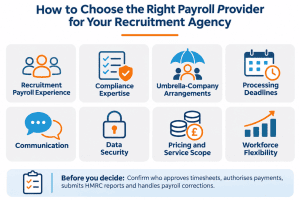
Choosing the right payroll provider involves assessing recruitment industry experience, compliance expertise, service reliability, and transparent pricing. The provider should understand temporary worker arrangements, weekly payroll deadlines, and the responsibilities associated with umbrella companies.
Before appointing a provider, consider the following:
| What to assess | What to look for |
|---|---|
| Recruitment payroll experience | Experience managing temporary workers, variable pay rates, and frequent starters and leavers. |
| Compliance expertise | Knowledge of PAYE, National Insurance, holiday pay, AWR, and workplace pensions. |
| Umbrella-company arrangements | Clear procedures for checking umbrella-company compliance and managing PAYE risks under the rules introduced in April 2026. |
| Processing deadlines | Defined timesheet cut-offs, approval procedures, and arrangements for late submissions. |
| Communication | A dedicated contact and clear procedures for resolving payroll queries. |
| Data security | Appropriate safeguards for worker information, bank details, and payroll records. |
| Pricing and service scope | Transparent fees covering payroll runs, corrections, reporting, and additional services. |
| Workforce flexibility | Capacity to handle changing worker numbers and payroll volumes. |
Before signing an agreement, confirm who approves timesheets, authorises payments, submits HMRC reports, and handles payroll corrections. For agencies working with umbrella companies, ask how the provider checks PAYE compliance and what evidence it can supply to support due diligence.
A suitable payroll partner should offer clearly defined responsibilities, dependable processing, and practical support for the agency’s specific workforce arrangements.
How Can Direct Payroll Services Support Recruitment Agencies?
Recruitment agencies often manage weekly payroll runs, changing worker numbers, variable pay rates, and tight timesheet deadlines. These demands require accurate processing and a clear understanding of PAYE obligations.
Direct Payroll Services offers outsourced payroll support to help recruitment agencies manage:
- Weekly payroll processing: Calculating wages based on approved timesheets and agreed pay rates.
- PAYE and National Insurance: Managing statutory deductions and HMRC reporting.
- Payslips and payroll reports: Preparing payment information and records for review.
- Workplace pensions: Supporting applicable pension calculations and administration.
- Payroll adjustments: Helping resolve discrepancies and process corrections.
Agencies can discuss their worker arrangements, payroll frequency, and reporting requirements to establish which responsibilities can be outsourced.
Need reliable payroll support for your recruitment agency? Contact Direct Payroll Services to discuss your requirements and explore a suitable service.
How Can Recruitment Agencies Switch to Outsourced Payroll Smoothly?
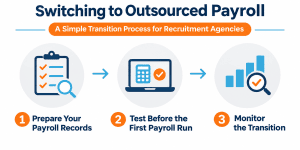
Recruitment agencies can reduce disruption during payroll outsourcing by reviewing existing records, agreeing on responsibilities, testing calculations, and establishing clear approval procedures. A planned transition gives both teams time to identify problems before the first live payroll run.
The following steps can help make the change more manageable.
How should you prepare your payroll records?
Start by reviewing your current payroll systems and identifying recurring problems. Gather worker details, pay rates, tax information, pension records, and previous payroll reports. Check that the information is complete and up to date before transferring it.
The agency and provider should also agree on a timetable, including responsibilities for worker onboarding and timesheet approval.
What should happen before the first payroll run?
Before the first live week, confirm that worker records and payroll balances have transferred correctly. Test sample calculations and review any differences between the previous and new systems.
Where practical, running a parallel payroll calculation can help identify problems without affecting actual worker payments.
How Can You monitor the transition?
Assign an internal payroll manager or authorised employee to review the initial payroll reports. Check wages, deductions, and worker records before approving payments. After the first run, discuss any issues with the provider and agree on corrective actions.
The transition may take longer than a matter of days, depending on the number of workers, existing systems, and data quality.
How Is Payroll Outsourcing Different From Payroll Recruitment Services?
Payroll outsourcing and payroll recruitment services serve different purposes. Payroll outsourcing involves hiring an external provider to manage payroll processing, while payroll recruitment focuses on finding qualified professionals to fill internal payroll positions.
| Feature | Payroll Outsourcing | Payroll Recruitment Services |
|---|---|---|
| Main purpose | Manage payroll operations externally. | Recruit payroll professionals. |
| Services provided | Wage calculations, PAYE deductions, payslips, and HMRC reporting. | Candidate sourcing, screening, and placement. |
| Specialist roles | External payroll administrators and specialists. | Payroll clerks, administrators, managers, and heads of payroll. |
| Executive search | Not typically included. | May include recruiting senior payroll professionals. |
| Best suited for | Businesses wanting to reduce internal payroll administration. | Businesses building or expanding an internal payroll team. |
| Ongoing responsibility | Provider manages agreed payroll tasks. | Employer manages payroll through recruited staff. |
Specialist payroll recruitment agencies may use salary surveys, industry networks, and executive search services to identify candidates. For example, financial services businesses in the City of London may use these services to recruit senior payroll professionals.
The choice depends on your business needs. If you want to build an internal payroll team, recruitment services may be suitable. If you need external support with payroll processing and reporting, outsourcing may be more practical.
How Can Recruitment Agencies Make Payroll More Efficient?
Start by identifying where your current payroll process causes delays, unnecessary costs, or compliance risks. Review your timesheet approval procedures, clarify internal responsibilities, and assess whether your existing resources can support future workforce changes.
If payroll demands exceed your team’s capacity, compare outsourced providers based on their recruitment industry experience, service scope, and compliance support. The goal is to establish a reliable payroll process that supports business growth without increasing administrative pressure.
Frequently Asked Questions
What are outsourced payroll services for recruitment agencies?
Outsourced payroll services allow recruitment agencies to appoint an external provider to manage agreed payroll tasks. These may include wage calculations, tax deductions, payslips, HMRC submissions, and payroll reporting for temporary or permanent workers.
Is payroll outsourcing suitable for small recruitment agencies?
Yes. Small recruitment agencies may benefit from outsourcing when payroll administration takes time away from recruitment activities. A provider can manage agreed processing responsibilities while the agency maintains oversight of worker information and payments.
Can outsourced payroll providers manage weekly payments?
Yes. Many outsourced payroll providers support weekly payroll processing. Recruitment agencies should confirm timesheet deadlines, approval procedures, payment arrangements, and correction processes before choosing a service to ensure workers receive their wages on schedule.
What is the difference between recruitment agency payroll and standard payroll?
Recruitment agency payroll often involves temporary workers, variable hours, multiple assignments, and frequent payments. Standard payroll may involve more consistent working arrangements, although both must follow applicable PAYE, National Insurance, and employment requirements.
Can recruitment agencies outsource payroll and retain control?
Yes. Recruitment agencies can retain control over worker information, timesheet approvals, and payroll authorisation while outsourcing agreed processing tasks. The exact division of responsibilities should be clearly documented in the service agreement.
Does payroll outsourcing remove compliance responsibilities?
No. Outsourcing payroll does not automatically remove an agency’s legal responsibilities. The agency must understand its obligations, provide accurate information, and maintain appropriate oversight, even when an external provider handles calculations and reporting.
Can payroll software integrate with recruitment management systems?
Yes. Some payroll software for recruitment agencies integrates with recruitment management, timesheet, and accounting systems. Integration capabilities vary, so agencies should confirm compatibility and data transfer requirements before purchasing or implementing a system.
How long does it take to switch payroll providers?
The transition period depends on worker numbers, payroll complexity, data quality, and the provider’s onboarding process. Agencies should allow time for transferring records, checking calculations, testing systems, and resolving issues before the first live payroll run.