Key Highlights
- Back pay is compensation owed to an employee for past work that was underpaid or unpaid.
- Common causes of back pay include payroll errors, delayed implementation of a pay rise, and failure to meet minimum wage requirements.
- Employers have legal requirements to correct underpayments promptly to maintain payroll compliance.
- Calculating back pay involves determining the difference between what was paid and what was owed for a specific period.
- Using reliable payroll software can help prevent errors and simplify the process of calculating and issuing back pay.
Payroll isn’t just about numbers; it’s about trust. When employees aren’t paid correctly for work they’ve already done, that trust takes a hit. In the UK, where compliance matters just as much as accuracy, even small payroll mistakes can lead to bigger issues, making back pay essential to set things right.
Back pay occurs when wages that should have been paid earlier are paid later due to payroll errors, delayed adjustments, or contractual changes. While correcting payroll discrepancies is part of responsible payroll management, failing to address underpayments promptly can lead to employee disputes, legal claims, and compliance risks.
Understanding how back pay works helps employers manage payroll corrections effectively while meeting statutory obligations. This guide explains what back pay means, the situations that lead to back pay adjustments, how to calculate it correctly, and how employers can ensure payroll accuracy when issuing backdated payments.
What Is Back Pay?
Back pay refers to wages that an employee is owed for work they have already completed but were not paid correctly when payment should have been made. This typically happens when an employer identifies that an employee was underpaid during a previous payroll cycle. The missing wages must then be calculated and paid in a later payroll run.
Back pay may apply to a range of payroll scenarios, including wage miscalculations, delayed salary adjustments, or statutory pay corrections. Once the issue is identified, employers must calculate the difference between what the employee was paid and what they should have received. The resulting amount is then issued to the employee as a payroll adjustment.
While the concept is straightforward, how back pay is applied in practice depends on UK payroll rules and employer obligations.
How Does Back Pay Work in the UK?
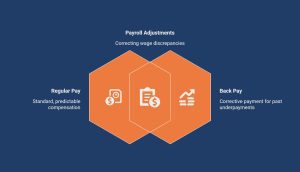
Back pay in the UK is processed as a corrective payroll adjustment when an underpayment is identified. Once a discrepancy is found, employers must recalculate the owed amount and include it in a future pay run with the correct tax and National Insurance deductions. This ensures payroll records remain accurate and compliant with UK employment law.
1. What Does Back Pay Mean for Wages?
In payroll operations, back pay is treated as an adjustment rather than a standard payment. It is applied after identifying a shortfall in a previous pay period and is included in a later payroll run.
To process back pay correctly, employers must:
- Recalculate the difference between actual and correct pay
- Apply PAYE tax and National Insurance contributions
- Record the adjustment clearly in payroll reports
Handling back pay this way ensures consistency across payroll records and supports accurate HMRC reporting.
2. Back Pay vs Regular Pay: Key Differences
Back pay and regular pay differ in both purpose and timing within payroll processing.
| Feature | Back Pay | Regular Pay |
| Purpose | Corrects previous underpayment | Pays for current work period |
| Timing | Processed after discrepancy is identified | Paid within scheduled payroll cycle |
| Frequency | Occasional adjustment | Recurring payment |
| Payroll Treatment | Included as an adjustment | Standard payroll processing |
| Compliance Role | Resolves past discrepancies | Maintains ongoing payroll accuracy |
While regular pay reflects current earnings, back pay ensures that any past payroll discrepancies are corrected.
3. Why Is Correct Back Pay Processing Important?
Accurate back pay processing is essential for maintaining compliant payroll operations. Once an underpayment is identified, delays or incorrect calculations can increase financial and legal risk.
For employers, this helps:
- Prevent HMRC penalties and wage disputes
- Maintain accurate payroll and audit records
- Ensure compliance with minimum wage regulations
Consistent handling of back pay also strengthens payroll accuracy across multiple pay cycles.
Back pay is not just about correcting past errors. It directly impacts how payroll is calculated, reported, and communicated to employees. Understanding how it works is important, but knowing what causes it is equally critical to preventing recurring payroll issues.
What Common Situations Lead to Back Pay?
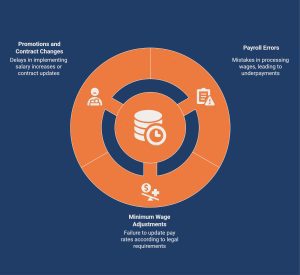
There are several common reasons why an employee might receive back pay. The most frequent triggers include payroll errors, adjustments to the minimum wage, and changes to an employee’s contract, such as a pay rise or unpaid overtime.
Understanding these common scenarios can help you, as an employer, be more vigilant, reduce the administrative burden of corrections, and ensure your team is always paid accurately. Let’s look at some of these situations in more detail.
1. Payroll Errors and Delays
Payroll errors are a common cause of back pay and occur more often than expected. Issues like missed overtime, incorrect tax codes, or delayed record updates may seem minor individually, but can quickly scale across payroll, leading to significant financial discrepancies. These are often identified during audits or employee queries.
Even with payroll software, manual inputs can introduce risk. Errors such as unrecorded overtime, incorrect pay after role changes, or processing delays can affect multiple employees at once. If not resolved promptly, they can create operational strain and potential compliance issues.
2. Minimum Wage Adjustments
UK employers must comply with the National Minimum Wage (NMW) and National Living Wage (NLW), which are updated annually in April. Failing to apply these rates correctly can lead to underpayments, back pay liabilities, and potential HMRC enforcement, including penalties and public naming.
This risk also extends to age-related pay increases. If employees move into higher age brackets and rates are not updated on time, employers may face compliance breaches. Even small oversights can trigger legal exposure and require corrective payments.
3. Promotions, Pay Rises, or Contract Changes
Back pay often occurs when salary updates from promotions, pay rises, or contract changes are not processed on time. If the new pay rate is applied late, employees are owed the difference for the period of delay.
Backdated pay agreements, especially in unionised settings, can also result in back pay. These ensure employees receive the correct earnings aligned with updated contracts and agreed financial terms.
Beyond these operational scenarios, employers must also consider the legal framework governing when and how back pay must be issued.
What are the legal requirements for back pay in the UK?
There are significant legal requirements for employers regarding back pay in the UK. Failing to pay an employee the correct amount is considered an “unlawful deduction from wages” under the Employment Rights Act 1996. This applies to all workers, regardless of their employment status.
Let’s examine the specific rules employers must follow:
1. Statutory Regulations for Employers
In the UK, employer obligations are defined under legislation such as the Employment Rights Act 1996 and the National Minimum Wage Act 1998. Employers must ensure all work is paid at the correct contractual or statutory rates, including full compliance with minimum wage laws.
If underpayment occurs, it must be corrected as a legal requirement. Failure to do so can trigger HMRC enforcement, including repayment orders, financial penalties of up to 200% of the underpaid amount, and public naming of non-compliant employers.
2. Time Limits on Back Pay Claims
Employees can bring a claim for unlawful deduction from wages within three months (minus one day) from the last underpayment. For employers, this highlights the importance of resolving payroll errors quickly, as claims can arise within a relatively short timeframe.
Where underpayments form part of an ongoing series, the time limit is linked to the most recent deduction. This means repeated payroll errors can extend exposure, allowing claims to cover multiple instances and increasing potential financial and legal risk.
3. Employer Responsibilities Under UK Law
UK employers must ensure accurate and compliant payroll, paying employees correctly and on time. This includes effectively handling different pay rates, contract updates, and statutory changes.
Keeping accurate payroll records is essential. Employers must track hours, payments, and quickly correct any underpayments by issuing back pay to maintain compliance and avoid disputes.
Once these obligations are understood, the next step is ensuring that any back pay owed is calculated accurately.
How to Calculate Back Pay in the UK?
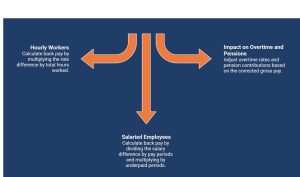
Calculating back pay doesn’t have to be complicated. The fundamental step in all back pay calculations is to determine the difference between what an employee should have been paid and what they actually received for a specific period. This involves checking their correct rate of pay, hours worked, and any overtime hours.
Let’s break down how to approach these calculations:
1. For Hourly Workers
Back pay for hourly workers is calculated by finding the difference between the correct and incorrect hourly rates, then multiplying that difference by the total hours worked during the underpayment period. Use this formula: rate difference × total hours worked = back pay owed. Don’t forget to include any missed overtime, especially if higher overtime rates apply.
2. For Salaried Employees
For salaried employees, calculate the difference between the old and the new annual salary. Divide this by the number of pay periods to find the shortfall per period. Then multiply by the number of underpaid periods. For example, a delayed pay rise over three months means multiplying the monthly shortfall by three.
3. Impact on Overtime and Pensions
Back pay can affect overtime and pension contributions. If the base pay increases, overtime rates (often 1.5x or more) must also be recalculated for the affected period. Pension contributions, based on total earnings, should also be adjusted. This ensures that both employee and employer contributions accurately reflect the corrected gross pay.
Even with a clear calculation method, errors can still occur if the process is not handled carefully.
What Are the Most Common Mistakes to Avoid?
Incorrectly managing back pay can lead to payroll inaccuracies, compliance breaches, and employee disputes. For employers, these mistakes often stem from process gaps or oversight, but their impact can scale quickly across multiple pay cycles and employees.
1. Failing to Identify Payroll Errors Promptly
Delays in detecting payroll issues can increase liability, especially if underpayments continue over several pay periods. Regular audits and reconciliations are essential to minimise financial exposure.
2. Incorrect Back Pay Calculations
Miscalculating the difference between what was paid and what should have been paid can result in further discrepancies. Employers must account for rates, hours, bonuses, and any contractual changes accurately.
3. Ignoring Tax Implications
Back pay is subject to PAYE tax and National Insurance, and incorrect handling can lead to reporting errors and HMRC scrutiny. Proper adjustments must be made at the time of processing.
4. Overlooking Pensions and Deductions
Backdated payments may affect pension contributions and other statutory deductions. Failing to adjust these correctly can create compliance gaps and impact employee benefits.
5. Poor Payroll Record-Keeping
Incomplete or inaccurate records of back pay adjustments can lead to audit issues and disputes. Clear documentation is essential to demonstrate compliance and justify corrections.
Addressing these areas proactively helps employers reduce risk, maintain compliance, and ensure payroll adjustments are handled accurately and transparently.
How Is Back Pay Handled on Your Payslip?
When an employee receives back pay, it will be processed through your standard payroll process. This means it is subject to the same deductions as regular earnings, including income tax and National Insurance contributions. The back pay amount is added to the employee’s gross pay for the current pay period.
How Back Pay Appears on a Payslip in the UK?
Back pay should be clearly itemised on a payslip to avoid confusion. Adding it to the regular salary without explanation can raise questions about unexpected changes in pay. Most payroll systems include it as a separate line item. A clear label, gross amount, and relevant pay period help ensure transparency and show that past payment issues have been corrected.
Tax and National Insurance Considerations for Back Pay
Back pay is subject to income tax and National Insurance under PAYE. Since it’s taxed in the current pay period, a lump sum may temporarily push employees into a higher tax bracket. While income tax usually balances over the tax year, National Insurance is calculated per pay period. Keeping accurate records is essential, especially if payments relate to a previous tax year.
Given these technical considerations, many businesses seek structured support when managing payroll adjustments, such as back pay.
How Direct Payroll Services Can Help Manage Back Pay?
Direct Payroll Services takes the complexity out of back pay adjustments, helping businesses stay accurate, compliant, and stress-free, even when payroll gets complicated.
Managing back pay across multiple employees, changing pay structures, and statutory deductions like PAYE, National Insurance, and pensions can quickly become overwhelming. With expert support, these challenges are handled efficiently and correctly the first time.
- Accurate back pay calculations with full compliance checks
- Seamless PAYE, National Insurance, and pension adjustments
- Reliable HMRC reporting and submission support
- Scalable solutions for businesses of all sizes
- Reduced administrative burden with dedicated payroll expertise
With Direct Payroll Services, you can minimise errors, maintain compliance, and ensure every payslip reflects exactly what it should, without the operational strain.
Ready to simplify payroll and eliminate costly errors? Contact Direct Payroll Services today and take control with confidence.
Conclusion
Back pay plays an important role in correcting payroll discrepancies and ensuring employees receive the wages they are entitled to. Whether caused by payroll errors, delayed salary adjustments, or minimum wage corrections, back pay helps employers maintain accurate payroll records and comply with employment regulations.
However, calculating and managing back pay requires careful payroll administration to ensure that tax deductions, pension contributions, and payroll reporting obligations are handled correctly. Businesses that implement structured payroll processes or work with experienced payroll professionals can reduce the risk of payroll errors and maintain consistent compliance with UK payroll regulations.
Frequently Asked Questions
1. Can back pay be paid over several payments, or must it be a lump sum?
While back pay is typically paid as a lump sum on the next pay day, an employer and employee can mutually agree to spread the payment over more than one pay period. Both parties must agree upon this, and the full amount must still be paid. Your payroll systems should be able to accommodate this arrangement.
2. What should employees do if back pay is missing?
If an employee believes they are owed back pay, the first step is to discuss the pay issues with their manager or the payroll department. If this doesn’t resolve the matter, they can raise a formal grievance. As a last resort, they can initiate legal action through an employment tribunal.
3. How can employers and HR ensure accurate back pay calculations?
To ensure payroll compliance, employers should use reliable payroll software to automate the payroll process and maintain accurate records. Double-checking all calculations and being transparent with employees can help reduce the administrative burden and prevent future errors. A clear, documented procedure is key.
4. How is backdated pay calculated?
Backdated pay is calculated by finding the difference between the correct rate of pay and the rate that was actually paid. You then multiply this difference by the number of hours or pay periods affected. Always consult your payroll records to ensure accuracy.
5. How is back pay different from normal pay?
Regular pay is for work done in the current pay period, whereas back pay (or retro pay) is a corrective payment for underpaid work from a past period. While regular pay is routine, issuing back pay is a legal requirement to fix a past error.