Key Highlights
- Real Time Information (RTI) is an HMRC system requiring employers to report payroll information every time they pay staff.
- The system uses two main submission types: the Full Payment Submission (FPS) and the Employer Payment Summary (EPS).
- Using RTI-compliant payroll software is essential for submitting pay, income tax, and National Insurance contributions accurately.
- RTI was introduced to make PAYE reporting more efficient and accurate throughout the tax year.
- Late or incorrect submissions can lead to penalties from HMRC.
Payroll reporting no longer ends with year-end submissions. Under HMRC’s Real Time Information (RTI) framework, employers must send employee pay, PAYE deductions, and National Insurance details every time staff are paid.
The system was introduced to reduce discrepancies between employer payroll records and HMRC tax data. Incorrect employee details, missed deadlines, or duplicate submissions can trigger PAYE issues, compliance checks, and financial penalties.
Businesses operating PAYE schemes need clear processes for submitting, reviewing, and correcting payroll data throughout the tax year. This guide explains how RTI submissions work, when FPS and EPS reports are required, how corrections are handled, and the compliance risks employers should monitor.
What Is RTI in Payroll?
Real Time Information (RTI) is HMRC’s system for reporting employee pay and deductions whenever payroll is processed. Instead of submitting payroll records at the end of the tax year, employers must send payroll data each time employees are paid through PAYE.
RTI was introduced in 2013 to replace annual PAYE reporting with ongoing payroll submissions linked to each pay cycle. Employers submit payroll information on or before payday, allowing HMRC to maintain more current tax records throughout the year.
RTI submissions typically include:
- Employee pay
- Income tax deductions
- National Insurance contributions
- Statutory payments
- Pension deductions
The system helps identify payroll discrepancies earlier and keeps employee tax records aligned with payroll activity.
Why Did HMRC Introduce RTI?
HMRC introduced RTI to improve PAYE accuracy, provide more up-to-date employee tax records, and reduce the delays associated with year-end reporting. More frequent payroll submissions also support faster tax code updates and help government benefit calculations, including Universal Credit.
Who Must Comply With RTI Reporting?
RTI reporting applies to most employers operating a PAYE scheme, regardless of business size. Businesses must submit payroll information whenever employees are paid, including payments made to part-time, temporary, seasonal, and director-only payroll staff.
Employers typically required to comply with RTI include:
- Limited companies operating PAYE
- SMEs with payroll employees
- Recruitment agencies and contractors
- Businesses paying directors through payroll
Employers also need:
- A PAYE reference number
- An Accounts Office reference
- HMRC-recognised payroll software
RTI has become a core requirement of PAYE payroll reporting, making it essential for employers to understand how submissions work and when reporting obligations apply.
What Are RTI Submissions?
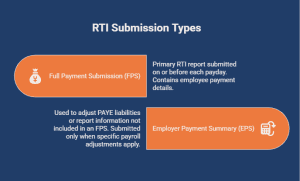
RTI reporting uses two main submission types: the Full Payment Submission (FPS) and the Employer Payment Summary (EPS).
1. What Is Full Payment Submission (FPS)?
A Full Payment Submission (FPS) is the primary RTI report employers submit on or before each payday. It contains employee payment details for that pay cycle, including earnings, PAYE deductions, National Insurance contributions, pension deductions, and statutory payments.
HMRC uses FPS data to:
- update employee tax records,
- calculate PAYE liabilities,
- and monitor payroll reporting activity.
Most employers submit an FPS every time payroll is processed.
2. What Is Employer Payment Summary (EPS)?
An Employer Payment Summary (EPS) is used when employers need to adjust PAYE liabilities or report information not included in an FPS. Unlike FPS submissions, an EPS is only submitted when specific payroll adjustments apply.
Businesses typically use an EPS to:
- Reclaim statutory payments
- Claim Employment Allowance
- Report periods with no employee payments
- Adjust PAYE amounts owed to HMRC
When Do You Need an EPS?
Use an EPS when:
- No employees were paid during a tax period
- Claiming Employment Allowance
- Recovering statutory payments
- Reporting PAYE adjustments not included in an FPS
This keeps the section concise, improves scannability, and follows the editor’s instruction to add a practical checklist rather than more explanatory content.
How Does RTI Reporting Work?
RTI reporting links payroll processing directly to HMRC reporting requirements. Each time employees are paid, payroll information is submitted through RTI-compliant software, allowing HMRC to maintain current PAYE records throughout the tax year.
This approach replaces year-end payroll reporting and gives HMRC more timely visibility of employee earnings, tax deductions, and National Insurance contributions. More frequent reporting also helps support PAYE accuracy, tax code updates, and benefit calculations.
What Payroll Information Is Included in RTI Reporting?
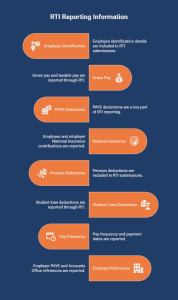
RTI submissions typically include:
- Employee identification details
- Gross pay and taxable pay
- PAYE deductions
- Employee and employer National Insurance contributions
- Pension deductions
- Student loan deductions
- Pay frequency and payment dates
- Employer PAYE and Accounts Office references
By providing more timely payroll data throughout the tax year, RTI helps HMRC maintain current PAYE records and reduces the reliance on year-end reporting adjustments.
How Can Employers File RTI Online?
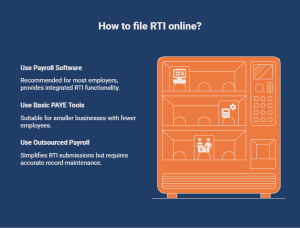
RTI submissions are filed electronically through HMRC-recognised and RTI-compatible payroll software. Employers use these systems to generate FPS or EPS reports and submit them directly to HMRC on or before payroll deadlines. Businesses with fewer employees may use HMRC’s Basic PAYE Tools, while larger employers typically use commercial payroll software with integrated RTI functionality.
1. What Do Employers Need Before Filing RTI?
Before submitting RTI reports, employers need:
- HMRC-recognised and RTI-compatible payroll software
- Government Gateway account credentials
- PAYE and Accounts Office reference numbers
- Accurate employee payroll records
- Validation that payroll software is correctly configured for RTI submissions
Incorrect employee details, invalid PAYE references, or incomplete payroll setup can lead to rejected submissions and reporting delays.
2. How Is RTI Submitted to HMRC?
Once payroll has been processed, payroll software generates an FPS or EPS report using employee pay and deduction records for that pay period. The report is then submitted electronically to HMRC through the employer’s PAYE online account.
After submission, HMRC returns a confirmation showing whether the file has been accepted or rejected. Rejected submissions should be reviewed immediately, as incorrect employee details, duplicate records, or late corrections can create PAYE discrepancies and filing penalties.
Businesses using outsourced payroll providers usually have RTI submissions handled on their behalf, although employers remain responsible for maintaining accurate payroll records and employee information.
3. What Are the RTI Filing Deadlines?
Most employers must submit an FPS on or before each employee’s payday. Missing this deadline is one of the most common RTI compliance issues and can result in HMRC penalties.
EPS deadlines apply when employers need to report payroll adjustments or periods with no employee payments. Businesses running weekly payroll often face more frequent filing, increasing the risk of missed deadlines if payroll records are not maintained consistently.
| Submission Type | Deadline |
|---|---|
| Full Payment Submission (FPS) | On or before employee payday |
| Employer Payment Summary (EPS) | By the 19th of the following tax month |
| Final FPS or EPS for the tax year | By 19 April following the tax year |
Most RTI filing issues stem from missed deadlines, incorrect employee records, or payroll setup errors. Regular payroll reviews and prompt resolution of rejected submissions can help employers maintain compliant PAYE reporting throughout the tax year.
How Do You Correct an RTI Submission?
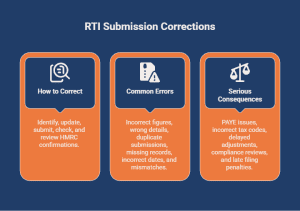
RTI corrections are made by updating payroll records and submitting revised information through payroll software. The correction process depends on whether the discrepancy relates to the current or previous tax year.
How to Correct an RTI Submission
Step 1: Identify the payroll discrepancy
Review payroll records to determine whether the issue relates to employee details, pay figures, deductions, payment dates, or submission data.
Step 2: Update the payroll record
Correct the affected employee information or payroll figures within the payroll system before generating a revised submission.
Step 3: Submit revised payroll information
For current tax year discrepancies, corrected year-to-date figures are usually included in the next Full Payment Submission (FPS).
Step 4: Determine whether a previous-year correction is required
Historic payroll discrepancies may require an additional FPS or an Earlier Year Update (EYU), depending on the payroll period affected and the payroll software used.
Step 5: Review HMRC confirmation messages
Check that the revised submission has been accepted and that no further action is required.
Common RTI Errors
Common RTI discrepancies include:
- Incorrect gross pay or deduction figures
- Wrong National Insurance details
- Duplicate payroll submissions
- Missing starters or leavers
- Incorrect payment dates
- Employee record mismatches
When Can RTI Errors Become Serious?
Payroll discrepancies become more serious when incorrect records remain unresolved across multiple pay periods. Repeated inaccuracies can result in:
- PAYE underpayments or overpayments
- Incorrect employee tax codes
- Delayed tax adjustments
- HMRC compliance reviews
- Late filing penalties
Correcting RTI discrepancies promptly helps maintain accurate PAYE records and reduces the risk of payroll errors affecting future submissions.
What Are the Biggest RTI Compliance Risks?
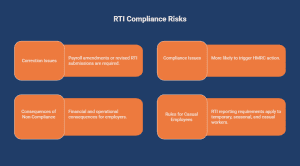
Most RTI compliance issues are linked to missed filing obligations, unresolved submission problems, and weak payroll controls. While some payroll discrepancies can be corrected through amended submissions, repeated reporting failures are more likely to result in HMRC penalties and compliance reviews.
What Causes RTI Compliance Issues?
RTI risks generally fall into two categories:
Correction Issues:-
These issues usually require payroll amendments or revised RTI submissions:
- Incorrect employee details
- Wrong pay or deduction figures
- Duplicate submissions
- Missing starters or leavers
Compliance Issues:-
These issues are more likely to trigger HMRC action:
- Late FPS submissions
- Failure to submit RTI reports
- Repeated reporting inaccuracies
- Unresolved rejected submissions
- Missed payroll deadlines
| Compliance Issue | Potential Impact |
|---|---|
| Late FPS submission | HMRC penalties |
| Failure to submit RTI reports | Compliance reviews |
| Repeated reporting inaccuracies | PAYE discrepancies |
| Unresolved rejected submissions | Reporting delays |
| Missed payroll deadlines | Filing penalties |
What Are the Consequences of RTI Non-Compliance?
Persistent filing failures and unresolved reporting issues can lead to both financial and operational consequences. Employers may face:
- Late filing penalties
- Interest charges on unpaid PAYE liabilities
- HMRC compliance reviews
- Requests for payroll record investigations
Incorrect or missing submissions can also affect employee tax codes, statutory payments, and benefit calculations where HMRC records no longer align with payroll data.
What Are the Rules for RTI for Casual, Seasonal, and Temporary Employees?
RTI reporting requirements apply to temporary, seasonal, and casual workers in the same way as permanent employees where payments are processed through PAYE.
Employers must:
- Include temporary staff within FPS submissions
- Maintain accurate starter and leaver records
- Apply the correct tax treatment throughout employment
Seasonal hiring and irregular pay schedules often create additional reporting complexity, making accurate employee records and timely submissions particularly important.
How Can Businesses Improve RTI Compliance?
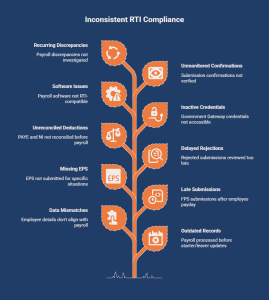
Employers can use the following checklist to reduce common RTI reporting issues and maintain compliant PAYE reporting throughout the tax year:
- Confirm employee starter and leaver records have been updated before payroll is processed
- Verify employee names, dates of birth, and National Insurance numbers match payroll records
- Check FPS submissions are scheduled for on or before employee’s payday
- Submit an EPS when claiming Employment Allowance, recovering statutory payments, or reporting periods with no employee payments
- Review rejected RTI submissions immediately and correct any payroll record mismatches
- Reconcile PAYE deductions and National Insurance contributions before finalising payroll
- Ensure Government Gateway credentials and PAYE references remain active and accessible
- Validate that payroll software is RTI-compatible and configured correctly for HMRC submissions
- Monitor submission confirmations to verify FPS and EPS reports have been accepted
- Investigate recurring payroll discrepancies before they affect multiple pay periods
Regular reviews of payroll records and submission confirmations can help identify reporting issues early and reduce the risk of penalties, rejected submissions, and PAYE discrepancies.
How Can Direct Payroll Services Support RTI Compliance?
Managing RTI reporting internally can be difficult when payroll deadlines, employee changes, and PAYE adjustments must be handled across multiple pay cycles. Missed submissions or unresolved payroll discrepancies can quickly create compliance issues, particularly for businesses with growing payroll demands.
Direct Payroll Services supports employers with:
- RTI payroll submissions
- FPS and EPS reporting
- PAYE administration
- Payroll reconciliation
- Employee payroll record management
- Payroll correction support
Outsourcing RTI administration can also reduce the operational pressure linked to payroll processing, submission monitoring, and HMRC reporting deadlines. Businesses with complex payroll structures or frequent employee changes often benefit from dedicated payroll oversight and more consistent reporting processes.
Businesses looking to improve payroll accuracy and reduce RTI reporting risk can contact Direct Payroll Services for outsourced payroll and compliance support.
Conclusion
RTI has changed payroll reporting from an annual process to continuous PAYE reporting throughout the tax year. Employers must maintain accurate employee records, submit FPS and EPS reports on time, and resolve payroll discrepancies quickly to reduce the risk of PAYE issues and HMRC penalties. Delayed submissions, incorrect employee details, and unresolved payroll mismatches can all create reporting complications that affect both employers and employees.
Businesses with frequent payroll changes, seasonal staff, or complex PAYE requirements often face greater reporting pressure across multiple pay cycles. Regular payroll reviews, reliable RTI-compliant software, and consistent payroll controls can help reduce filing errors and improve reporting accuracy. Employers should also review payroll processes regularly to identify discrepancies early and maintain compliant reporting practices throughout the tax year.
Frequently Asked Questions
What are the key steps for getting ready for RTI reporting as an employer?
The key steps for preparing for RTI reporting include registering for PAYE with HMRC, setting up HMRC-recognised payroll software, collecting accurate employee payroll records, obtaining PAYE and Accounts Office references, and reviewing payroll data before submitting FPS or EPS reports.
What are the consequences for employers if RTI submissions are late or incorrect?
Late or incorrect RTI submissions can lead to HMRC penalties, PAYE discrepancies, compliance reviews, and interest charges on unpaid liabilities. Ongoing payroll inaccuracies may also affect employee tax codes, statutory payments, and benefit calculations linked to HMRC records.
What is the main purpose of RTI in the context of UK payroll systems?
The main purpose of RTI in UK payroll systems is to provide HMRC with up-to-date employee pay and deduction records throughout the tax year, helping improve PAYE accuracy, tax calculations, and payroll compliance reporting.
What is an RTI, and When Does RTI Return have to be submitted?
An RTI (Real Time Information) return is a payroll submission sent to HMRC containing employee pay, PAYE deductions, and National Insurance details. Most RTI returns, including FPS submissions, must be submitted on or before the employee payday for each payroll cycle.
What types of information must be included in RTI submissions to HMRC?
RTI submissions typically include employee identification details, gross pay, taxable pay, PAYE deductions, National Insurance contributions, pension deductions, student loan repayments, payment dates, and employer PAYE reference information.