Key Highlights
- Parallel payroll testing involves running your old and new payroll systems at the same time to compare results.
- The primary goal is to identify and resolve any discrepancies before the new payroll system goes live.
- This process validates payroll data accuracy, ensuring employees are paid correctly.
- Comparing the old system with the new one helps confirm calculations for taxes, benefits, and net pay.
- Achieving accurate results during testing is crucial for a smooth transition to your new software.
- It minimises risks, ensures compliance, and builds confidence in the new system.
Switching to a new payroll system can feel like a big step, but it’s an exciting opportunity to improve your processes. To ensure everything goes off without a hitch, payroll parallel testing is a must.
This crucial stage involves running your old and new payroll software side-by-side. It acts as a safety net, helping you catch any potential issues before you make the final switch.
This guide will walk you through how to conduct a parallel test effectively for a seamless transition.
What Is a Payroll Parallel Run?
A payroll parallel run is a controlled testing process used when switching payroll systems to confirm accuracy before going live. Payroll is processed simultaneously in both the old and new systems, allowing teams to validate calculations, identify discrepancies, and ensure employees are paid correctly without disruption.
Here’s how a payroll parallel run works in practice:
- Payroll is processed for the same pay period in both the legacy and new payroll systems
- Results such as gross pay, deductions, taxes, and net pay are compared side by side
- Any differences are reviewed, corrected, and retested before full implementation
- Testing may run for one or multiple pay cycles to ensure consistent accuracy
A successful payroll parallel run reduces risk, prevents pay errors, and ensures a smooth transition to a new payroll system with confidence.
Why Does Payroll Parallel Testing Matter for UK Businesses?
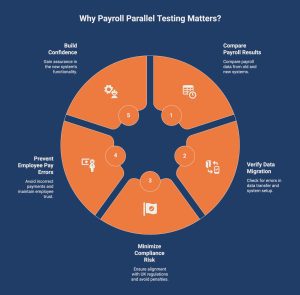
Payroll parallel testing helps UK businesses confirm payroll accuracy and compliance when implementing new payroll software. By testing before going live, organisations can identify discrepancies early, reduce risk, and ensure employees are paid correctly from the first official payroll run.
1. Ensuring Accurate Payroll Calculations
Parallel testing compares payroll results from old and new systems using the same data. This confirms that wages, taxes, deductions, and net pay are calculated correctly, allowing teams to validate accuracy across multiple pay cycles before fully switching systems.
2. Verifying Data Migration and System Configuration
Running payroll in parallel highlights issues caused by incorrect data transfers or system setup. Errors in employee records, pay structures, or deduction rules become visible early, enabling teams to correct configurations before they affect real employee payments.
3. Minimising Compliance and Regulatory Risk
Payroll errors can lead to HMRC penalties and legal exposure. Parallel testing ensures tax calculations, National Insurance contributions, and reporting align with UK regulations, reducing the risk of non-compliance when the new payroll system goes live.
4. Preventing Employee Pay Errors and Disruption
Incorrect pay damages employee trust and morale. Parallel testing allows businesses to catch discrepancies before employees are affected, ensuring consistent, accurate payments and avoiding complaints, corrections, or emergency payroll adjustments.
5. Building Confidence Before Going Live
Successful parallel runs provide clear evidence that the new payroll system works as intended. This builds confidence for payroll teams and leadership, supporting a smooth transition without operational disruption or uncertainty.
Payroll parallel testing is a critical safeguard that ensures payroll software changes are accurate, compliant, and stress-free for UK businesses.
When Should You Initiate a Payroll Parallel Run?
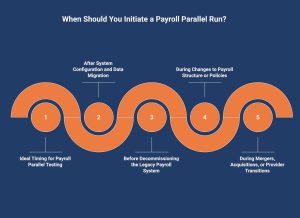
Payroll parallel testing should be initiated after your new payroll system is fully configured and initial employee data has been migrated. It is one of the final validation steps before retiring the legacy system, allowing you to confirm accuracy using real payroll data in a controlled test environment.
1. Ideal Timing for Payroll Parallel Testing
Parallel runs should be carried out during standard payroll cycles that reflect normal business operations. Testing during typical pay periods provides a reliable baseline and avoids anomalies caused by bonuses, mass hires, or unusually quiet cycles, ensuring accurate assessment of system performance.
2. After System Configuration and Data Migration
Parallel testing should only begin once payroll rules, tax settings, and employee data are correctly set up in the new system. Starting too early can produce misleading results and create unnecessary rework during the validation process.
3. Before Decommissioning the Legacy Payroll System
A parallel run should always occur before the old payroll system is switched off. This overlap ensures you can safely compare results, resolve discrepancies, and confirm confidence in the new system without risking employee pay accuracy.
4. During Changes to Payroll Structure or Policies
Parallel testing is recommended when implementing major payroll changes such as new overtime rules, benefits structures, or deduction policies. Running both systems together confirms that new rules are applied correctly before becoming operational.
5. During Mergers, Acquisitions, or Provider Transitions
Complex changes like mergers, acquisitions, or switching payroll providers require parallel testing to validate combined data, pay structures, and compliance. This reduces risk and ensures consistency across all employee records.
Initiating payroll parallel runs at the right time helps organisations transition smoothly, protect accuracy, and maintain employee trust throughout payroll changes.
How Do You Prepare for a Parallel Payroll Assessment?
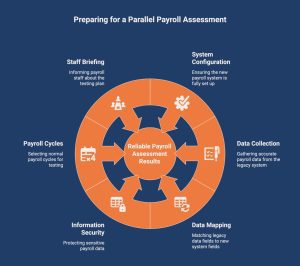
Preparing for a parallel payroll assessment ensures testing runs smoothly and produces reliable results. Before starting, organisations must align data, systems, and teams. Strong preparation helps payroll staff identify issues early, validate accuracy, and avoid confusion or rework during the testing phase.
Step 1: Finalise System Configuration and Testing Plan
Confirm that the new payroll system is fully configured, including pay rules, tax settings, and deductions. Define the scope, timelines, and responsibilities for the parallel run so everyone involved understands the process and expected outcomes clearly.
Step 2: Collect and Validate Payroll Data
Extract complete payroll data from the legacy system for the chosen pay period. This includes employee details, tax codes, benefits, and salary information. Ensure the data is accurate, up to date, and suitable for use in the new system.
Step 3: Map and Convert Data for the New System
Match legacy payroll fields to the correct fields in the new system. Convert formats where needed to avoid mismatches, calculation errors, or missing data during the parallel run comparison.
Step 4: Secure Payroll Information
Store extracted payroll data securely to protect sensitive employee information. Limit access to authorized payroll staff only and follow internal data protection and security policies throughout the testing process.
Step 5: Select the Right Payroll Cycles for Testing
Choose normal payroll cycles that reflect everyday operations. Avoid periods with bonuses, mass salary changes, or unusual activity so test results accurately reflect the new system’s core payroll performance.
Step 6: Brief Payroll Staff and Assign Responsibilities
Ensure payroll administrators understand the testing plan, comparison process, and issue-resolution steps. Clear ownership helps identify discrepancies quickly and ensures consistent evaluation of results across both systems.
Thorough preparation creates a strong foundation for successful parallel payroll testing and a smooth transition to the new payroll system.
What Are the Best Practices for Parallel Payroll Runs?
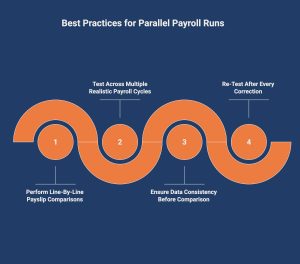
Parallel payroll runs are most effective when they are treated as structured validation exercises, not simple spot checks. Following disciplined best practices helps organisations uncover hidden issues before go-live and builds confidence in long-term payroll accuracy.
1. Perform Line-By-Line Payslip Comparisons
Compare every payroll component, not just net pay. Reviewing gross pay, tax, pensions, benefits, and deductions line by line helps identify configuration or calculation differences that may not be immediately visible.
2. Test Across Multiple Realistic Payroll Cycles
Run parallel payroll over several pay periods. This exposes issues related to cumulative tax thresholds, recurring deductions, and timing differences that may not appear in a single payroll run.
3. Ensure Data Consistency Before Comparison
Parallel testing only works when both systems use identical data. Employee records, tax codes, pay rates, and benefits must be fully aligned to avoid false discrepancies caused by setup or migration errors.
4. Re-Test After Every Correction
After resolving any issue, rerun the parallel payroll to confirm the fix works and has not created new errors. Retesting ensures changes deliver consistent results across all employees and pay elements.
Applying these practices helps organisations identify real risks early, avoid payroll disruptions, and confidently transition to a new payroll system.
What Are the Common Pitfalls to Avoid in Parallel Payroll Runs?
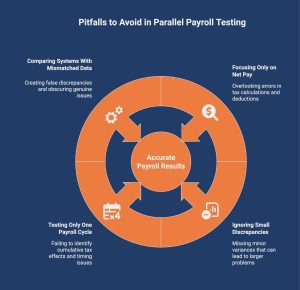
Even small missteps during parallel payroll testing can undermine results and allow serious issues to slip through. Avoiding these common pitfalls is just as important as following best practices.
1. Focusing Only On Net Pay
Focusing only on net pay hides errors in tax calculations, benefits, pensions, or deductions. This mistake commonly appears on any payroll parallel testing checklist, where issues may surface later during audits, compliance reviews, and reconciliations.
2. Ignoring Small Discrepancies
Minor discrepancies often signal incorrect tax rules, rounding logic, or configuration errors. When teams misunderstand what is payroll parallel testing, they may ignore small variances, allowing problems to compound and cause incorrect payments after go-live.
3. Testing Only One Payroll Cycle
Testing only one payroll cycle gives a limited view of performance. It fails to reveal cumulative tax effects, recurring deductions, or timing issues that appear when parallel runs payroll systems operate across multiple pay periods.
4. Comparing Systems With Mismatched Data
Comparing systems with mismatched data undermines parallel payroll testing entirely. Differences in employee records, tax codes, or pay rates create false discrepancies, waste time, reduce confidence, and obscure genuine calculation or configuration issues during validation.
Separating best practices from pitfalls helps organisations run parallel payroll with clarity, reduce risk, and move into live payroll with confidence rather than assumption.
What Are the Benefits of a Payroll Parallel Run for HR and Finance Teams?
Payroll parallel runs deliver more than technical validation. They reduce risk, protect employee trust, and give HR and finance teams confidence that payroll operations will remain accurate during system changes. By validating results before go-live, teams avoid costly disruptions and safeguard core people and financial processes.
Streamlining Onboarding of New Payroll Providers
Parallel runs make provider onboarding practical and controlled. HR and finance teams gain hands-on experience with the new system, learning workflows, reports, and controls before live payroll. Issues are resolved early, ensuring a smooth handover and operational readiness from day one.
Reducing Post-Go-Live Payroll Errors
Validating payroll calculations in advance prevents correction-heavy payroll cycles after launch. This lowers stress for payroll teams, avoids emergency fixes, and protects employees from incorrect pay, ensuring operational stability and consistent payroll outcomes.
Strengthening HR and Finance Collaboration
Parallel testing requires close coordination between HR and finance on data accuracy, pay rules, and compliance. This collaboration improves data quality, aligns responsibilities, and creates shared accountability for payroll accuracy across both functions.
Enhancing Team Confidence During Payroll Transition
Involving teams in testing builds familiarity and trust in the new system. Seeing accurate results across multiple pay cycles reduces uncertainty, boosts morale, and prepares teams to manage payroll confidently once the system goes live.
Supporting Risk Management and Compliance Assurance
Parallel runs act as a safeguard against financial and regulatory risk. By confirming tax, deduction, and reporting accuracy before launch, HR and finance teams can move forward knowing compliance requirements are met and payroll integrity is protected.
A well-executed payroll parallel run empowers HR and finance teams with confidence, clarity, and control throughout payroll system transitions.
What Are the Disadvantages of Payroll Parallel Testing?
Payroll parallel testing is highly effective, but it is not without challenges. Understanding its limitations helps organisations plan realistically, allocate resources properly, and avoid frustration during implementation while still benefiting from the added assurance it provides.
Increased Workload for Payroll Teams
Parallel testing requires payroll teams to process payroll twice for the same period, once in the legacy system and once in the new system. This significantly increases workload and time commitment, especially during already busy payroll or implementation phases.
Higher Time and Resource Requirements
Running multiple systems in parallel extends project timelines and requires additional coordination. Payroll administrators, HR, finance, and vendors may need to stay involved longer than planned, which can strain internal resources and delay other priorities.
Added Complexity for Large or Complex Payrolls
Organisations with multiple pay structures, benefits, or compliance rules may find parallel testing complex to manage. The more variables involved, the more effort is required to analyse discrepancies and validate results accurately.
Potential Pressure on Implementation Deadlines
Because parallel testing adds extra steps, it can place pressure on go-live schedules. If discrepancies take longer to resolve, organisations may need to delay system launch to avoid payroll risk.
Limited Coverage of All Possible Scenarios
Parallel testing only validates the scenarios and data included in the test cycles. Unusual events such as bonuses, mass changes, or rare deductions may not be fully tested, leaving a small chance of undiscovered issues after go-live.
Despite these drawbacks, most organisations find that the benefits of reduced payroll risk and increased confidence outweigh the limitations when parallel testing is planned and executed carefully.
Why Choose Direct Payroll as Your Payroll Partner?
At Direct Payroll Services, we support UK-based businesses with reliable, compliant, and fully managed payroll solutions. Our strategic payroll services are designed to reduce administrative pressure, improve accuracy, and give our clients confidence at every pay run. We work closely with businesses of all sizes, offering tailored support across managed payroll, outsourcing, payroll for accountants, CIS payroll, care sector payroll, and directors’ payroll.
With our hands-on approach, clear communication, and deep payroll expertise, we help you streamline processes, stay compliant, and focus on growing your business while we take care of payroll. Contact us today for a seamless payroll experience!
Conclusion
Conducting a payroll parallel assessment is crucial for ensuring the accuracy and effectiveness of your payroll processes during system changes. By understanding its importance, preparing adequately, and following best practices, you can minimise risks and enhance compliance within your organisation. The benefits extend beyond just accurate payroll; they also boost team confidence in transitioning to new systems and streamline the onboarding process with payroll providers. As you navigate this essential procedure, remember that thorough planning and execution can lead to a smooth payroll transition.
Frequently Asked Questions
How long does a typical payroll parallel run take?
Most payroll parallel runs last two or three consecutive pay periods. Timing varies based on workforce size, payroll complexity, system changes, and discrepancies identified. Organisations should plan enough time for investigation, correction, retesting, and validation before payroll go-live.
Can small businesses benefit from payroll parallel testing?
Small businesses benefit from payroll parallel testing by identifying errors early and reducing disruption during system changes. With limited payroll staff, early issue detection prevents costly corrections later and helps ensure employees are paid from the first run.
What should I do if discrepancies are found during the assessment?
When discrepancies appear during payroll parallel testing, investigate each variance to identify the root cause. Document issues, correct data or configuration errors, and rerun the test. Do not proceed to go-live until results align fully across all employees.
Are there payroll software tools that support parallel testing?
Many modern payroll software platforms support parallel testing through side-by-side payroll runs, comparison reporting, and variance tracking. These tools help validate calculations, tax rules, and employee pay accuracy before organisations switch systems with confidence and minimal risk.
How do I compare results in a parallel payroll test accurately?
To compare results accurately, review payslips line by line rather than net pay only. Check gross pay, tax, pensions, deductions, and benefits, and confirm employee data matches in both systems before drawing conclusions for each pay period tested.
What data do I need to prepare before running a parallel payroll test?
Before running a parallel payroll test, prepare complete employee records, including personal details, tax codes, pay rates, benefits, and deductions. Ensure historical pay data is accurate so calculations can be compared meaningfully across all employees, pay periods, and systems.
Can you give me a step-by-step checklist for payroll parallel testing?
A payroll parallel testing checklist typically covers data preparation, system configuration, multiple test runs, discrepancy investigation, retesting, and sign-off. Following a structured checklist ensures testing is thorough, repeatable, and supports a confident payroll system transition for organisations changing.