
Key Highlights
- Charity payroll solutions streamline payroll management for nonprofit organisations, ensuring compliance and efficiency.
- Integrating payroll giving allows employees to make automatic, tax-efficient donations directly from their paychecks.
- The right payroll software can significantly reduce administrative costs and improve donor retention.
- Key features to look for include automation, robust reporting, and dedicated support for payroll giving schemes.
- Understanding and meeting legal requirements, like HMRC and GDPR rules, is crucial for any charity.
- Specialised payroll services help nonprofits overcome challenges like complex tax rules and budget constraints.
For nonprofit organisations, effective payroll management is about more than just paying your team on time. It is a critical function that supports your mission and can even unlock new funding streams.
By choosing the right charity payroll solution, you can simplify complex administrative tasks and integrate powerful tools like payroll giving.
This guide will walk you through how to select a system that not only meets your operational needs but also helps you grow your impact and foster stronger donor relationships.
What Is Charity Payroll and How Does It Work for Nonprofits?
Charity payroll is a specialised payroll approach designed for nonprofit organisations that enables payroll giving directly from employee salaries. It automates donations, simplifies administration, and creates predictable funding streams, helping nonprofits receive consistent support while employees contribute easily to causes they care about.
This model typically works in the following ways:
Step 1: Employee donation selection
Employees choose a fixed amount or percentage to donate directly from each paycheque.
Step 2: Automatic payroll deductions
The payroll system deducts the selected donation amount every pay period.
Step 3: Contribution consolidation
Employee donations are collected and consolidated by the employer or a third-party provider.
Step 4: Scheduled fund distribution
The consolidated funds are distributed to the selected nonprofit organisations on a scheduled basis.
Step 5: Ongoing automation and reporting
Automated processes minimise administrative effort while simplifying tracking and compliance.
Charity payroll provides nonprofits with reliable, recurring income while allowing employees to support meaningful causes in a simple, structured way.
What Are the Differences Between Charity Payroll and Regular Business Payroll?

While both charity payroll and regular business payroll process employee pay, they are built for fundamentally different operating models. The differences become clear when you compare purpose, functionality, compliance, and reporting expectations side by side.
1. Core Purpose and Focus
- Charity payroll is designed to support nonprofit operations, where payroll must align with charitable missions, funding structures, and donor accountability.
- Regular business payroll is built to compensate employees efficiently within a profit-driven organisation, with no requirement to support charitable activity or donor oversight.
Trade-off: Charity payroll prioritises accountability and mission alignment, while regular payroll prioritises operational simplicity.
2. Payroll Giving Capability
- Charity payroll includes payroll giving, allowing employees to donate directly from their pay before funds are distributed to approved charities.
- Regular payroll typically excludes donation functionality, focusing only on wages, deductions, and taxes.
Trade-off: Charity payroll adds complexity to support giving; regular payroll avoids this complexity altogether.
3. Financial Structure and Tracking
- Charity payroll separates donated funds from operating expenses, supporting fund accounting and restricted fund tracking.
- Regular payroll treats all payroll-related costs as business expenses without donor or fund-level separation.
Trade-off: Charity payroll offers financial transparency at the cost of more detailed tracking requirements.
4. Compliance and Regulatory Scope
- Charity payroll must accommodate nonprofit-specific regulations, including tax exemptions and charity governance obligations.
- Regular payroll focuses on standard employment and tax compliance applicable to for-profit entities.
Trade-off: Charity payroll systems must handle broader regulatory considerations than standard payroll.
5. Reporting and Transparency Expectations
- Charity payroll emphasises detailed reporting for donations, deductions, and fund usage to meet stakeholder and regulator expectations.
- Regular payroll reporting centres on wages, taxes, and employer costs, with limited transparency requirements beyond compliance.
Trade-off: Charity payroll supports transparency and trust, while regular payroll supports internal financial management.
Understanding these contrasts helps organisations choose a payroll model that fits their structure, obligations, and long-term operational needs, rather than adapting a system that was never designed for their purpose.
What Are the Key Benefits of Using Dedicated Payroll for Charities?
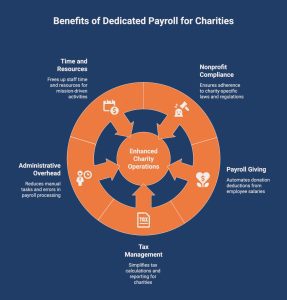
Dedicated payroll systems built for charities simplify nonprofit compliance, payroll giving, and tax handling while reducing administrative effort. By automating complex processes, these solutions help charities operate more efficiently, protect their legal status, and redirect time and resources toward advancing their mission and long-term organisational sustainability.
These benefits become clear across several critical areas:
1. Nonprofit Compliance and Regulatory Support
Charity-focused payroll systems are designed around nonprofit-specific laws and reporting requirements. They help ensure accurate filings, proper documentation, and readiness for audits, reducing the risk of penalties, reputational damage, or compliance gaps that can arise from using generic payroll solutions.
2. Payroll Giving and Donation Management
Dedicated charity payroll software supports payroll giving by automating donation deductions directly from employee salaries. It tracks contributions accurately, supports pre-tax deductions where applicable, and ensures donated funds are distributed and recorded correctly without adding manual administrative workload.
3. Streamlined Payroll Tax Management
Nonprofit payroll systems automate complex tax calculations while accounting for charitable deductions and exemptions. This ensures correct withholding each pay period, improves tax efficiency, and generates reliable tax reports, helping charities maximise available funds for programs and operational priorities.
4. Reduced Administrative Overhead
Automation eliminates repetitive payroll tasks such as manual calculations, data entry, and correction handling. This reduces errors, saves staff time, and allows HR and finance teams to focus on higher-value work rather than ongoing payroll administration and reconciliation activities.
5. Better Use of Time and Resources
By consolidating payroll, compliance, and giving management into one system, charities gain operational clarity and efficiency. Fewer systems and manual processes mean lower costs, improved internal coordination, and more resources directed toward mission-driven growth and impact.
Using dedicated payroll for charities creates a stronger operational foundation while supporting compliance, efficiency, and sustainable nonprofit growth.
What Features Should You Look for in a Charity Payroll Provider?
Choosing the right charity payroll provider means selecting software built for nonprofit needs, not just basic payroll processing. The ideal solution supports compliance, payroll giving, automation, and reporting, helping charities save time, improve efficiency, and strengthen fundraising efforts without increasing administrative workload.
When evaluating providers, prioritise these essential features:
- Automation and Payroll Accuracy
Automates payroll calculations, tax handling, and filings to reduce manual work, minimise errors, and ensure consistent, compliant payroll processing with fewer administrative resources required. - Advanced Reporting and Insights
Provides customizable reports for payroll costs, donations, compliance, and audits, supporting budgeting, grant applications, and leadership decision-making with clear, reliable data. - Payroll Giving Scheme Support
Enables employees to donate directly from paychecks through automated deductions, making payroll giving simple to manage while encouraging recurring, predictable donor contributions. - Donation Tracking and Fund Distribution
Tracks payroll donations accurately, consolidates contributions, and ensures timely transfer of funds to the charity with proper records for transparency and accountability. - Accounting and System Integrations
Integrates seamlessly with accounting and finance software to streamline reconciliation, reduce duplicate data entry, and maintain consistent financial records across systems.
A charity payroll provider with these features supports smoother operations, stronger compliance, and more effective fundraising, allowing nonprofits to focus on their mission with confidence.
How Do You Set Up Payroll Systems for Charities in the UK?
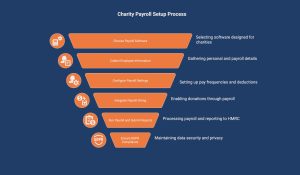
Setting up payroll systems for UK charities is easier when approached step by step. A clear setup process helps charities put the right foundations in place, meet HMRC requirements over time, and run payroll smoothly as operations grow.
Step 1: Register Your Charity as an Employer with HMRC (Before You Pay Anyone)
Before paying any employees for the first time, your charity must register with HMRC as an employer. This registration allows you to submit payroll information, calculate tax and National Insurance, and meet Real Time Information reporting requirements legally.
Step 2: Choose Payroll Software Designed for Charities (During Initial Setup)
Once registered, select payroll software that supports nonprofit compliance, payroll giving, and HMRC submissions. Choosing the right system early helps simplify calculations, automate reporting, and reduce administrative work as payroll operations begin.
Step 3: Collect and Set Up Employee Payroll Information (Before the First Payroll Run)
Before running payroll, gather employee details such as personal information, tax codes, pay rates, and bank details. Entering accurate data at this stage ensures correct pay calculations, deductions, and reporting from day one.
Step 4: Configure Payroll Settings and Pay Schedules (After Employee Data Is Entered)
After adding employee information, configure pay frequencies, deduction rules, and payroll giving options. Completing this setup ensures salaries, taxes, and charitable contributions are processed consistently each pay period.
Step 5: Integrate Payroll Giving Programmes (Before Launching Payroll Giving)
When your payroll system is configured, register your charity with workplace giving platforms and enable payroll giving. This step should be completed before promoting the programme, so donations can be processed automatically through payroll deductions.
Step 6: Run Payroll and Submit Reports to HMRC (Every Pay Cycle)
Each pay period, process payroll, issue payslips, and submit required reports such as Full Payment Submissions to HMRC on or before payday. Completing this step on time helps maintain compliance and avoid penalties.
Step 7: Ensure GDPR Compliance and Data Security (Ongoing)
From setup onward, protect employee data using secure, GDPR-compliant payroll software. Regularly review access controls, data handling policies, and security practices to safeguard sensitive payroll information over time.
Following these steps helps UK charities build a compliant, efficient payroll system that supports both employee payments and mission-driven fundraising efforts.
What Are the Common Challenges in Charity Payroll Management?
Managing payroll in a charity environment presents unique challenges that go beyond standard payroll administration. Limited resources, complex regulations, and competing priorities often place additional pressure on nonprofit teams. Understanding these challenges on their own helps charities recognise where risks commonly arise.
1. Navigating Complex Tax and Pension Requirements
Charities must comply with evolving tax laws, National Insurance rules, and workplace pension obligations, many of which differ from those affecting for-profit organisations. Keeping up with regulatory changes while ensuring accurate calculations can be difficult, especially without specialist payroll expertise.
2. Managing Payroll with Limited Internal Resources
Many charities operate with small administrative teams and no dedicated payroll specialists. Payroll responsibilities are often handled alongside fundraising, service delivery, or operational roles, increasing the likelihood of mistakes due to time constraints or lack of focused attention.
3. Balancing Payroll Accuracy with Mission-Critical Work
Payroll tasks compete with core charitable activities. When teams are stretched thin, payroll accuracy and timeliness can suffer, creating stress for staff and leadership while diverting attention from mission-driven priorities.
4. Handling Employee Benefits and Pension Administration
Administering employee benefits, pension contributions, and statutory deductions adds another layer of complexity. Errors in benefits handling can affect employee trust and lead to compliance issues, particularly when records are incomplete or inconsistently updated.
5. Maintaining Compliance Across Multiple Reporting Requirements
Charities must meet ongoing reporting obligations, including Real Time Information submissions and pension reporting. Managing these deadlines consistently can be challenging, especially when payroll is not processed frequently or is handled manually.
6. Protecting Sensitive Payroll and Employee Data
Payroll involves handling sensitive personal and financial information. Ensuring data accuracy, confidentiality, and secure access is an ongoing challenge, particularly for charities without formal data governance or dedicated IT support.
By identifying these challenges clearly, charities can better assess where payroll risks exist and prepare to address them in a structured, sustainable way later on.
How Can Charities Overcome Common Payroll Management Challenges?
Managing payroll in the charity sector is often complex due to limited resources, strict compliance requirements, and evolving tax and pension rules. When payroll responsibilities compete with mission-critical work, the risk of errors, delays, and non-compliance increases. Identifying these challenges early makes it easier to adopt reliable systems and expert support.
Direct Payroll Services UK helps charities manage complex tax, National Insurance, and pension obligations with confidence through compliant, up-to-date payroll technology and specialist guidance. For organisations facing tight budgets and limited in-house expertise, an automated, cloud-based approach reduces manual effort, controls costs, and improves accuracy.
With the right payroll partner in place, charities can reduce risk, stay compliant, and focus more time and energy on delivering impact. Reach out to us to help you make the best choice for your organisation’s needs.
Conclusion
Selecting the right charity payroll solution can significantly impact your nonprofit’s efficiency and compliance. By understanding the unique needs of your organisation and focusing on key features like automation, tax management, and legal compliance, you can streamline your payroll processes. Remember, choosing a dedicated payroll service not only simplifies operations but also ensures that your charity meets all regulatory requirements while protecting employee data.
Frequently Asked Questions
Are there payroll services designed specifically for nonprofits and charities?
Yes, several payroll providers offer systems built specifically for charities and nonprofits. These platforms support payroll giving, fund tracking, and nonprofit reporting requirements, helping organisations manage employee pay while meeting regulatory obligations and donation handling needs efficiently overall.
Can payroll systems help charities stay compliant with UK regulations?
Modern payroll systems help charities stay compliant by automating HMRC submissions, tax calculations, and pension reporting. They also support GDPR requirements by protecting sensitive employee data, reducing manual errors, and lowering the risk of penalties or regulatory breaches.
What should a charity consider when choosing payroll software?
When choosing payroll software, charities should assess automation features, HMRC compliance tools, payroll giving support, and reporting quality. Ease of use, data security, scalability, and responsive customer support are also important when managing payroll efficiently and responsibly ongoing.
How do charities set up payroll systems in the UK?
Charities set up payroll by registering with HMRC as an employer, selecting compliant payroll software, collecting employee details, configuring pay schedules, and submitting Real Time Information. Following a step-by-step setup helps ensure accurate payments and ongoing regulatory compliance.
Are there payroll services designed specifically for nonprofits and charities?
Yes, there are payroll services created specifically for nonprofits and charities. These services account for donation deductions, nonprofit reporting, and regulatory requirements, making payroll simpler for organisations that balance employee pay with charitable funding responsibilities and operational oversight.
Can a charity pay a salary?
Yes, charities can pay salaries to employees, provided payments are reasonable and aligned with the organisation’s charitable purpose. Salaries must follow employment law, be properly documented, and comply with HMRC, tax, and pension requirements fully and transparently recorded.
What is the entry for charity in accounting?
In accounting, charity income is recorded as restricted or unrestricted funds depending on donor conditions. Donations are recognised as income, while grants and funds are tracked separately to ensure transparency, compliance, and accurate financial reporting for charities specifically.