
Key Highlights
- Temporary worker payroll still falls under full PAYE and HMRC reporting rules
- Paying temporary employees correctly requires accurate data, tax codes, and hour tracking
- Holiday pay, variable hours, and frequent starters create complexity
- Temporary staffing payroll services reduce admin pressure and compliance risk
- Outsourcing helps ensure correct calculations and on-time payments
- Direct Payroll supports UK employers with end-to-end temporary staff pay administration
Temporary staff bring flexibility when you need it most. They help cover seasonal peaks, urgent projects, sickness, and sudden workforce gaps. On paper, it feels straightforward. A short-term hire joins, works agreed hours, and gets paid accordingly. The arrangement appears simple and efficient.
But if your payroll team is still rechecking tax codes at 5:30 pm because a temp started yesterday without a P45, you know how quickly that simplicity disappears. Different start dates, fluctuating hours, holiday accrual, and Real Time Information submissions can create unexpected pressure. One small oversight can delay processing or trigger compliance concerns.
Temporary worker payroll often becomes messy, not because it is complex in theory, but because it moves quickly in practice. When processes are not structured, short-term hires can lead to long administrative evenings, repeated checks, and unnecessary stress for already stretched payroll teams.
What Is Temporary Worker Payroll?
Temporary worker payroll is the process of calculating, managing, and issuing pay to employees hired for short-term, seasonal, or project-based roles, while remaining compliant with UK PAYE, tax, and employment regulations to avoid reputational damage. It includes tracking hours worked, applying correct pay rates, deducting Income Tax and National Insurance, issuing payslips, and submitting required payroll information to HMRC.
It becomes complex because temporary staff often have varying start and end dates, fluctuating hours, holiday pay accrual, and inconsistent documentation, such as missing P45 forms and tax forms. Frequent onboarding and offboarding increases the risk of incorrect tax codes, late RTI submissions, and payroll adjustments, making accuracy and compliance harder to maintain without structured processes.
Do Employers Need To Run Payroll For Temporary Employees?
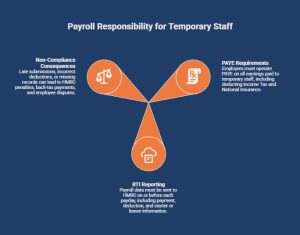
Temporary contracts may be short, but payroll risk is not. Each new starter creates a fresh compliance event, with immediate reporting and deduction obligations. The administrative cycle applies in full, regardless of contract length.
Before looking at the specific requirements, it is important to understand that temporary hires increase payroll frequency and complexity. Each starter triggers setup, verification, calculation, and reporting duties, which must be handled accurately from the very first payment.
1. HMRC PAYE Requirements For Short-Term Staff
Employers must operate Pay As You Earn (PAYE) on all earnings paid to temporary staff. This includes deducting Income Tax and National Insurance and setting workers up using a P45 or Starter Checklist. Proper setup ensures the correct tax code is used from the beginning.
2. RTI Reporting Obligations
Under Real Time Information, payroll data from a hiring company must be sent to HMRC on or before each payday. Temporary workers trigger the same reporting events as permanent staff, including payment, deduction, and starter or leaver information.
3. Consequences Of Non-Compliance
Missing a Real Time Information submission for a two week temporary contract can still trigger penalties from His Majesty’s Revenue and Customs (HMRC), even if the worker has already left. Incorrect tax deductions or incomplete records can result in back tax demands and employee disputes. Repeated payroll errors do not just create fines. They weaken internal trust and increase compliance risk.
In short, a temporary status does not simplify payroll. It increases the need for accuracy and timely reporting.
How To Pay Temporary Employees Correctly?
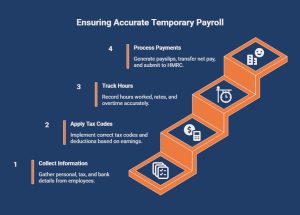
Once responsibilities are clear, the focus shifts to execution. Paying temporary employees correctly depends on a strong setup, accurate calculations, reliable time tracking, and on-time reporting. To ensure payroll accuracy, it is essential to follow best practices in payroll management. Because work patterns often change, consistency in process is what protects both compliance and payroll accuracy.
1. Collecting Employment And Tax Information
Payroll should begin with complete starter information, including personal details, National Insurance number, social security number, bank information, and tax documentation. A P45 should be requested where available, or a Starter Checklist used instead, to ensure correct tax treatment.
2. Applying Correct Tax Codes And Deductions
Temporary workers remain subject to standard PAYE rules. Payroll must apply the correct tax code and calculate Income Tax, National Insurance, and other statutory deductions based on actual earnings for each pay period.
3. Tracking Hours, Rates, And Overtime
Irregular shifts and multiple roles require dependable time recording. Payroll must link hours worked to the correct rates and overtime rules. System-based tracking helps reduce manual errors and ensures fair, accurate pay.
4. Processing Payments And HMRC Submissions
Each payroll run must generate payslips, transfer net pay, and submit a Full Payment Submission to HMRC on or before payday. Timely processing of employee payroll keeps reporting compliant and builds trust with temporary staff.
When these steps are controlled, temporary payroll becomes predictable rather than reactive.
What Challenges Arise When Paying Temporary Employees?
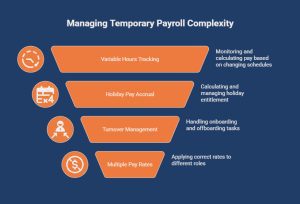
Even with the right process, temporary payroll brings operational pressure. It is not unusual for payroll teams to process five new starters on Monday, adjust three sets of hours by Wednesday, and finalise two leavers before Friday’s deadline. The complexity comes from constant movement. Without structured systems, small changes quickly multiply into reporting risks and manual corrections.
1. Variable Working Hours And Pay Cycles
When shifts change weekly, payroll cannot rely on standard figures. One week a worker logs 40 hours, the next 18. If timesheets arrive late or incomplete, payroll teams must chase data while still meeting submission deadlines. This is where discrepancies and employee queries begin.
2. Holiday Pay Accrual Rules
Temporary workers accrue paid holiday based on hours worked, but irregular schedules make entitlement harder to track. For example, if a worker leaves mid assignment, payroll must calculate the unused accrual accurately. Errors often surface only after final pay has been processed.
3. Frequent Starters And Leavers
High turnover means constant onboarding and offboarding. A missing P45, an incorrect starter checklist, or a leaver processed one day late can affect tax codes and reporting, including the need for issuing the correct form. When this happens repeatedly within a single pay cycle, the workload compounds quickly.
4. Multiple Pay Rates And Assignments
Temporary staff may work different roles within the same week, each with separate pay rates. If hours are not allocated correctly, underpayments or overpayments occur. Corrections then require adjustments in the following period, increasing administrative effort and reducing confidence.
The real challenge with temporary payroll is not understanding the rules. It is managing continuous change without losing accuracy, control, or compliance.
Curious how outsourced payroll actually works in practice? Explore how payroll companies manage compliance, calculations, and HMRC reporting behind the scenes.
What Are Temporary Staffing Payroll Services?
Temporary staffing payroll services are specialist providers that take full responsibility for paying your temporary and short-term workforce. Instead of your internal team juggling variable hours, deductions, and HMRC submissions, these services operate as an external payroll function built specifically for flexible staffing models.
At a practical level, they handle:
- Gross to net pay calculations for irregular hours and rates
- Tax, National Insurance, pension, and statutory deductions
- Payslip production and payment processing
- RTI submissions and ongoing HMRC reporting
- Record keeping and payroll documentation
Because temporary workforces move fast, these providers rely on structured processes and dedicated payroll systems designed to cope with frequent starters, leavers, and changing assignments. For employers, the result is less admin pressure, fewer errors, and greater confidence that payroll is being run correctly, even when workforce patterns are unpredictable.
How Does Payroll For Temporary Employees Affect Compliance?
Temporary payroll is not just an admin task. It sits directly at the centre of your compliance responsibilities. In the UK, most temporary workers are treated as employees for tax purposes, which means PAYE, National Insurance, and reporting obligations still apply in full.
Where risk tends to build is in the detail. Compliance depends on consistently getting the following right:
- Correct worker classification
- Accurate tax codes and deductions
- Timely RTI submissions for each pay run
- Proper handling of statutory pay and holiday entitlement
- Complete and accurate payroll records
When payroll processes are rushed or inconsistent, small mistakes can turn into HMRC penalties, backdated corrections, and employee disputes. A well-managed temporary payroll setup acts as a control mechanism. It ensures rules are followed as standard practice, not as last-minute fixes, helping protect the business legally and financially.
How Can Employers Simplify Temporary Worker Payroll?
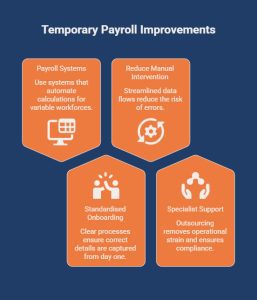
Simplifying temporary payroll is about reducing variation where you can and controlling it where you cannot. The more movement in your workforce, the more important structure becomes.
Employers typically see the biggest improvements by:
1. Using payroll systems built for variable workforces
Modern systems automate calculations for fluctuating hours, multiple rates, and statutory accruals. This reduces reliance on spreadsheets and manual adjustments, which are common sources of error.
2. Standardising how temporary workers are onboarded
Clear starter processes ensure tax details, pay rates, and working patterns are captured correctly from day one. This prevents emergency tax issues and rework later.
3. Reducing manual intervention in pay runs
The more payroll relies on rekeying data or last-minute changes, the higher the risk. Streamlined data flows from time tracking to payroll make the process more stable.
4. Bringing in specialist payroll support where needed
For many businesses, outsourcing part or all of temporary payroll removes the operational strain entirely. Specialists already have the systems, controls, and compliance knowledge in place, allowing internal teams to step back from day-to-day firefighting.
When structure, systems, and specialist support work together, temporary payroll stops feeling chaotic and starts operating as a predictable business function.
If you are considering additional support, it also helps to understand the financial side. Explore the average cost of payroll services for small businesses and the key factors that influence pricing.
What Risks Come With Managing Temporary Payroll Internally?
Managing temporary payroll internally may seem cost-effective at first. However, the real risk emerges as headcount fluctuates, reporting deadlines tighten, and payroll teams absorb additional administrative pressure. Unlike general operational challenges, these risks directly affect compliance exposure, financial stability, and organisational reputation.
Key exposure areas include:
1. Payroll Errors That Escalate Quickly
A small miscalculation can multiply across multiple temporary workers. For example, applying the wrong tax code to ten short-term hires in one pay cycle may require retrospective corrections, amended submissions, and repayment adjustments. What starts as a minor setup oversight can quickly become a time-consuming reconciliation exercise.
2. Compliance Breaches And Regulatory Penalties
Temporary payroll increases the volume of starter and leaver submissions. Missing a Real Time Information filing for a short contract, even by one day, can trigger automatic penalties from His Majesty’s Revenue and Customs. Repeated inaccuracies may also increase scrutiny during audits.
3. Cash Flow Disruption And Workforce Trust Issues
If holiday pay is calculated incorrectly or final pay is delayed for a leaver, temporary workers often notice immediately. For staff relying on weekly income, even a short delay can damage trust and affect your reputation as an employer of choice.
4. Hidden Administrative And Opportunity Costs
Internal teams may spend hours correcting errors, responding to queries, or reconciling payroll adjustments instead of focusing on workforce planning or strategic projects. For instance, a payroll manager chasing missing timesheets the day before submission diverts time from compliance review and reporting accuracy.
Over time, these pressures do not just affect payroll accuracy. They impact team capacity, compliance confidence, and overall operational stability.
When Should Businesses Outsource Temporary Staffing Payroll Services?
Outsourcing usually becomes relevant when payroll stops feeling routine and starts feeling reactive, especially when onboarding new clients. There are clear signals that the internal model is under strain.
It is often the right move when:
- Temporary staff numbers rise quickly due to seasonal or project demand
- Frequent starters and leavers dominate payroll activity
- Payroll queries and corrections are increasing
- Internal teams lack specialist payroll expertise for complex cases
- Compliance concerns are becoming a regular worry
At this point, outsourcing is less about convenience and more about control. Specialist temporary staffing payroll services bring dedicated systems, defined processes, and focused expertise. This stabilises payroll operations, reduces risk, and allows your business to scale its workforce without payroll becoming a bottleneck.
How Does Direct Payroll Support Temporary Worker Payroll?
When temporary payroll starts to feel unpredictable, the problem is usually complexity, not effort. Direct Payroll Services supports UK employers by taking on the day-to-day management of temporary staff pay, turning a high-pressure admin task into a controlled, compliant process.
Direct Payroll helps with:
- Accurate pay calculations for variable hours, rates, and overtime
- PAYE deductions including tax, National Insurance, and pensions
- RTI submissions and HMRC reporting for each pay period
- Holiday pay and statutory entitlement tracking
- Payslip production and timely payment processing
- Payroll records that support ongoing compliance
With specialist systems and payroll expertise, Direct Payroll reduces admin strain on HR and finance teams while helping ensure temporary workers are paid correctly and on time.
If temporary worker payroll is stretching your internal capacity, Direct Payroll Services can help you regain control while staying fully compliant.
Struggling with temporary payroll? Contact us now and take the pressure off your team.
Final Thoughts
Temporary worker payroll and payroll costs require the same PAYE accuracy and HMRC reporting as permanent payroll, but with greater variation in hours, rates, and workforce movement. Without structured processes, errors and compliance risks rise quickly. Clear onboarding, reliable time tracking, and consistent reporting are essential to stay in control.
As temporary staffing grows, payroll complexity can outpace internal capacity. Using strong systems and specialist support where needed helps ensure accurate pay, on-time submissions, and enhances operational efficiency in a more stable, compliant payroll operation overall.
Frequently Asked Questions
What are the HMRC requirements for hiring temporary staff?
When hiring temporary staff, employers must operate PAYE, deduct Income Tax and National Insurance, collect starter information using a P45 or Starter Checklist, issue payslips, and submit payroll data through Real Time Information on or before payday.
How do recruitment agencies handle payroll for temporary workers?
Many recruitment agencies act as the employer for tax purposes and manage payroll directly. They calculate pay, apply deductions, issue payslips, and report to HMRC. This reduces administrative responsibility for the hiring organisation, depending on the contractual arrangement.
Are temporary workers entitled to the same benefits as permanent staff?
Temporary workers are entitled to statutory rights such as National Minimum Wage, paid holiday, and Statutory Sick Pay where eligible. Enhanced contractual benefits offered to permanent staff depend on employer policy and specific contract terms.
Are there special rules for payroll processing with temporary staff?
Core PAYE rules remain the same, but temporary payroll requires close monitoring of variable hours, different pay rates, and holiday accrual. Frequent starters and leavers increase reporting activity, making accurate data handling and timely submissions essential.
Are temporary workers entitled to minimum wage?
Yes, temporary workers must receive at least the National Minimum Wage or National Living Wage based on their age. Employers must ensure payroll reflects current legal rates for every hour worked, regardless of contract duration.
How can temporary payroll services help me?
Temporary payroll services manage calculations, deductions, payslips, payments, and HMRC reporting for short-term staff. They reduce manual administration, improve accuracy, and help businesses stay compliant while handling changing workforce numbers and fluctuating pay patterns.