TL;DR
|
|---|
When a job ends, it’s important to understand your rights around contractual notice pay. This is the pay you’re entitled to during your notice period, as stated in your contract. In some cases, an employer may choose to offer pay in lieu of contractual notice – meaning you’re paid instead of working your notice period. This can help both parties move on more quickly.
If you’re being made redundant, you might wonder, Is contractual notice pay given as well as redundancy pay? The answer is yes – these are separate entitlements. In this blog, we discuss how notice pay works, when pay in lieu applies, and how it relates to redundancy pay.
What Does ‘Contractual Notice Pay’ Really Mean?
When your job ends – whether you resign or are let go – contractual notice pay is what you’re owed for your notice period. This period is usually set out in your contract. If it isn’t, you’re covered by statutory notice rules, just like with other entitlements such as Statutory Adoption Pay. The notice period starts from the day notice is given and continues until your final working day.
You might either work your notice and get paid as usual, or your employer may offer pay in lieu of notice (PILON), where your job ends immediately and you receive a lump sum instead.
So, does an employer have to pay the contractual notice? Yes – in most cases, employers must pay it. The only exception is if the employee has committed gross misconduct, which can justify immediate dismissal without notice or pay.
When you serve your notice period, you keep your regular contractual benefits and continue to earn holiday pay. But if you’re given pay in lieu of notice (PILON), your employment ends immediately, and holiday usually stops accruing unless your contract says otherwise.
Here’s a simple table to show the key differences between contractual notice pay and pay in lieu of notice (PILON):
|
Feature |
Contractual Notice Pay |
PILON (Pay in Lieu of Notice) |
|---|---|---|
|
Do you work the notice period? |
Yes | No |
|
How is it paid? |
Normal wages over time |
One-off lump sum |
|
Are contractual benefits included? |
Usually yes |
Not always (depends on the contract) |
|
When does the job end? |
At the end of the notice period |
Immediately |
| Does the holiday continue to accrue? |
Yes |
No (unless contract says otherwise) |
| Commonly used when… | Employee continues working | Employer prefers immediate departure |
What Is the Legal Framework for Contractual Notice Pay in the UK?
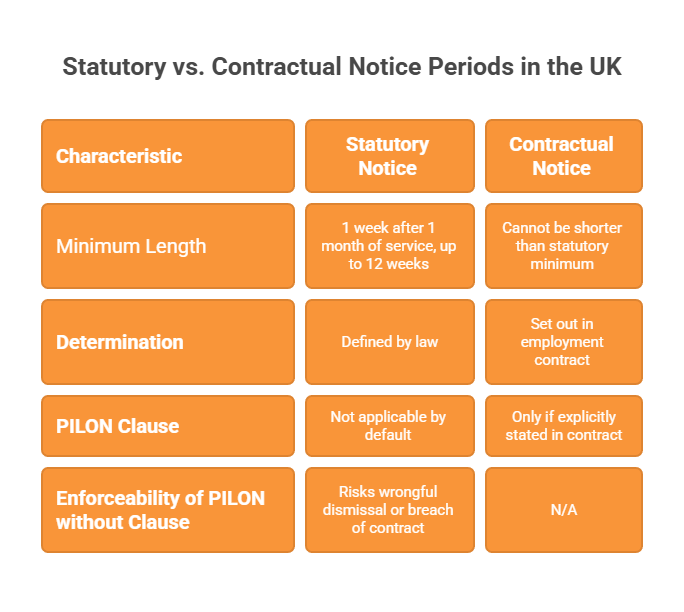
In the UK, employment law requires that employers provide at least the statutory notice period, or a longer period if stated in the contract of employment. The notice period in a contract of employment cannot be shorter than the statutory minimum, but can be extended to offer better terms.
Statutory notice periods provide a legal minimum:
- 1 week’s notice after 1 month of continuous service
- 1 week for each year worked, up to a maximum of 12 weeks
Contractual notice periods are set out in the employment contract:
- They can be longer than the statutory notice, but never shorter
- Employees are entitled to whichever is longer – statutory or contractual
Employment contracts often contain specific clauses that define rights and responsibilities when employment ends. These may include:
- The length of the contractual notice period
- A clause allowing pay in lieu of notice (PILON) if the employer wants to end employment immediately
- Whether bonuses, benefits, or allowances are included during the notice period
- Special terms for redundancy, misconduct, or early termination
Is there a contractual right to pay in lieu of notice? Only if it’s clearly written in the contract. Without this clause, enforcing PILON can risk wrongful dismissal or breach of contract.
Employers must make sure notice pay is calculated accurately and paid on time. Legal advice is often helpful when dealing with complex notice pay situations, such as disputes involving benefits or unclear contract terms.
Who Is Eligible for Contractual Notice Pay?
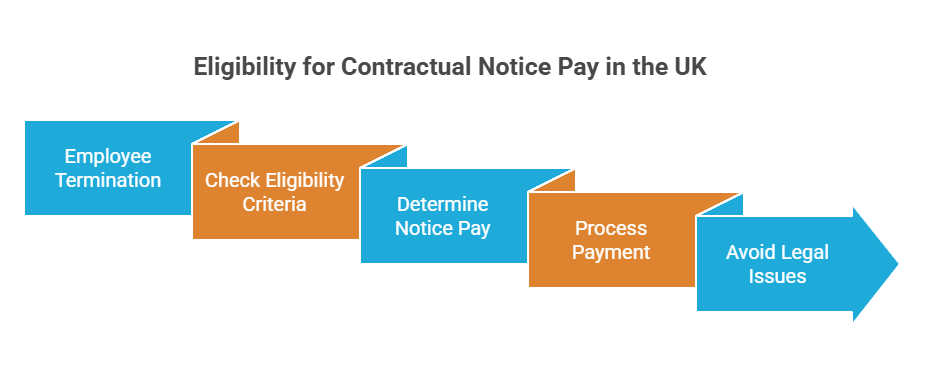
Contractual notice pay applies to employees whose employment is ending, either through dismissal, redundancy, or mutual agreement. To be eligible, the employee must be entitled to a notice period in their contract of employment, or at least the statutory minimum. The specific terms of the contract and the reason for termination both play a role in determining whether notice pay is owed.
Employees usually qualify for contractual notice pay if:
- They have worked for the employer for at least one month
- The termination is not due to gross misconduct
- They are being made redundant (often in addition to redundancy pay)
- There’s a mutual agreement to end the employment early, without working the full notice period.
- They are on protected leave (like maternity or sick leave) but still within their notice entitlement.
In these cases, employers are typically required to pay either the full notice or pay in lieu of notice, depending on the contract terms.
However, there are situations where notice pay may not be owed. These include:
- Dismissal for gross misconduct, where the employer can terminate employment immediately without notice
- If the employee breaches the contract, they may lose the right to notice pay
- In wrongful dismissal cases, where the employer fails to follow proper notice procedures
- If the employee resigns without giving the required notice
- Termination during a probation period, if the contract limits notice during this time
Employers usually must provide notice, as long as the termination follows legal and contractual terms. Refusing to do so without a valid reason and proper process can lead to breach of contract or unfair dismissal claims.
To avoid delays or errors, employers should ensure notice pay is included in the correct payroll cycle. Understanding payroll cut-off dates is essential to processing these payments on time and avoiding compliance issues.
Does Contractual Notice Affect Eligibility For Severance Pay Or Other Termination Benefits?
Getting contractual notice pay doesn’t automatically affect your right to severance pay, redundancy pay, or other termination-related payments. These are usually treated as separate entitlements, especially in redundancy situations where you often receive both notice pay and statutory redundancy pay.
It’s important to remember:
- Severance pay and redundancy compensation are different from notice pay and have their own rules for eligibility. Eligibility can vary depending on the type of employment contract. For instance, workers on zero-hours contracts may have different redundancy pay rights compared to those on fixed-hours contracts.
- You can read more about how redundancy pay works for zero-hours contracts to see how these entitlements differ.
- Notice pay can sometimes affect how certain benefits – like pension contributions – are calculated.
- All payments made on termination should follow both employment law and any contractual terms.
To keep things clear and avoid disputes, employers should always separate notice pay from other termination payments in any settlement or redundancy agreement, making sure everything is clearly explained and legally compliant.
How Contractual Notice Pay Is Calculated?
| Notice Pay = (Weekly Pay x Length of Notice Pay) + Additional Entitlements |
|---|
It mainly depends on the length of the notice period (as set out in the contract or by law) and the employee’s normal earnings. Employers must look at the full employment contract to make sure they’re including everything the employee is entitled to during the notice period – not just basic pay.
What’s usually included:
- Basic salary or regular wages for the full notice period
- Bonuses or commissions are regularly paid and specified in the contract
- Pension contributions, unless the contract says otherwise
- Payment for the unused holiday accrued but not taken before the termination date
Some contracts may also include things like car allowances, health insurance, or other benefits. If those are part of your regular package, they should continue or be compensated for during notice.
These payments are treated like normal income, so:
- Tax and National Insurance are deducted
- Payments must go through payroll
- HMRC requires correct reporting and calculations
To understand what can be taken out before tax, including pension contributions or salary sacrifice schemes, read our guide on pre-tax deductions in the UK.
Being clear and accurate about what’s owed helps avoid disputes and ensures both sides stay legally compliant when employment ends. Every contract is different, so careful review is key.
How Does Contractual Notice Pay Apply to Fixed-Term and Temporary Contracts?
Fixed-term and temporary workers also have rights when it comes to contractual notice pay, but how those rights apply depends on the type of contract, how long it’s been in place, and whether statutory or contractual notice periods apply.
For fixed-term employees, the rules vary:
- If the contract ends on a set date or after a task is completed, no notice may be needed—unless the contract says otherwise
- If the contract is ended early, the employee is usually entitled to either the contractual or statutory notice period, whichever is longer.
- If the fixed-term contract lasts a year or more, the employee often has the same notice rights as permanent staff.
- Some contracts may fall under collective agreements or industry-specific terms, which can affect notice requirements.
Always check the notice period in the contract of employment to ensure the correct process is followed.
For agency and temporary workers, things can be more complex:
- If the contract ends because a project or task finishes, notice pay may not apply
- Temporary workers who have worked continuously may qualify for statutory notice pay after a certain period
- Some agency workers are classed as employees under UK law, which means they’re entitled to minimum notice periods and pay like other staff.
Employers must review both the contract wording and the worker’s legal status to decide if notice pay is owed. Misunderstanding these rules can lead to disputes or legal risks—so clear contracts and fair treatment are key.
How Are Notice Pay Disputes Resolved?
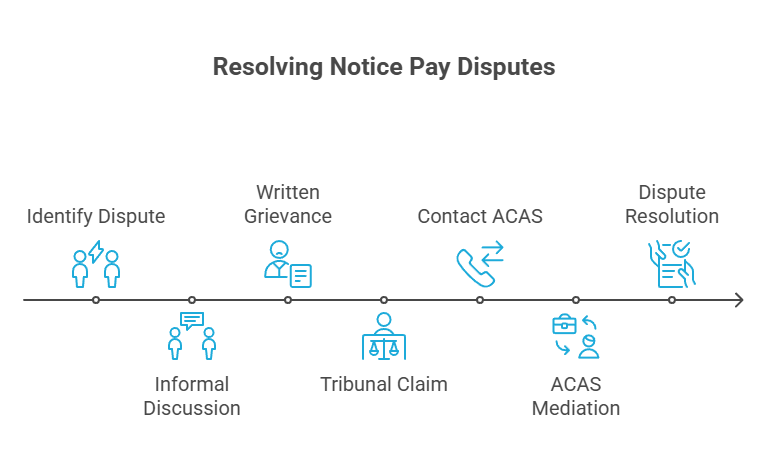
Disagreements over contractual notice pay can happen when there’s confusion about pay entitlements, contract terms, or how payments are calculated. Here’s how the legal obligations work and what steps employees and employers can take to resolve disputes:
- Employers must meet legal obligations by paying notice in line with the contract or, at a minimum, the statutory notice period.
- If the contract includes additional entitlements (e.g., bonuses or benefits), these must also be honoured during the notice period.
- Failure to pay notice properly may lead to claims of wrongful dismissal or breach of contract.
- Employees should first raise the issue informally with their employer or HR to seek a quick resolution.
- If the issue remains unresolved, employees can submit a written grievance or move to a formal claim process.
- Tribunal claims must usually be made within three months of the employment ending.
- Before filing a tribunal claim, employees must contact ACAS (Advisory, Conciliation and Arbitration Service) for early conciliation.
- ACAS provides free support and aims to help both parties reach a settlement without legal proceedings.
- Most disputes are resolved through ACAS mediation, avoiding the cost and time of a full tribunal hearing.
Employers and employees should keep clear records and communicate openly. Understanding the legal obligations regarding contractual notice pay helps reduce misunderstandings and ensures a fair and compliant end to the employment relationship.
How Contractual Notice Pay Interacts with Other Termination Payments?
Contractual notice pay often works alongside other termination payments like redundancy pay, severance pay, and holiday pay. Both employers and employees need to understand how these payments interact so that nothing is missed or double-counted.
When an employee is made redundant or their employment ends by agreement, they may receive a mix of:
- Notice pay (based on the notice period in the contract or law)
- Statutory redundancy pay (based on service, age, and weekly pay)
- Accrued holiday pay (for unused annual leave)
These are separate entitlements, and receiving one does not cancel out the others.
To avoid confusion, employers should always provide a clear written breakdown of:
- What each payment is for
- How it’s calculated
- Whether it includes basic pay, benefits, or other entitlements
Also, while receiving notice pay doesn’t affect your right to other payments, the total amount received could affect eligibility for some means-tested benefits.
Holiday pay works a little differently depending on how the notice period is handled:
- If the employee works their notice or is placed on garden leave, they keep accruing holiday as usual
- If PILON (pay in lieu of notice) is given, holiday stops accruing from the termination date
- Any unused holiday must be paid out
- Employers can ask employees to use a holiday during the notice period—but only with proper notice.
The notice of termination of employment should clearly explain the final holiday position, including the accrued balance, the amount used, and what will be paid. Clear communication helps avoid disputes and ensures legal compliance.
Clear, Compliant, and Hassle-Free – Let Us Manage Your Contractual Notice Pay with Confidence
At Direct Payroll Services, we take the stress out of managing contractual notice pay—whether your staff are on PAYE, umbrella, CIS, or zero-hours contracts. Our expert team ensures notice periods are calculated accurately, in line with employment contracts and UK legal requirements.
Using our secure, cloud-based payroll platform, we track notice pay entitlements, process payments correctly, and itemise them clearly on payslips. This gives your business full visibility and ensures your employees receive exactly what they’re owed—on time and without confusion.
Reduce errors, avoid disputes, and stay compliant with Direct Payroll Services. Get in touch today for a tailored solution that works for your team.
Conclusion
Understanding contractual notice pay is essential for both employees and employers in navigating employment law. It provides a safety net during transitions, ensuring fair compensation while aligning with legal frameworks. By knowing how notice pay is calculated and the influencing factors, you can prepare for potential disputes and ensure compliance. Whether facing dismissal or restructuring, being informed empowers sound decision-making. For personalised guidance, reach out for a free consultation to discuss your situation.
Frequently Asked Questions (FAQ)
What happens if an employee receives a termination notice while being made redundant?
If an employee receives a termination notice during redundancy, the outcome depends on the specific contract terms. These terms determine entitlement to severance pay, notice pay, and any potential damages. Complex cases, like constructive dismissal or gross misconduct, require careful legal review.
Can an employer enforce payment in lieu of notice without a written contract clause?
No, an employer generally cannot enforce payment in lieu of notice (PILON) unless specified in the employment contract. Enforcing PILON without a contractual right may be a breach of contract and could result in legal claims for wrongful dismissal or minimum notice violations.
What if an employee refuses to work their notice period?
If an employee refuses to work their notice period, it could be treated as a resignation or constructive dismissal, affecting their termination date and employment relationship. The employer may not have to pay notice pay if the employee leaves without proper notice, unless a mutual agreement is reached.
Are all employees entitled to contractual notice pay on dismissal?
Not all employees are entitled to contractual notice pay on dismissal. Eligibility depends on the terms of the employee’s contract, statutory minimum requirements, and the reason for dismissal (e.g., gross misconduct). Redundancy situation and much notice given can also impact entitlement.