
Key Highlights
- Umbrella payroll pays contractors through PAYE without requiring a limited company.
- Umbrella companies handle payroll, tax deductions, payslips, and HMRC reporting.
- Agencies use umbrella payroll to simplify contractor payment administration.
- Contractor payslips include PAYE tax, National Insurance, pension deductions, and payroll costs.
- Compliant umbrella companies follow HMRC PAYE, RTI, and pension regulations.
- Non-compliant umbrella schemes can create tax risks and HMRC investigations.
- Umbrella payroll suits agency workers and short-term contractors needing simpler payroll management.
- Transparent payroll providers help reduce deduction disputes and compliance risks.
Managing contractor payroll becomes more difficult when agencies, PAYE deductions, timesheet approvals, and employment responsibilities all sit across different parties. Payroll errors, unclear deductions, or non-compliant payment structures can quickly create disputes for contractors and compliance risks for businesses.
Many UK recruitment agencies and contractors use umbrella payroll because it allows workers to be paid through PAYE without setting up a limited company or managing payroll administration independently. Umbrella payroll companies handle tax deductions, payslips, pension contributions, and payroll reporting while helping agencies streamline contractor payment management.
This guide explains what umbrella payroll is, how umbrella payroll companies work, how deductions and fees are calculated, and what contractors and businesses should understand about compliance, worker rights, payroll risks, and choosing a reliable umbrella payroll provider in the UK.
What Is Umbrella Payroll?
Umbrella payroll is a PAYE arrangement where an umbrella company employs contractors and handles tax deductions, payslips, pension contributions, and HMRC reporting before paying workers their net salary.
This model is commonly used by contractors working through recruitment agencies or moving between temporary assignments. Instead of operating a limited company, contractors work as employees of the umbrella company while continuing assignments for different clients.
For agencies and businesses, umbrella payroll reduces the administrative burden of managing contractor payments and PAYE compliance internally.
Who Is Involved in an Umbrella Payroll Arrangement?
Umbrella payroll arrangements usually involve four parties working within the same payment structure. Each party has a different role in managing work, payroll, and payment responsibilities.
| Party | Role in the Umbrella Payroll Process |
|---|---|
| Contractor | Completes work assignments and submits timesheets |
| Umbrella company | Employs the contractor and processes PAYE payroll |
| Recruitment agency | Places contractors with clients and approves payments |
| End client | Receives the contractor’s services or project work |
Because responsibilities are split across different organizations, delays in approvals, incorrect payroll information, or unclear payment terms can affect contractor payments and compliance handling.
How Does the Umbrella Payroll Process Work?
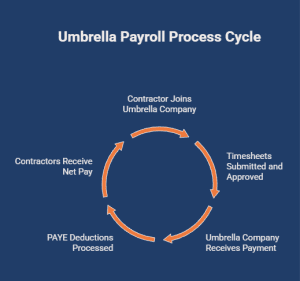
Umbrella payroll follows a structured PAYE process that connects the contractor, recruitment agency, end client, and umbrella company within a single payroll arrangement.
1. Contractor Joins the Umbrella Company
The contractor registers with an umbrella company and signs an employment agreement before starting assignments. The umbrella company collects payroll details, tax information, pension data, and right-to-work documents needed for PAYE processing.
2. How Are Timesheets Submitted and Approved?
After completing work, the contractor submits timesheets to the recruitment agency or end client for approval. Delayed approvals can slow contractor payments because payroll cannot usually be processed until working hours are confirmed.
3. How Does the Umbrella Company Receive Payment?
Once timesheets are approved, the recruitment agency or client sends payment to the umbrella company. This amount normally includes the contractor’s agreed contract rate and employment costs linked to PAYE processing.
4. How are PAYE deductions processed?
The umbrella company processes contractor payments through PAYE, deducting Income Tax, National Insurance contributions, pension payments, and other applicable payroll costs before generating payslips.
5. How Do Contractors Receive Their Net Pay?
After deductions are processed, the contractor receives net pay along with a payslip showing taxable earnings, payroll deductions, pension contributions, and payment calculations. The umbrella company also submits payroll data to HMRC through RTI reporting requirements.
Why Do Businesses and Contractors Use Umbrella Payroll?
Umbrella payroll helps contractors receive PAYE payments without managing a limited company, while allowing agencies and businesses to reduce the administrative burden of handling contractor payroll internally. This structure is widely used across temporary staffing and recruitment because it simplifies contractor payments, supports PAYE compliance, and speeds up workforce onboarding.
1. Why Do Contractors Choose Umbrella Payroll?
Many contractors use umbrella payroll to avoid the accounting, tax filing, and company administration responsibilities that come with operating a limited company.
Instead of managing payroll independently, contractors are paid through PAYE while the umbrella company handles tax deductions, payslips, pension contributions, and HMRC reporting. This is often useful for contractors moving between short-term assignments or working through recruitment agencies regularly.
Umbrella payroll can also help contractors maintain continuous employment records across assignments, which may support mortgage applications, tenant referencing, and employment verification checks.
2. Why Do Agencies and Businesses Use Umbrella Payroll?
Recruitment agencies and businesses often use umbrella payroll to simplify contractor workforce management and reduce payroll administration pressure when handling large volumes of temporary workers.
Rather than processing contractor payments internally, businesses can outsource PAYE administration, payslip generation, pension handling, and payroll reporting through a single umbrella payroll structure. This can reduce onboarding delays and help agencies manage contractors across multiple clients and assignments more efficiently.
For agencies handling fast-changing staffing demands, umbrella payroll also provides greater workforce flexibility without expanding internal payroll administration teams.
| Contractor Benefits | Business and Agency Benefits |
|---|---|
| PAYE payments without running a limited company | Simplified contractor payroll management |
| Reduced accounting and payroll administration | Faster contractor onboarding |
| Continuous employment records across assignments | Workforce flexibility during changing demand |
| Easier movement between temporary contracts | Centralised contractor payment processing |
| Statutory employment rights through PAYE | Reduced payroll administration workload |
| Payslip and pension administration support | PAYE compliance and HMRC reporting support |
How Do Umbrella Payroll Taxes, Deductions, and Fees Work?
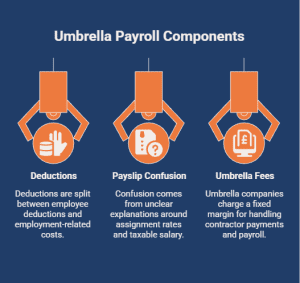
Umbrella companies process contractor payments through PAYE, meaning tax and employment costs are deducted before workers receive their final pay. Confusion usually happens when contractors mistake the advertised assignment rate for taxable salary, without realizing employment costs and umbrella fees are included within the overall payment structure.
Many first-time contractors are surprised by their payslips because umbrella payroll combines worker deductions, employment costs, and service fees within one calculation. Understanding how assignment rates convert into taxable earnings is important for avoiding disputes and unrealistic take-home pay expectations.
1. What Deductions Are Taken Under Umbrella Payroll?
Under umbrella payroll, deductions are split between employee deductions and employment-related costs attached to PAYE contractor payments.
Typical deductions may include:
| Deduction | Why It Applies |
|---|---|
| Income Tax | PAYE tax deduction |
| Employee National Insurance | Employee NI contribution |
| Employer National Insurance | Employment cost linked to PAYE |
| Apprenticeship Levy | Government payroll levy |
| Pension Contributions | Workplace pension deduction |
| Umbrella Margin | Administration and payroll service fee |
For example, a contractor may see a £500 assignment rate but receive a lower taxable salary after employment costs and umbrella fees are accounted for before PAYE calculations begin.
2. Why Can Contractor Payslips Feel Confusing?
Most payslip confusion comes from unclear explanations around assignment rates, taxable salary calculations, and employment costs.
Contractors often misunderstand:
- Why Employer National Insurance appears in calculations
- How umbrella company margins are applied
- Why pension deductions reduce net pay
- How PAYE differs from self-employed income
Some providers also advertise unusually high take-home pay percentages that may not reflect genuine PAYE calculations. If deductions are unclear or payment structures seem unrealistic, contractors should review the arrangement carefully before joining.
3. What Fees Do Umbrella Payroll Companies Charge?
Most umbrella companies charge a fixed weekly or monthly margin for handling contractor payments, payslips, HMRC reporting, and payroll administration.
Transparent providers explain:
- their service margin clearly
- How deductions are calculated
- What employment costs apply
- When contractors are paid
Hidden charges, unclear calculations, or vague payment breakdowns can create disputes later, particularly when contractors compare assignment rates against actual net pay.
Are Umbrella Payroll Companies Legal and HMRC-Compliant?
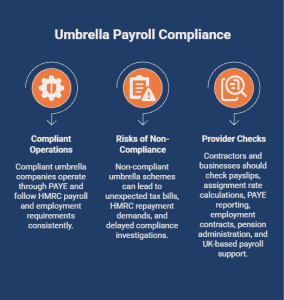
Umbrella payroll companies are legal in the UK when they operate through PAYE, submit payroll information to HMRC correctly, and provide transparent payment calculations and employment documentation. HMRC expects umbrella companies to deduct tax properly, follow RTI reporting rules, manage pension obligations, and issue accurate payslips that clearly explain how contractor pay is calculated.
Because umbrella payroll sits between contractors, agencies, and employment regulations, compliance failures can expose all parties to tax disputes, repayment demands, and HMRC investigations. This has increased scrutiny on umbrella companies using aggressive tax structures or unclear payment models.
1. What Makes an Umbrella Payroll Company Compliant?
A compliant umbrella company operates through PAYE and follows HMRC payroll and employment requirements consistently across contractor payments.
Strong compliance indicators include:
- PAYE payroll processing through HMRC systems
- Real Time Information (RTI) payroll submissions
- Workplace pension auto-enrolment compliance
- Transparent payslips with clear payment calculations
- Employment contracts and payroll documentation
- Accurate tax and National Insurance handling
- UK-based payroll administration and support
Compliant providers should clearly explain:
- How assignment rates are converted into taxable pay
- What deductions apply
- When contractors are paid
- How payroll information is reported to HMRC
2. What Are the Risks of Non-Compliant Umbrella Schemes?
HMRC has increased enforcement activity against umbrella schemes using artificial payment structures designed to reduce PAYE liabilities improperly.
Common warning signs include:
- disguised remuneration schemes
- offshore payroll arrangements
- loan-based payments
- unusually high take-home pay claims
- unclear deduction structures
- missing employment documentation
Contractors linked to non-compliant schemes can face:
- unexpected tax bills
- HMRC repayment demands
- delayed compliance investigations
- disputes over incorrect deductions
Businesses and agencies using non-compliant providers may also face reputational risks and supply chain compliance concerns.
3. What Should Contractors and Businesses Check Before Choosing a Provider?
Low umbrella fees or high take-home pay promises should not be the main factor when choosing a provider. Payroll transparency and HMRC compliance are far more important for avoiding long-term payroll and tax problems.
Before joining an umbrella company, contractors and agencies should check:
- Whether payslips explain deductions clearly
- How assignment rates are calculated
- whether PAYE reporting is handled properly
- If employment contracts are transparent
- How pension administration is managed
- whether UK-based payroll support is available
Providers that avoid explaining payment calculations clearly or promise unrealistic net pay percentages should be reviewed carefully before entering any payroll arrangement.
What Employment Rights Do Umbrella Workers Receive?
Contractors working through umbrella companies are usually employed under PAYE, which means they may qualify for statutory rights such as holiday pay, Statutory Sick Pay (SSP), pension auto-enrolment, and maternity or paternity benefits, depending on eligibility.
PAYE employment can also help contractors maintain continuous income records between assignments, which may support mortgage applications, tenant referencing, and employment verification checks.
Statutory Rights and PAYE Employment
Umbrella workers may receive:
- Holiday pay
- Statutory Sick Pay (SSP)
- Workplace pension enrolment
- Maternity and paternity pay
- National Minimum Wage protections
- Payslips and payroll records
Continuous PAYE employment may also reduce gaps in employment history, which some lenders and referencing providers review during affordability or background checks.
Because payroll policies vary between umbrella companies, contractors should check:
- How holiday pay is handled
- What deductions apply
- Whether employment terms are explained clearly
- How are payslips and payroll records managed
Is Umbrella Payroll Better Than Using a Limited Company?
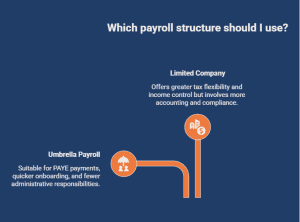
Umbrella payroll usually suits contractors who want PAYE payments, quicker onboarding, and fewer administrative responsibilities. Limited companies can offer greater tax flexibility and income control, but they also involve more accounting, compliance, and director responsibilities.
The right structure often depends on IR35 status, contract length, annual income, and how much financial administration a contractor wants to manage independently.
| Factor | Umbrella Payroll | Limited Company |
|---|---|---|
| Tax Handling | PAYE deductions processed automatically | Contractor manages corporation tax and dividends |
| Payroll Administration | Managed by an umbrella company | Managed by a contractor or an accountant |
| Compliance Responsibility | Mostly handled by the provider | Director responsible for filings and compliance |
| Employment Rights | PAYE employment protections available | No standard employee protections |
| Administrative Workload | Lower | Higher |
| Flexibility Between Assignments | Easier for short-term contracts | Better suited to stable long-term contracts |
| Best Suited For | Agency workers and temporary contractors | Higher-earning long-term contractors |
Many contractors move to umbrella payroll when:
- working inside IR35
- starting agency contracts
- moving between short-term assignments frequently
- wanting faster onboarding without managing company accounts
Limited companies are often more suitable for contractors:
- operating outside IR35
- working on stable long-term contracts
- earning higher contract income
- wanting greater control over tax planning and business finances
The main trade-off is simplicity versus control. Umbrella payroll reduces administration and compliance pressure, while limited companies offer more financial flexibility but require greater responsibility for filings, payroll, and tax management.
What Is the Difference Between an Umbrella Company and an Employer of Record?
An umbrella company mainly supports contractors working through recruitment agencies by handling PAYE payments, payslips, and employment administration. An Employer of Record (EOR) is typically used when businesses hire employees in other countries without opening a local legal entity.
The main difference is the workforce structure. Umbrella payroll is contractor-focused, while EOR services are designed for long-term employee hiring and international workforce expansion.
| Factor | Umbrella Company | Employer of Record (EOR) |
|---|---|---|
| Employment Structure | Employs contractors for PAYE processing | Legally employs workers for another business |
| Workforce Type | Agency workers and temporary contractors | Domestic or international employees |
| Geographic Scope | Mainly UK contractor market | International hiring and expansion |
| Payroll Responsibility | Contractor payments and payslips | Payroll, tax, HR, and employment compliance |
| Compliance Focus | PAYE and contractor payroll compliance | Multi-country labour law compliance |
| Typical Use Cases | Temporary contract assignments | Global hiring without local entities |
For example, a UK recruitment agency supplying temporary IT contractors would usually use an umbrella payroll structure. A business hiring full-time employees in countries where it has no registered office would typically use an Employer of Record service instead.
Umbrella payroll remains more suitable for contractors moving between assignments because it simplifies PAYE payments and onboarding through recruitment agencies without the complexity of international employment structures.
How Can Direct Payroll Services Support Umbrella Payroll Administration?
Direct Payroll Services helps recruitment agencies, contractors, and businesses manage umbrella payroll through structured PAYE processing and HMRC-compliant payroll administration.
Their umbrella payroll support helps reduce:
- contractor payment delays
- payroll administration pressure
- deduction disputes
- payroll processing errors
Payroll Support Services for Contractors and Agencies
Direct Payroll Services provides umbrella payroll administration support designed for recruitment agencies, contractors, and businesses managing temporary workforces across the UK.
Their payroll support services include:
- PAYE payroll processing
- Contractor payroll administration
- HMRC payroll reporting
- Payslip generation and management
- Pension contribution administration
- Payroll compliance support
- Contractor payment processing
- Payroll record management
For agencies handling large contractor workforces, structured payroll support can improve payment consistency, reduce payroll processing delays, and help maintain HMRC compliance across contractor payroll operations.
Businesses looking to improve contractor payroll administration can explore umbrella payroll support through Direct Payroll Services’ umbrella payroll solutions.
Conclusion
Umbrella payroll helps contractors, recruitment agencies, and businesses manage temporary workforce payments through a structured PAYE arrangement. For many contractors, it reduces the administrative burden of running a limited company while providing payroll support, statutory employment rights, and simplified tax handling. Businesses and agencies also benefit from improved contractor payment management and reduced payroll administration pressure.
However, umbrella payroll structures can vary significantly between providers. Understanding how deductions, fees, compliance obligations, and employment rights work is important for avoiding payroll disputes and compliance risks. Businesses and contractors reviewing umbrella payroll arrangements should prioritise transparent payroll processes, clear payslips, and HMRC-compliant payroll administration before choosing a provider.
Frequently Asked Questions
What are the main differences between umbrella payroll and PAYE for contractors?
Umbrella payroll employs contractors through an umbrella company that handles PAYE deductions and payroll administration, while standard PAYE usually involves direct employment by a single employer without intermediary contractor payroll management.
What are the pros and cons of using an umbrella company for payroll?
Using an umbrella company reduces payroll administration, handles PAYE deductions, and provides employment rights. However, contractors may pay umbrella fees, receive lower take-home pay than expected, and have less control compared to operating through a limited company.
What steps are involved in getting started with Umbrella Payroll as a contractor?
Contractors usually register with an umbrella company, provide payroll and right-to-work documents, sign an employment contract, submit approved timesheets, and receive PAYE payments after payroll deductions and HMRC reporting are processed.
Are there any specific tax implications when working under an umbrella payroll system?
Yes. Under umbrella payroll, contractors are paid through PAYE, so Income Tax and National Insurance are deducted automatically. Employer payroll costs and umbrella company fees may also affect take-home pay compared to limited company contracting.
What should I look for when choosing a reputable umbrella payroll company?
Look for PAYE compliance, transparent payslips, clearly explained fees, RTI reporting, pension administration, UK-based support, and proper employment contracts. Avoid providers promising unusually high take-home pay or unclear payroll deduction structures.
How do umbrella companies handle expenses and reimbursements for contractors?
Umbrella companies usually reimburse allowable business expenses through payroll when supported by valid receipts and HMRC rules. However, tax relief on travel and subsistence expenses is now more restricted for many contractors working through umbrella payroll arrangements.
How do umbrella payroll companies work?
Umbrella payroll companies employ contractors through PAYE and process payroll on behalf of recruitment agencies or clients. They collect approved timesheets, deduct tax and payroll costs, issue payslips, submit HMRC reports, and pay contractors their net salary after deductions.