Key Highlights
- Zero-hour status does not automatically remove notice rights
- Employment status determines notice entitlement
- Statutory notice can apply despite irregular hours
- Notice pay must follow the average pay rules
- Contract terms cannot reduce statutory minimums
- Payroll accuracy prevents termination disputes
Managing people is already complex. Ending employment, especially under zero-hour contracts, is where things feel risky. And when zero-hour arrangements are involved, many UK employers pause and ask, are we even required to give a zero-hour contract notice period here?
That uncertainty is common. Zero-hour working patterns feel informal, flexible, and sometimes casual. But when a working relationship ends, payroll rules and employment law do not stay flexible. Notice periods, notice pay, and statutory protections can still apply, even when hours have never been guaranteed. UK employment law guidance from Acas and GOV.UK confirms that notice rights depend on employment status, not hours worked.
This guide clears up the confusion around zero-hour contract notice period rules. You will understand when notice is required, how notice pay works with irregular hours, and how to protect your business from payroll and legal disputes.
What Is a Zero-Hour Contract?
A zero-hour contract is an agreement where an individual works only when required, with no guaranteed minimum hours. The employer offers work as needed, and the individual is paid only for hours actually worked.
Key features of a Zero-Hour Contract
- No guaranteed weekly or monthly hours
- Work offered based on business demand
- Payment only for hours worked
- Individuals can usually accept or decline shifts
- Earnings may vary from week to week
Zero-hour arrangements are common in hospitality, retail, care, and logistics, where staffing needs fluctuate.
How UK Law Defines Zero-Hour Workers vs Employees?
Under UK law, the label “zero-hour” does not determine legal status. What matters is the working relationship.
- Workers typically have fewer rights, such as holiday pay and minimum wage protection, but no statutory notice entitlement.
- Employees have broader rights, including statutory notice, redundancy pay, and unfair dismissal protection after qualifying service.
Status depends on factors such as mutual obligation, control, and integration into the business. The contract structure sets the framework, but legal classification determines notice and pay obligations.
How is Employment Status Decided?
Employment status is determined by the reality of the working relationship, not just the contract label. UK tribunals look at how the arrangement operates in practice.
Key factors include:
- Regular work patterns: Consistent hours over time may indicate employee status rather than casual engagement.
- Obligation to accept shifts: If the individual is expected to accept offered work, this suggests a mutual obligation.
- Employer control: The more control the business has over how, when, and where work is performed, the more likely employee status applies.
- Length of relationship: A long-term, ongoing arrangement strengthens the case for employee classification.
Status affects notice rights, pay obligations, and broader legal protections.
What Are the Notice Period Rules for Zero-Hour Contracts in the UK?
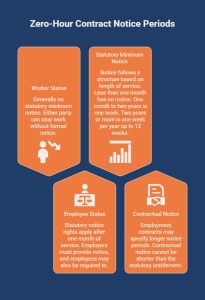
Zero-hour contracts often feel informal, but notice rights are not. The key factor is employment status, not the number of zero hours worked. Whether notice is required, and how much, depends on legal classification and length of service.
1. Worker Status
If the individual qualifies as a worker rather than an employee:
- There is generally no statutory minimum notice requirement
- Either party can stop offering or accepting work without formal notice
- Rights are limited compared to employee status
However, contractual terms may still set expectations.
2. Employee Status
If the individual qualifies as an employee, statutory notice rights apply once they have one month of continuous service.
- Employers must provide statutory or contractual notice
- Employees may also be required to give notice
- Broader employment protections apply
Irregular hours do not remove these rights.
3. Statutory Minimum Notice Framework
Where employee status applies, statutory notice follows this structure:
| Length of Continuous Service | Minimum Statutory Notice |
|---|---|
| Less than one month | No statutory notice |
| One month to two years | One week |
| Two years or more | One week per full year of service (up to 12 weeks) |
These are legal minimum requirements. Contractual notice may be longer but cannot be shorter than the statutory entitlement.
4. Contractual Notice
Employment contracts may specify longer notice periods.
- Contractual notice can exceed statutory minimums
- It cannot be shorter than the statutory entitlement
- Once agreed, it becomes legally binding
Before ending a zero-hour arrangement, employers should confirm status and contract terms to avoid compliance risks.
Payroll myths often lead to costly mistakes and compliance risks. See what UK employers commonly get wrong and what actually applies in practice.
How Is Notice Pay Calculated for Zero-Hours Contracts?
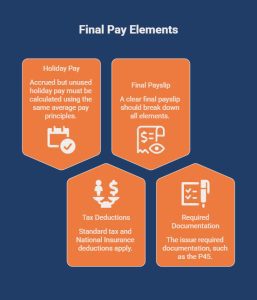
When notice applies, pay cannot be based on the last few shifts or a quiet week. The law aims to reflect what the individual normally earns. Because zero-hour work fluctuates, notice pay relies on an average earnings method, not short-term scheduling patterns.
1. Average Pay Is the Foundation
Notice pay is designed to protect income stability during the notice period. The calculation must represent typical earnings, not recent downturns.
- Pay must reflect average weekly earnings, not the latest rota patterns
- Temporary drops in shifts cannot reduce notice entitlement
- Regular overtime, commission, and consistent allowances may be included
- The calculated pay must still meet national minimum wage rules
The goal is to mirror what the person would reasonably have earned if work had continued.
2. Reference Period Rules
To calculate average earnings for irregular hours, the law looks backwards rather than focusing on recent weeks.
- Use the previous 52 paid weeks before notice begins
- Ignore the unpaid weeks and go further back to find the paid weeks
- The maximum lookback period is 104 weeks
- If the person worked fewer than 52 weeks, use the total weeks worked
| Work Pattern | Reference Period Used |
|---|---|
| Regular hours | Normal pay before notice |
| Irregular hours | Last 52 paid weeks |
This approach smooths out peaks and dips, creating a fair earnings average.
3. Other Final Pay Elements
Notice pay is only one part of the final payroll responsibilities. Employers must also ensure all statutory entitlements are settled correctly.
- Accrued but unused holiday pay must be calculated using the same average pay principles
- Standard tax and National Insurance deductions apply
- A clear final payslip should break down all elements
- The issue required documentation, such as the P45
Using consistent averaging methods across notice and holiday pay reduces disputes.
In practice, notice pay for zero-hour employees is an averaging exercise built around historical earnings. Getting this calculation right protects employers from wage claims, payroll corrections, and post-termination disputes.
What Are the Common Employer Mistakes With Zero-Hour Notice?
Zero-hour contracts often create false confidence. The flexibility of hours leads many employers to assume notice rules are flexible too. They are not. Most disputes arise from misclassification or payroll shortcuts.
Common mistakes include:
- Assuming zero hours means zero notice without checking employment status
- Basing notice pay on the last week worked instead of the 52-week average
- Ignoring contractual notice clauses that exceed statutory minimums
- Failing to confirm continuous service, especially where work has been regular
- Not issuing proper documentation, such as final payslips and P45S
- Treating termination as informal rather than as a formal payroll event
These errors often lead to wrongful dismissal claims, unlawful deduction of wages claims, or costly payroll corrections.
Zero-hour flexibility does not remove legal structure. A status check, a clear notice calculation, and a documented payroll exit process prevent most disputes before they arise.
What Are the Risks of Not Providing Proper Notice or Pay?
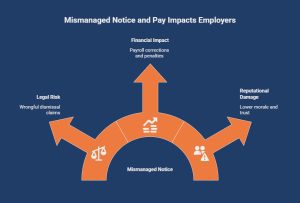
Notice and final pay decisions may seem routine, but they sit at the intersection of employment law and payroll compliance. When notice rights are misunderstood or pay is miscalculated, issues can escalate quickly, exposing employers to legal claims, financial corrections, and wider operational disruption.
1. Legal Risk Exposure
When an eligible employee does not receive the correct notice or pay, formal claims can follow.
Employers may face:
- Wrongful dismissal claims for failing to provide statutory or contractual notice
- Unlawful deduction from wages claims where notice or holiday pay is underpaid
- Unfair dismissal claims for longer-serving employees if the dismissal process or reasoning is challenged
- Employment status disputes that reopen broader entitlement questions
Even relatively small underpayments can trigger time-consuming legal proceedings.
2. Payroll and Financial Consequences
Incorrect notice handling often leads to complex payroll corrections.
Common outcomes include:
- Retrospective recalculation of notice pay and holiday pay
- Tax and National Insurance adjustments on revised payments
- Amended payroll submissions and corrections to HMRC records
- Administrative time spent resolving disputes and reviewing calculations
If escalated to the tribunal level, employers may also face additional financial penalties.
3. Reputational and Operational Impact
Termination disputes rarely remain isolated events within a business.
They can result in:
- Lower staff morale if issues become known internally
- Strained employee relations and reduced trust in management processes
- Management’s attention was diverted away from core operations
- Greater internal scrutiny of payroll and HR systems
Poorly managed exits can highlight broader process weaknesses.
A structured payroll exit process significantly reduces these risks. Treating notice and final pay as formal, carefully calculated payroll events, supported by accurate average pay methods and clear documentation, protects compliance and helps maintain organisational stability.
Can Contract Terms Override Statutory Notice Rules?
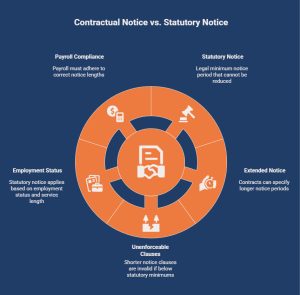
When reviewing zero-hour contract notice period obligations, it is easy to assume the written contract has the final say. In reality, contract terms sit within a legal framework. They can shape notice arrangements, but they cannot remove core statutory protections.
The key rule is simple: this type of contract’s contractual terms cannot reduce statutory notice rights, only extend them. Statutory notice is a protected legal entitlement. Even if a contract states a shorter period, the law takes priority.
What this means in practice:
- Statutory notice acts as a legal minimum floor that every employment contract must respect
- Contracts may specify longer notice periods, which then become binding on both employer and employee
- Shorter contractual notice clauses are not enforceable if they fall below statutory requirements
- Employment status and service length still determine whether statutory notice applies in the first place
- Payroll must follow the correct notice length, not simply what seems convenient or customary
For example, if the legal minimum is one week but the contract states one month, payroll must process pay based on one month’s notice, not one week.
Contract wording matters, but it operates above the legal minimum, never below it.
What Should Employers Include in a Zero-Hour Contract Termination Payroll Process?
Once a zero-hour arrangement ends, flexibility stops and precision begins. Termination is a defined payroll event, and having a guaranteed hours offer means that irregular hours make accuracy even more important. A structured process ensures notice pay, holiday pay, and deductions are handled correctly every time.
Before any figures are processed, employers should confirm the termination framework, including dismissal protections. The leaving date, notice requirements, and employment status must all be clear, as these directly affect final pay calculations and legal compliance.
A reliable termination payroll process should include:
- Confirming the official leaving date so all pay and entitlement calculations are based on the correct endpoint, while maintaining a positive relationship with the employee.
- Checking whether notice applies and for how long, including any contractual notice exceeding statutory minimums
- Calculating notice pay using average earnings is especially important where hours and pay fluctuate
- Reconciling the accrued but unused holiday and ensuring this is paid in the final salary
- Processing final pay through payroll with accurate tax and National Insurance deductions
- Issuing a final payslip and P45 to complete documentation and reduce post-termination queries
When these steps are standard practice, termination payroll becomes controlled, compliant, and defensible rather than a source of avoidable risk.
A consistent payroll checklist turns complex zero-hour terminations into a manageable, compliant process.
Why Choose Direct Payroll Services for Zero-Hour Notice Pay and Termination Compliance?
Handling notice pay for zero-hour contracts demands more than routine payroll processing. It requires accurate average pay calculations, a clear understanding of employment status implications, and payroll systems that reflect statutory and contractual notice rules. Direct Payroll Services supports UK employers in managing these complex scenarios with confidence.
From irregular earnings and fluctuating hours to final pay reconciliation, our payroll specialists ensure notice pay, holiday pay, and deductions are processed correctly and in line with UK employment and payroll requirements. We help configure payroll systems to handle variable pay patterns, maintain clear documentation, and reduce the risk of disputes or retrospective corrections.
With Direct Payroll Services, you lower administrative strain, avoid costly payroll errors, and gain assurance that termination pay is handled accurately, even in complex zero-hour arrangements.
Want compliant, stress-free payroll support? Speak to Direct Payroll Services today and let our experts manage your payroll with clarity and control.
Final Thoughts
Zero-hour contracts may feel flexible, but notice rights and pay rules are not. Employment status, service length, and statutory protections shape what employers must provide, regardless of irregular hours. Accurate average pay calculations, correct notice handling, and structured final payroll processes reduce legal, financial, and reputational risk.
Treating termination as a controlled payroll event, not an informal ending, protects your organisation. With the right processes and payroll support in place, employers can manage exits confidently, compliantly, and with fewer disputes.
Frequently Asked Questions
Can an employer end a zero-hour contract without notice?
Yes, but it depends on status. Genuine workers usually have no statutory right to notice, while employees may request flexible working arrangements. If the individual qualifies as an employee, the employer must provide statutory or contractual notice, unless dismissal involves gross misconduct or another lawful exception.
Do I need to give notice as an employee on a zero-hour contract?
Workers on zero-hour arrangements are generally not legally required to give a notice of termination, though employee contracts may request it. If you have employee status, you may be contractually or statutorily required to give notice, depending on your agreement and length of continuous service.
Where can I find official guidance on zero-hour contract notice?
Official guidance on notice periods and employment rights is available through GOV.UK and Acas. These sources explain statutory notice rules, employment status, and employment law guidance on termination rights, helping employers and individuals understand legal responsibilities and avoid common compliance misunderstandings.
Can the notice period for zero-hour contracts be different from regular contracts?
Yes. Workers often have no statutory notice entitlement, unlike employees. Where employee status applies, statutory minimum notice mirrors other employment types, and contracts can provide reasonable notice of shifts. Contracts can set longer notice periods, but they cannot lawfully provide less than the statutory minimum.
Is there a minimum notice period in the UK?
Yes. Employees are entitled to statutory annual leave and minimum notice after one month of continuous service. This starts at one week and increases by one week for each full year worked, up to 12 weeks, regardless of whether hours were fixed or irregular.
How is notice pay calculated?
Notice pay for employees with irregular hours is based on average weekly earnings, typically using a 52-week paid week reference period. Only paid weeks are counted, including sick pay where applicable. This method reflects normal earnings and must comply with national minimum wage rules.
How should holiday pay be calculated when terminating a zero-hour contract?
On termination, the accrued but untaken holiday must be paid. For irregular hours under a guaranteed hours contract, this is usually calculated using average pay over the previous 52 paid weeks. Holiday pay, which constitutes a statutory holiday entitlement, must be included in the final payroll.
Are there any recent changes to zero-hour contract notice period rules in the UK?
Core statutory notice rules remain stable, but wider employment law reforms and case decisions can affect employment status assessments and pay calculations. Under the new rules, employers should monitor government consultation guidance from Acas and GOV.UK to ensure notice handling and payroll practices remain compliant.